
Dr. Ljiljana Tomović is a full professor at the Faculty of Biology, University of Belgrade. She completed her undergraduate, master’s, and doctoral studies at the Faculty of Biology, University of Belgrade.
She is an expert in reptile biodiversity, population ecology, and nature conservation.
Throughout her nearly thirty-year career, she has published more than 80 scientific papers in internationally indexed journals.
She has participated in or led more than 20 national and international projects.
She is a member of the Fauna Committee of the Serbian Academy of Sciences and Arts.
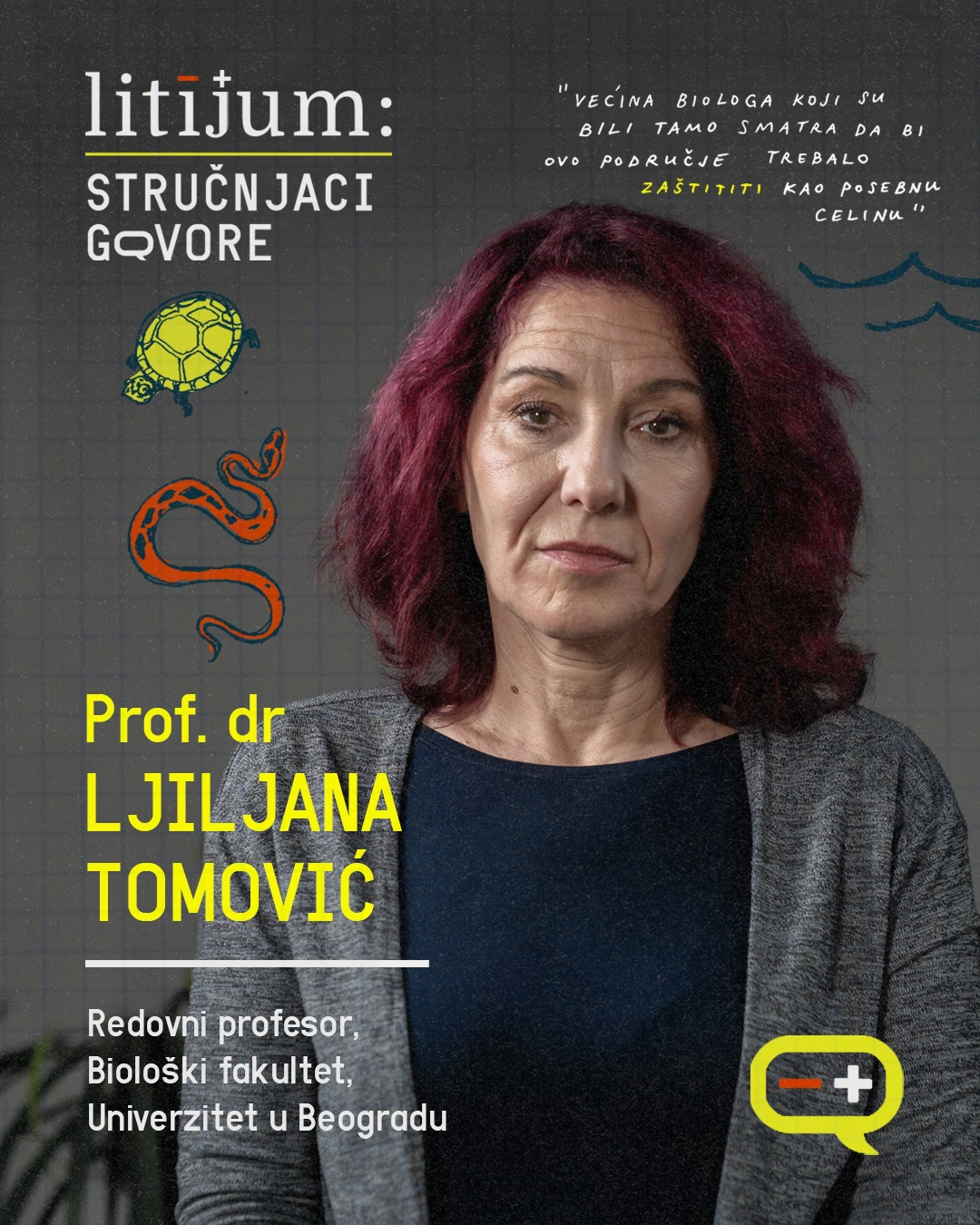
In the program Lithium – Expert Opinion, Prof. Dr. Ljiljana Tomović, a full professor at the Faculty of Biology, University of Belgrade, and a prominent biologist, speaks about the severe consequences that opening a lithium mine in the Jadar Valley would have on Serbia’s natural environment. Based on field research and a comprehensive analysis conducted by the Faculty of Biology and partner institutions, she warns that Rio Tinto’s mining project would lead to the irreversible destruction of natural habitats and protected species.
Good day to you too.
According to information collected by colleagues who specialize in this field, it has not been recorded that lithium mines are located in close proximity to urban settlements, or even rural settlements.
An environmentally friendly approach is logically nonsensical. Of course, everything people do has an ecological impact. Unfortunately, in our country, there are no suitable conditions, to the best of our knowledge, for this to be achieved in an ecologically optimal way.
Can you imagine someone saying no to this question? To me, it is logical that everyone wants to leave the environment in at least the same condition as they found it.
Of course, any person, company, or institution can guarantee anything at any time, but that is not the essential question here. The question is the risk and probability that, sooner or later, such guarantees cannot be met under these conditions.
That question would be the same as asking if you are against the development of human civilization or the survival of human civilization? Human civilization, among other things, has developed on mining and other human activities, so that would mean that I want to prevent the further social evolution of human civilization. Of course not.
Specifically, I was not a participant in the formal project that began in June. The field activities of the researchers started in June and were carried out in June and July 2020. Fifteen researchers participated in this study, almost all of whom were PhD holders from five scientific institutions in Serbia: the Faculty of Biology, University of Belgrade, which was also the project lead, the Institute for Biological Research "Siniša Stanković," University of Belgrade, the Institute for Multidisciplinary Studies, University of Belgrade, the Natural History Museum, Belgrade, and the Faculty of Sciences, University of Niš. These were my colleagues, biologists, botanists, and zoologists who carried out their field research in groups lasting from 3 to 5 days. There was a total of 7 groups, but I will elaborate on that later.
The initiative to start this formal project came from Rio Tinto. As part of their activities, which aimed to gather data on the potential impacts on various areas in Serbia, Rio Tinto essentially offered the Faculty of Biology to be the executor of a study that would focus on the biodiversity aspects of the area. This was in 2020, although negotiations started earlier, in 2019, and the field research was carried out in June and July 2021.
My colleagues conducted a detailed qualitative and partially quantitative analysis of the state of biodiversity. This was not an impact study, which everyone talks about and which is, of course, a legal obligation. This study was only to document which plant and animal species, habitats, and ecosystems exist in the Jadar Valley area, specifically the area designated for the planned activities. The aim was to document all species to some extent and their population status. In some cases, it was also possible to estimate the abundance, population density, and the potential impact on these populations that could occur as a result of the activities proposed by the project. In some ways, this was inadequate. As I mentioned, the researchers worked for only 3-5 days, and this was done in only one season, which is completely insufficient for drawing any comprehensive conclusions. However, based on this, the conclusions were more than unfavorable for the project initiators.
A colleague of mine, a sadly late ecologist from the University of Saint Cyril and Methodius in Skopje, who worked in the region, told me that he had never seen such harmoniously aligned and mosaic-like ecosystems across the entire Balkans, even though he had traveled the entire region. He was fascinated by how the natural ecosystems and human-made ecosystems coexisted in the area of Northwestern Serbia, specifically the Valjevo mountains, Gučevo, Mačva, Cer, Jadar, Rađevina.
Most biologists and ecologists who have worked in this area believe that this region should be protected as a unique natural unit, harmonizing the coexistence of nature, ecosystems, wildlife, and human activity. This is the most significant uniqueness of the area, as many other parts of Serbia either have highly developed regions where the last remnants of nature are so small they are barely noticeable, or, on the other hand, are desolate, like much of Eastern, Southeastern, and parts of Western Serbia, where there are no human settlements. While this is beneficial for nature, it does not allow for the coexistence and harmonious development of human settlements and preserved nature, which is a specific feature of this region.
In the research conducted previously, in a very short period, over 100 plant and animal habitat types were recorded in this relatively small area, designated by the project for Rio Tinto’s activities. Of these habitats, over 30 types were marked as priority or significant for protection under national legislation or international agreements, including the Natura 2000 program.
Additionally, over 470 species of vascular plants, or higher plants, were recorded. Further research raised this number to over 500 species, which is highly significant. Regarding animals, nearly 100 species of aquatic invertebrates, or those in water habitats, were recorded, along with over 190 species of beetles, which is an enormous number, over 50 species of butterflies, though this is a relatively small number compared to the total number of butterfly species in Serbia. However, since the project activities were limited to June and July, which is not the peak season for butterfly activity, this is a lower number than would likely be present. Furthermore, 23 species of fish, 11 species of amphibians, 10 species of reptiles, and nearly 60 potential and real mammal species were recorded, representing an extraordinary diversity for such a small area. The majority of these species, over 70% in certain groups, are strictly protected or protected under national legislation and international agreements such as the Bern Convention, the Bonn Convention, and the Natura 2000 program. These are highly significant species in terms of biodiversity protection.
It is undeniable that the construction of any mine, including a lithium mine, as determined by these studies, would inevitably lead to the destruction of certain populations of these species in the area, the destruction of habitats, because species cannot survive without their habitats. Some other habitats would be so degraded that even if individuals of certain species remained, their populations would soon decline and eventually disappear.
So, it is clear that within the mining zone, both the excavation area and the industrial processing plant, but even more so the waste disposal site, which has been changing in various documents and is still undefined in recent ones, would lead to significant environmental risks. The location of the waste disposal site is crucial given the toxicity of certain elements in the waste. Even today, we do not know exactly where this disposal site will be located, near which watercourses, and so on.
So, on one hand, you have terrestrial animals and plants that live on the land, in those habitats. On the other hand, you have aquatic or marine invertebrates and fish, which have completely different requirements, and the impacts of certain actions or incidents in the environment can affect them in a completely different way. This is very, very diverse, and in some cases, you can't predict or warn about what might happen in just five days.
The main conclusion of the team working in the Jadar area is that, in order to preserve and protect the biodiversity of plants and animals, as well as the habitats in this area, the most optimal measure at this moment would be to abandon the Jadar project to protect the entire area.
You don't need a crystal ball to make many assumptions; you can look at the existing mines in Serbia. If you’ve been in the Bor mining basin, Majdanpek, most of northeastern Serbia, and parts of southeastern Serbia, such as Dukat, Besna Kobila, or any mine, you can compare the condition with pictures or testimonies. What lived there? What did the ecosystems look like—forest, meadow, mountain ecosystems, whatever they were? And look at pictures of how they look today. By simply comparing the state before and after, you can see what will happen.
Of course, this is not a situation in some developed parts of the world. These are mostly less developed parts of the world, mining colonies or neocolonial, which we de facto already are in much of eastern and northeastern Serbia. So, there is no doubt about what would happen, because it is already happening in other parts of our country and the world. Specifically, what would happen if something like this were realized is linked to the direct activities that are inevitable and already happening.
As you’ve seen recently, if you were in the area from Šabac to Loznica, from Loznica to Donje Nedeljice and Gornje Nedeljice, and even towards Valjevo, a large part of nature and ecosystems has already been devastated. The roads have already started being constructed and largely completed in this area. Similarly, work is already planned and taking place for the railway network. So, part of that has already been destroyed—there’s no doubt. Of course, there must be roads, human settlements, and infrastructure, but it's not the same when you destroy nature for a hospital, highway, or bridge, where the benefit to the community and population is many times greater than the damage caused to nature. This is how civilization progresses. But if all of this were happening, and it already is, at the expense of another party, rather than the people benefiting from it, then the damage done to natural ecosystems would be much, much greater than the benefits to nature and the human community. It’s just a matter of a cost-benefit analysis.
Specifically, since humans are beings, or animals like other animal species, they are, of course, influenced by the same factors as other populations. For them, such potential incidents, whether chemical, biological, or physical, would naturally have the same effect as on other living beings. Furthermore, in the mining zone itself, the human population would need to be relocated, as it would be impossible for humans to be present or to carry out human activities in the immediate zones of the mine, industrial plant, or waste disposal sites.
Not only would it affect humans, but it would also affect crops and agricultural production. Surely, in the mining zone and its surroundings, agriculture couldn’t be carried out. Similarly, domestic and wild animals would face the same or very similar effects from potential negative impacts on the environment. Of course, the impact on plant and animal species wouldn't be limited to 200, 400, 800 hectares, as is suggested, but would encompass a much larger area. Simply put, these are all beings that move—humans and other populations are moving beings. You can't limit life to the 200 hectares that have been stated for the realization of the mine; that's impossible.
Mining activities are, of course, the most important and significant potential factor threatening living populations—plants and animals. Mining activities, the extraction of ore, directly affect the physical survival of plants and animals in that area. This is the most important and significant impact. Another important factor, as I mentioned, is the construction of infrastructure such as railways, roads, urban infrastructure, and auxiliary facilities related to the mine and industrial plant.
So, it's a physical impact that definitively affects the survival of life in that area. Not to mention the waste disposal site, which has not only physical characteristics that lead to the destruction of organisms, but also potentially large amounts of toxic substances, which chemists have spoken about many times, which would lead to chemical negative impacts on natural populations and habitats.
And there is a particular potential risk. We always talk about risks—meaning, we can't say that all major disasters will happen, but they do happen—it’s just a matter of assessing the probability of a certain event. We saw in 2014, if I remember correctly, when the greatest floods occurred, and after that, there were several high-water levels in this area, and everything was completely devastated. So, you can't prevent that from happening. We are not gods.
But it’s just a matter of assessing the probability and potential impacts on the living world. Undoubtedly, such impacts already exist, primarily in the waterways of the Jadar valley, Korenita, and other tributaries—certain activities have already been recorded that have led to changes, restrictions in waterways, and changes in the structure of the waterways themselves, which have already led to changes in the structure and quality of aquatic invertebrate communities, and, through the food chain, also to fish. So, aquatic animals would suffer the most and are already suffering because there has already been a change in the waterways in that area.
Water ecosystems are actually the most endangered. And I repeat again, it’s not just 200, 400, or 800 hectares. It’s the entire watershed of the Jadar valley with several rivers that flow into each other and naturally affect one another. The condition in one river greatly impacts the condition in another river. And, of course, downstream from the confluence of the Jadar River into the Drina River, which dramatically increases the impact of potential mining activities on, according to our estimates, approximately 10,000 hectares—if you calculate the entire watershed of the Jadar and Drina rivers downstream from Jadar. So, a single chemical or physical incident in one of the Jadar tributaries will inevitably affect at least 10,000 hectares of the Jadar watershed and part of the Drina.
That was actually a draft study. A draft study is not sufficiently recognized as a distinct document. A draft study is not a binding document. As the authors of the study themselves stated, these are actually three separate studies, and legally, this is not allowed. A single plant, infrastructure facility—in this case, an industrial facility and a mine—cannot be represented in three separate drafts.
You must cover the entire infrastructure being considered. They separated this into three studies or draft studies: one is related to the mine, another to the processing industrial facility, and the third to the disposal site.
What bothered us first was that they distanced themselves from the accuracy of the information presented in the study, which is logically nonsensical. You give this document as a basis for public, transparent discussion, but at the same time, you distance yourself from the accuracy of the information provided in those documents and disclaim responsibility. This is essentially a pamphlet with no real accountability.
Specifically, the Faculty of Biology had a huge objection, and the main conclusion or recommendation of the Faculty of Biology was to abandon the Jadar mine to protect the area's biodiversity. The optimal measure, the abandonment of the project, was completely omitted from the conclusions they shared, despite referring to the biodiversity study conducted by the Faculty of Biology together with five institutions.
They referenced the main documents but failed to adequately present all the conclusions made. Furthermore, it’s a violation because they essentially plagiarized or deliberately avoided presenting what was even published in the monograph or proceedings of the symposium on Jadar held in 2021 at the Serbian Academy of Sciences and Arts. By doing so, they discredited the monograph and the printed edition of the SANU because they didn’t include all the conclusions presented by the Faculty of Biology. This can only be interpreted as a deliberate omission of the most important conclusion, as it didn’t suit their agenda. They presented other conclusions related to various groups such as invertebrates, fish, amphibians, reptiles, and so on, but didn’t include the most crucial recommendations for the study.
And one more thing, which is completely unacceptable for us as scientists: in the agreement between Rio Tinto and the Faculty of Biology, the Faculty was bound by a confidentiality agreement. We weren’t allowed to disclose any information from the analysis and results of the project, while Rio Tinto was able to, and did, release the results reached by our biological colleagues.
Not to mention that the documents, which we were not allowed to present, but they were, were not only delivered to third parties, in this case even Minister Đedović, and even the President of the Republic, who had access to documents that should have been confidential between the two contracting parties. Why was it allowed for Rio Tinto to give these documents to third parties, whether it’s the President of the Republic or an ordinary citizen, who has the right to access information on biodiversity under the Constitution of the Republic of Serbia, meaning any citizen can have that document in their hands? But at that moment, we were not allowed to respond adequately when the people responsible from Rio Tinto reacted to that document issued by the Faculty of Biology.
In the document presented by the Faculty of Biology, in the biodiversity status analysis submitted to Rio Tinto, and later in the monograph published and available to the public as a result of the SANU symposium, it is stated that there are, of course, certain measures to mitigate the negative effects of certain actions, but given the scope of the proposed activities outlined in the proposed project, they would only have a limited effect, both in terms of time and space. No expert who worked there can guarantee that these measures would be effective for all populations and species.
So, very limited effects in terms of time and space, that’s the first thing. For specific groups of plants and animals, whether aquatic or terrestrial, colleagues have, of course, foreseen certain ecological measures, this is not the first case, these are not the only activities taking place, there are measures that would require enormous financial resources to be invested in order to mitigate the consequences and save parts of ecosystems. However, the majority of habitats would be completely destroyed in that area, there is no doubt about that. Some parts of habitats could be revitalized, brought into a relatively satisfactory state, but they could never be fully restored to their previous condition after these activities, no matter how much money and time you have. These ecosystems have evolved over thousands of years. First, we do not have the right to completely destroy something like that, and second, we cannot replicate 10,000 years of evolution.
So, all these measures have some effect and the ability to mitigate the consequences, but no one can guarantee that they will be effective in the long run. Additionally, what such companies do in these countries is that they begin their activities, do what they need to do, and when the exploitation period ends, they, thanks primarily to corruption, because corruption is the biggest problem in nature conservation worldwide, avoid the most expensive process, which is the process of revitalization, or reclamation, meaning the reduction of impacts from residual tailings and mines and returning them to some adequate, relatively adequate state.
The process of revitalizing the mines and entire plants and complexes is, in many Western countries, the most expensive part of mining exploitation. There, they have to do it, so they carefully think about how they will carry out the exploitation to minimize those final closure costs, which can last for years and cost an enormous amount. Here, no one is doing that.
First of all, of course, on scientific research. The colleagues worked for a very short time, because that’s all the time they were given, they were not given more time. But what the colleagues stated in that document is that any further and broader research would only strengthen the argument that there are even more species and habitats that need protection, which are endangered. So, if someone were to come again to do research, they would have to repeat identical studies in the field, and it would be difficult to arrive at, practically impossible to arrive at, different conclusions. It would only strengthen the argument of what has already been presented as a result—not only based on the 5-6 days of field research they had per group, but also based on the adequate and relevant scientific literature that they used, not only for this area but also to compare the state of biodiversity with other regions in Serbia or the Balkans in terms of how significant and what percentage of biodiversity this area represents in the overall biodiversity of Serbia and so on.
Additionally, the Faculty of Biology has a Center for Research and Information on Biodiversity, which has collected a huge database, hundreds of thousands of quality data on which plant and animal species live in which areas, what the factors of threat are, and what measures need to be taken. This is a project that has been ongoing intensively for 7-8 years. So, even from this third source, the biodiversity database at the Faculty of Biology, all these research findings have been presented. And these conclusions are based on solid scientific support.
Well, as a biologist, I have no doubt about what my position is. What could the general stance be, well, go see Bor or Majdanpek, what life is like in these mining areas. I have no doubt, if it’s a choice between a mine in this condition, in this situation in the country, and this type of planned mine construction, or on the other hand, the maintenance of life in the broadest sense of the word, whether human populations, animal and plant populations, and habitats, the entire web of life, I have no doubt that these two things do not go together. Either the mine, this type of mine, or life—you must choose one. I, as a biologist, have no doubt what I choose.
Well, I think the only sensible message is that we must respect the precautionary principle, which indicates that if there are certain risks from projects or activities for future generations, no matter how financially profitable they may be, they must be halted or stopped. Because there is no gambling with life, with the survival of life, not only human populations and future generations of human populations but everything that makes up the web of life. Even when, according to the precautionary principle, there is no direct scientific evidence that there could be severe harmful effects, exactly because you cannot gamble with potential risks, even with the smallest probability if the cost is too high. In this case, the cost is too high because it would lead to the devastation of the entire area. You cannot make such a decision. Whether you are a decision-maker in Serbia, an expert, a local community member, or part of the wider public, do you have the right to make a decision that impacts the future of your children, their descendants, or the entire living world in that area, and even at the level of Serbia? How much can a person risk holding this kind of gamble in their hands?
We have already discussed it. Colleagues have reached a consensus to go to this area and investigate it further, independently from this project funded by Rio Tinto, which they expected to receive a green light for, but didn’t. We plan to go and study the complexity of the life network in this area even more and gather more arguments as to why this project should be stopped in the Jadar region. And not just in Jadar. You know that there have been several other places where exploratory drilling has been done, and there are still drilling sites, so exploitation is planned for at least ten other areas in Serbia, though not yet for full-scale exploitation. Publicly, there is even talk of eleven mines, just for lithium and boron.
I think there is no doubt that we, as biologists and ecologists, have a lot of work ahead of us because if this project is realized, it will have a domino effect on other areas. We have a lot of work to do to go to other potentially endangered areas and investigate and prove that these areas should not fall under short-term, shortsighted, and greedy interests of other parties, and not our people.

Start building your first prototypeno time Ogency intuitive, drag drop interface gives building blocks that you needs
Learn More
Start building your first prototypeno time Ogency intuitive, drag drop interface gives building blocks that you needs
Learn More
Start building your first prototypeno time Ogency intuitive, drag drop interface gives building blocks that you needs
Learn More
Start building your first prototypeno time Ogency intuitive, drag drop interface gives building blocks that you needs
Learn More
Start building your first prototypeno time Ogency intuitive, drag drop interface gives building blocks that you needs
Learn More
Start building your first prototypeno time Ogency intuitive, drag drop interface gives building blocks that you needs
Learn More
Naši gosti, nezavisni stručnjaci iz raznih naučnih oblasti, pružiće stručno i objektivno mišljenje o ovoj temi, koja ima dalekosežne posledice za našu prirodu, buduće generacije i zdravlje.
Naši gosti, nezavisni stručnjaci iz raznih naučnih oblasti, pružiće stručno i objektivno mišljenje o ovoj temi, koja ima dalekosežne posledice za našu prirodu, buduće generacije i zdravlje.

© Copyright 2026. All right reserved