

Are citizens informed about all the permits and plans issued for lithium and boron mining? What exactly was approved from 2004 to the end of 2021 regarding the Jadar project? Were Serbia's laws respected, and what does the Constitutional Court's decision to annul the regulation mean? These are just some of the topics discussed in this show with Luka Đorđević, a lawyer and environmental and nature protection advocate.
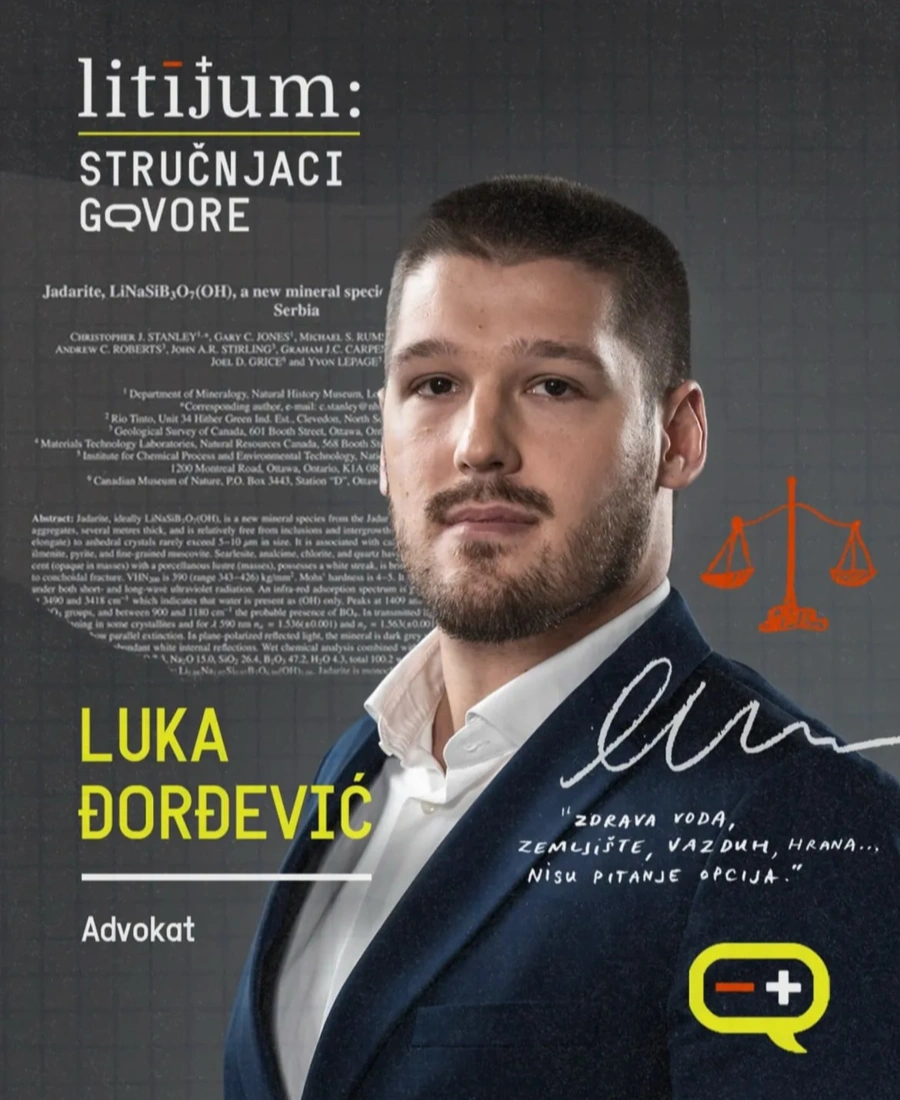
Da li su građani informisani o svim izdatim dozvolama i planovima za rudarenje litijuma i bora? Šta je tačno odobreno od 2004. do kraja 2021. u vezi sa projektom Jadar? Da li su ispoštovani zakoni Srbije i šta znači odluka Ustavnog suda o ukidanju uredbe? – samo su neke od tema o kojima u ovoj emisiji razgovaramo sa Lukom Đorđevićem, advokatom i borcem za zaštitu životne sredine i prirode.
Of course.
Based on available data, information, documentation, and what is publicly known, lithium is not mined or processed near populated areas, agricultural land, or particularly fertile soil. For example, in Australia, one of the largest lithium mining fields is located deep in the continent, and the extracted lithium is transported to China for processing—far from residential and agricultural zones. This proves that both materially and economically, it is not viable to mine lithium on fertile land. Fertile land serves other purposes, and so-called green, harmless mining does not exist.
The official and unofficial documentation I have reviewed over the past few years does not support such a claim. Neither company nor government documents indicate that even the basic conditions for mining in Jadar exist at this time.
I see myself as being on the border between current and future generations, and my answer is simple: clean water, land, air, and food are not optional—they are imperative.
No, I am not against mining as an industry, but I am strongly against illegal mining, which, unfortunately, has become common practice in our country.
It is important to understand how companies operate. If you were running a company, your primary concern would be your interests. Companies take advantage of the opportunities they are given to maximize their profits. This is not a question for companies—it is a question for the state.
Our government, if we look at its inspection systems, is not capable of adequately overseeing and regulating even protected natural parks. How could it possibly oversee such a complex mining project, which does not exist anywhere else in the world? Our mining inspection team consists of only three individuals. Considering that Serbia has around 450 exploration and exploitation sites, each with hundreds of locations, these three inspectors would need over 200 years to visit every location at least once—assuming they worked every single day.
In the early 2000s, Rio Tinto started establishing subsidiaries in Serbia, one of which is Rio Sava, the most relevant entity today and the holder of mining rights. From 2004 until a few years ago, when the last permit for preliminary geological exploration was extended, Rio Tinto in Serbia was only authorized to conduct geological exploration of boron and lithium ores at various locations—not just in Jadar but also in Valjevo and other areas before other companies took over. There is considerable public confusion regarding this matter, which is why it is crucial to examine it through the lens of Serbia’s evolving legal framework over the past 20 years. The legal system has changed multiple times: one law applied until 2011, another until 2015, then in 2018, 2021, and most recently in 2023. Each change in the system favored the mining companies, adapting to their needs and enabling a certain degree of legal non-compliance. In other words, it was not a matter of legal obligations but rather the opportunities afforded to companies. Approval conditions varied over the years—what was required in 2004 differed from 2011, 2015, and 2020. The oversight of mining companies also evolved. In the 2000s, local governments had inspection powers; today, they are not even informed when geological exploration takes place on their territory. Also, what is disturbing is that during the past 20 years, the company has been operating even under laws that mining lobbyists and some former ministers in previous governments of Serbia have declared as the best or among the best mining laws in the world. Nevertheless, the company had certain obligations, and the state had certain responsibilities and authorities that were neither respected nor implemented. I hope we will have the opportunity to discuss this further. What I would like to emphasize is that the mining law is considered the best for miners while at the same time being regarded as the worst for nature and the environment.
Citizens were not informed, and the answer is straightforward: neither was the government. This is highly problematic because the state itself was the primary recipient of company reports before issuing and extending permits. Our legal office, representing the "March for the Drina" initiative, has obtained a vast number of documents through official requests for information. We have analyzed compliance with mining laws since Rio Tinto’s operations began in Serbia, evaluating both company and government obligations, including whether the company submitted required reports and whether the state conducted adequate oversight. Alarmingly, official responses from the Ministry of Mining confirm that they do not possess the documentation they should legally have. If it's not a problem, I have prepared, I can read a few things.
For example, we are talking about the 1995 law that was valid until 2011, the 2011 law that was valid until 2015, and so on. I will not now separate the laws individually. The Ministry does not possess the contracts prescribed by certain articles, which are the basis for issuing permits that the company must conclude with a certain entity.
It does not possess data on tenders through which the implementation of applied geological research was granted. It does not possess reports on the classification of mineral raw material reserves. It does not possess data on the state of mineral raw material reserves. It does not possess quarterly and annual reports on conducted geological research. That is an obligation in order to extend the permit. Every company, when issued a permit, in order to extend the permit, must complete 75% of the projected work. How does the Ministry know that the company has completed 75% of the work? By the company’s obligation to report. If the Ministry does not possess reports, on what basis did it extend the permits? It does not possess projects of applied geological research. It does not possess final reports. It does not possess requests for issuing approvals for the implementation of applied geological research. These are, these are official, I will give them to you. These are official documents, responses from the Ministry of Mining and Energy. If the Ministry does not possess these reports, on what basis were permits extended?
Absolutely. This is how citizens are being informed.
The result of the protests in the fall and winter of 2021 was that at the beginning of 2022, the state annulled the decree that established the spatial plan for the special-purpose area for the implementation of the Jadar project. It sounds complicated. If you allow me, I will explain in one sentence. The spatial plan for a special-purpose area is adopted by the government in this case through a decree, it establishes it, and it serves as the basis for carrying out further procedures that should lead to the realization of the project. Let’s say that, in that sense, this decree is a kind of law. Everything else is implemented based on it. In January 2022, the government annulled its decree on the spatial plan, on which further procedures were based—impact assessments, unified procedures for issuing permits, procedures before the Ministry of Mining for granting approval for an exploitation field, and so on. When the foundation—the decree—disappeared, all these procedures had to be suspended, and the decisions made up to that point annulled. It is completely logical. Most procedures were indeed suspended, most decisions were annulled, including some decisions on impact assessments, and so on. The only procedure that was directly based on this spatial plan decree was the procedure conducted by the Ministry of Mining and Energy for granting approval for the exploitation field. The procedures in mining, construction, and environmental protection are closely connected and interdependent. A mining procedure for an exploitation field cannot be conducted unless an environmental impact assessment for that area is first conducted by the Ministry of Environmental Protection. So, this mining procedure was conducted unlawfully. First, it had to be suspended because the decree was annulled. Second, it had to be suspended because the decision on the scope and content, which was the basis for this procedure, was annulled. Neither then nor today has the Ministry of Mining suspended this procedure. Today, there are additional reasons for its suspension since a new impact assessment procedure is being conducted before the Ministry of Environmental Protection, which is not the previous one. So, logically, based on the new impact assessment procedure, the Ministry of Mining would have to conduct a new procedure for the exploitation field, and so on. But that is not the only issue. That may be the focus, but it is not the only issue. Infrastructure projects and their accompanying procedures were never suspended. The expressway connecting Valjevo and Loznica, the gas pipeline connecting Valjevo and Loznica, the high-voltage network, the railway. In the documentation of the Government of Serbia and the ministries I have just talked about, it is explicitly stated that these projects serve the realization of the Jadar project. This is very important. They are not meant to connect Valjevo and Loznica so that a Valjevo resident can reach Loznica faster for lunch with their friend. They serve so that a truck carrying sulfuric acid from Valjevo can reach Jadar.
Not just the ministry. I gave the example of the Ministry of Mining, but the same can be said about other ministries. The state has never abandoned the Jadar project, even though this persistence is unlawful.
It is not in accordance with the law.
Since January 2022, the situation has been that the government adopted a new decree, which annulled the decree on the spatial plan for the Jadar project. Until July this year, that second decree was in effect. The first decree was annulled, and the second one was valid. Rio Tinto challenged this second decree before the Constitutional Court, and the Constitutional Court ruled that this second decree was unconstitutional and unlawful. These are strong words, but that is not entirely the case. The Constitutional Court declared the second decree unconstitutional and unlawful not because of its content, nor did it dispute the government's right to decide on these matters, but because of the procedure in which it was adopted. And in its explanation, the Constitutional Court repeatedly emphasizes that declaring the second decree unconstitutional does not revive the project or bring the first decree back into legal force—it ceased to exist permanently. Nevertheless, I would say that, by exploiting the atmosphere created in public discourse—perhaps through media outlets that support the project and have a significant influence on our homes—the government, under the pretext of implementing the Constitutional Court's decision (which is not true), adopted a new, third decree, let’s say, stating in just two sentences:
‘The decree on the spatial plan, the first one that was annulled, is re-applied.’
This is illegal and unconstitutional to the extent that no trace of legality or constitutionality can be found in such a decree.
Maybe we have already touched on this topic, but thank you for this question. We submitted a large number of requests for access to information of public importance, both representing clients and in the public interest, because in such cases, the public must have access to these documents. After all, that is also the state's obligation. Let’s break it down into two scenarios: one where you submit a request, and ministries or other state bodies respond either by providing the requested information or by rejecting you—after which we file complaints, and the Commissioner issues second-instance decisions, and so on. The second scenario is that the ministry simply says: "We do not possess this information." Every request for access to information of public importance is formulated based on a legal provision that obliges the authority to have that information. So, these requests were very precisely formulated. In more than 50% of cases, the second scenario occurred—where the competent authorities did not possess the requested information at all. For example, Loznica and Krupanj, as municipalities, do not have any information on whether certain financial resources that were supposed to be allocated to them were ever actually given to them.
Well, as I told you, it's an atmosphere in which companies—and even the state—are used to not having to comply with all laws. That’s the reason. It can be called arrogance, recklessness, overprotection, ignorance, or even naivety. Everyone will interpret it differently based on their values, but legally speaking, for the past 20 years in Serbia, a system has been created that serves not to be obeyed. This system creation significantly disturbs citizens, because in the past few months—and even over the past few years—we have been hearing stories that Serbia will become some kind of mining destination.
Look, these are not just stories. These are data contained in the draft spatial plan of the Republic of Serbia, which is an official document. These are facts. The plan to open around 40 mines by 2035 is something our state takes so seriously that it includes it in a major planning document, which is currently in draft form. We hope it won’t be adopted as such, right? But if it is, it will be binding for all of us. Rio Tinto and the Jadar Valley are in focus. Rio Tinto and the Jadar Valley are a symbol. However, focusing only on Rio Tinto and Jadar is not the right approach, because boron and lithium exploration is happening across a vast area of our country—from the Drina River to the border with North Macedonia.
That’s exactly what I’m telling you. If we look only at boron and lithium, there are dozens of exploration sites. Many companies have been involved in this over the past 20 years. In Valjevo, around 50 drill holes have been made—more than in the rest of the country, except for Jadar. Valjevo is the second most endangered location in Serbia. In documents and projects of the European Union, Valjevo has been identified as one of the top three locations for boron exploitation in Europe. One of the most promising boron extraction sites in the world. It is not true that boron and lithium exist only in Jadar. People in Valjevo are aware of this. I am from Valjevo. The exploration sites extend into the urban core of my city. There are plans for a sulfuric acid plant in Valjevo that would produce quantities currently consumed by the entire country. And with those quantities—likely even larger—Valjevo’s mining basin, as well as Loznica’s and Jadar’s, would be supplied. Don't believe what you're being told, because it is not true.
And boron.
No, no exploitation permits have been issued anywhere. There are permits for applied geological exploration, and that is what these companies are working on. In Valjevo and its surroundings, let’s say toward Belgrade, there are several exploration areas. In Valjevo and its surroundings, toward Loznica, there are also several exploration areas. The maximum area of an exploration site is 100 square kilometers. Just imagine that. Now imagine three such areas adjacent to each other. Why is it done this way? Because—take Kolubara or Zijin in Bor as examples—when excavation in one area is completed, the operation moves to the next. That’s why it continues. If you look at the publicly available map on the website of the Ministry of Mining, you can see that from Valjevo to Loznica and from Loznica to Šabac, all the exploration areas are arranged like steps. The company Eurolithium Balkan in Valjevo had several rights for applied geological exploration. We represented hundreds of residents of Valjevo and surrounding villages who were endangered by this. For example, a mine is planned to be just 3 km from the city center.
According to EuroLithium’s project documentation, a mine is supposed to be located 3 km from the city center. Along with the mine, there would be a processing plant, a sulfuric acid production facility, and other infrastructure. What has been achieved in Valjevo is that the citizens have recognized their power in legal proceedings. When EuroLithium requested the extension of one of its permits, the residents demanded to be recognized as a party in the process and opposed the permit extension. They presented evidence regarding water quality, soil contamination, and the presence of harmful substances in plants—boron, for instance, was found in the leaves. In some wells near Valjevo, the concentration of prohibited substances exceeded the legal limit by up to 9,000 times. The Ministry of Mining did not consider this evidence relevant and rejected the residents' request to participate in the process, even though they legally have that right. After an appeal, the Administrative Commission of the Government of Serbia upheld the Ministry’s decision and dismissed the complaints. In response to this final ruling, the residents filed a lawsuit with the Administrative Court. At the same time, due to their inability to participate in the procedures, they submitted a request for a temporary injunction to the Basic Court in Valjevo, seeking to halt applied geological exploration until the Administrative Court decides whether they have the right to be involved in these proceedings. In November 2021, the Basic Court in Valjevo granted this request. In December 2021, the Higher Court in Valjevo upheld the decision of the Basic Court, temporarily and partially defending Valjevo. However, for the reasons I mentioned earlier, Valjevo remains highly endangered, and that should not be forgotten. It is one of the world’s most promising locations for boron extraction. It is rapidly and continuously being linked with the Loznica basin and serves both extraction and processing not only in Valjevo but also in Loznica. That is why the citizens of Valjevo must stay vigilant, stay informed in every possible way, and be ready to fight.
All the companies that are now exploring lithium, as well as those that have done so in the past, are closely connected and cooperate very closely. Let’s put it this way—when applied geological explorations for borates (boron), lithium, and related elements began, the group of people organizing and leading these explorations was very small. They were so connected that some of them were even related, like the Grubin brothers, for example.
Before EuroLithium started its explorations in Valjevo, Rio Tinto was already there. To put it figuratively, Rio Tinto drilled several holes in a circle and then left. Later, EuroLithium came and drilled a hole in the center of that circle—and found boron. These companies frequently exchange personnel—on a monthly or yearly basis—from geology experts to marketing managers and top executives. Some individuals have, at different points, been founders, directors, or owners of multiple mining companies. Why is this important? It’s important because people need to understand that there aren’t many of them. It’s a small group of individuals with personal interests. The number of local residents in Valjevo and its villages who stood up against them is far greater. 900 people, 2,000 people, even just 50 people—that’s still more than the number of people on the other side. We shouldn’t be fooled into thinking that working for EuroLithium is "cool" or that it’s trendy to say, “I work at Rio Sava.” It’s not. And I doubt that even those who work at Rio Sava are happy about it. I also doubt that the officials in the ministries, who are supposed to sign off on approvals, are too eager to do so. This is what Serbian citizens need to understand—Valjevo is proof that legal action can be effective and that victory is possible when people stand together, stay informed, and are ready to act.
Rio Sava is in the process of obtaining permits, specifically for the approval of an exploitation field, through the Ministry of Mining. That process is illegal—to such an extent that it does not even resemble a lawful procedure. It is being artificially and unlawfully kept alive. Here’s why:
Before submitting a request for exploitation field approval, the investor (operator) must meet several conditions and submit specific accompanying documents. One of these is a feasibility study on exploitation. According to Article 70 of the Mining Law, for a feasibility study to be valid, there must be an official decision from the Ministry of Environmental Protection on the scope and content of the Environmental Impact Assessment Study. Now, if the decision on the scope and content has been annulled—which, in this case, it has—how is it possible that you still have a valid feasibility study that serves as the basis for the approval process?
Legally, it’s impossible. But in practice, it is happening. Someone once asked me what legal weight the studies and drafts that Rio Sava has published over the past few months carry. My answer was that, legally, they do not exist. But in practice, they do.
It could be anything. You see, if you are capable of conducting an illegal process and making an illegal decision, permit, or anything else, the real question is whether the citizens will react or not. If they don’t react, the process will continue. If they do react, as is currently the case with the ongoing environmental impact assessment, then it becomes a significant problem and an inconvenience for the other side.
First and foremost, let’s remember that many legal professionals work in state institutions. The general perception among citizens that government institutions are incompetent does not apply to these legal experts. In our country, there are still skilled lawyers with integrity, who remember their oaths, their state exams, their universities, and the reasons why they chose to pursue law in the first place. They should, in accordance with their profession and calling, take these legal processes out of the hands of politics. We are not engaged in politics; we are engaged in upholding the law. They should remove these cases from political influence and restore legality to these procedures, even if it means risking their jobs, their integrity, and their reputation. Every time they are pressured to sign an illegal decision, they should ask themselves: where is their integrity? This doesn’t happen often, but they should not succumb to such pressure, and they should know that their colleagues outside the state system support them. I also want to commend my fellow lawyers, as we have seen an increasing involvement of bar associations and legal professionals in public discussions on these matters. Even those who are not specialists in environmental law are participating in the discourse, sharing their opinions and assessments. We have now reached a point where we are no longer discussing technical details of environmental law—we are debating the very foundations of our legal system. And the legal profession recognizes this. Lawyers must empower and support citizens—without fear—and help them in this fight.
Thank you for the opportunity.
This show was recorded in November 2024. Considering that shortly after the recording, the Ministry of Environmental Protection issued a Resolution on the scope and content for the preparation of the Environmental Impact Assessment for the mining part of the "Jadar" project by the company Rio Tinto, we asked our guest, lawyer Luka Đorđević, to further explain the new situation.
The Resolution on the scope and content for the mining part of the Jadar project was issued - BetaRS.
Yes, a large number of people—more than a hundred citizens—submitted objections and opinions during the process initiated by the Rio Sava company. I had access to these objections at the Ministry of Environmental Protection, and the majority of them were well-founded, pointing out the reasons why this decision should not have been made. However, the Ministry issued the decision, determining the scope and content of the environmental impact assessment study for the mining segment of the Jadar project, and citizens are currently filing appeals against it. The Administrative Commission is expected to rule on these appeals, but we can assume that all objections will be rejected, allowing Rio Sava to proceed to the third phase of the environmental impact assessment. This phase is crucial because it evaluates the quality of the environmental impact study and determines whether approval will be granted or denied. If approval is granted, the company can proceed with obtaining the necessary permits for exploitation.
What is almost unbelievable is that immediately after issuing the decision on the scope and content of the study, the state adopted two new laws in the field of environmental impact assessment—the Law on Strategic Environmental Assessment and the Law on Environmental Impact Assessment. The Law on Environmental Impact Assessment was adopted right after this decision because the new law will apply to the third phase of the process. I will explain why this is problematic, but first, I want to comment on the Law on Strategic Environmental Assessment. This law regulates the impact assessment of plans and programs, spatial plans, development plans, and so on. You can stop reading the law after Article 2, which defines exemptions from its application. One of the exemptions is the highest-ranking planning document in our country—the development plan and the investment plan that elaborates on the development plan. Why do I say you don’t need to read the law beyond that? Because any strategic environmental assessments conducted for lower-ranking plans will be meaningless if they must already align with the highest-ranking plan. This will create a simulated process, where citizens will think they have some influence, but in reality, they won’t, as the results of these strategic assessments will be predetermined.
The new Law on Environmental Impact Assessment, which is highly relevant and, in my opinion, adopted specifically because of the Jadar project, is essentially unenforceable. It introduces even some extralegal categories that allow investors to bypass the entire process. Even before the process begins, the law contradicts other laws, such as the Law on Planning and Construction and the Law on Mining and Geological Research. From the very first step, all authorities responsible for conducting environmental impact assessments will face serious difficulties in implementing this process, to the detriment of both the environment and the citizens of Serbia.
What is particularly concerning regarding the Jadar project is that under the new law, the public may be denied access to all key information held by authorities about projects and project documentation—if the investor decides that such information is their intellectual property and classifies it as a trade secret. In such cases, the ministry is obligated to withhold this information from the public.
The interested public, as a party in the process, appears only twice in the procedural section of the law. To put this into perspective, in the European Union directive, the interested public appears as a party in the process 18 times.
Moreover, none of the decisions made in the environmental impact assessment process will be published. Only a notification will be issued—essentially, "Hey, people, a decision has been made"—but the content of the decision will not be available to the public. This means that provisions allowing the public to appeal or file a lawsuit with the Administrative Court within, for example, 15 days, will become meaningless. The public will not even know what they are appealing against or suing over.
To conclude, a law written in this manner is not the work of legal experts—or if it is, then it was written by incompetent lawyers. This law will result in a situation where no state body responsible for environmental impact assessments or related procedures will be able to issue a single legally valid decision in these cases.
Yes, it was.
I believe that citizens should use all legal means available to them, no matter how limited they are. When citizens exercise their rights and the legal mechanisms at their disposal, it often puts the authorities conducting the process in a very difficult—sometimes even unbearable—position. If we start with administrative matters, for example, they are required to record every request, every objection, and every remark, which creates complications for them.
Not immediately. The Ministry of Environmental Protection significantly exceeded the deadline for issuing the decision, and in the decision itself, it failed to rule on any of the objections submitted by the interested public. That alone is enough for any citizen who submitted an objection to challenge the decision through an appeal. So, even if we reduce this fight to the bare minimum legal rights, if citizens use them, we still have a good chance. However, if citizens don’t use them, then it doesn’t matter how many rights they have—if they aren’t exercised, we have no chance at all.
This decision is entirely unlawful—fundamentally unlawful—and it should never have been issued in the first place. Now that it has been, it must be annulled. If the Government of Serbia does not annul this decision and return the process for reconsideration or reject Rio Sava’s request outright, citizens will have the right to file a lawsuit with the Administrative Court against the decision of the Administrative Commission. With the new laws, things have dramatically shifted in favor of investors because citizens have been practically—factually—excluded from these proceedings. They will not have access to information; the investor will have control over everything; they won’t be able to participate in the process as they should; and they won’t even know what decisions have been made. Imagine a scenario where approval is given for the environmental impact assessment study for Rio Sava’s Jadar project, but the public has no idea what is written in that approval.
No, we don’t.
Yes, this is an entirely new law. It contains extralegal categories, as I have already mentioned. For example, the concept of an "opinion." Before even initiating an environmental impact assessment process, the investor can ask the relevant authority: Do I need to conduct an environmental impact assessment? The request for this opinion, which is not an administrative act, cannot be appealed, and no one is informed about it. This request requires only a small number of documents, based on which it is impossible to determine whether an environmental impact assessment is necessary. Yet, the relevant authority may simply tell the investor: No, you don’t have to. This opinion, which is neither an administrative act nor a legally binding decision, nor aligned with any existing legal standards, allows the investor to proceed with the integrated procedure and obtain a construction permit. The law states that issuing an opinion does not relieve the investor of the obligation to initiate an environmental impact assessment by asking again: Do I need an environmental impact assessment? Do you really think that the same authority, asked the same question a second time, will give a different answer? This creates a huge legal uncertainty and a significant risk—not just for the public but even for the investor. Do you understand? He will come, say what should and shouldn’t be done, so why are you answering the same question twice? And what I haven't said yet, but which could be crucial, is that this law stipulates in one provision of Article 9 that the compliance between the documentation from the environmental impact assessment and the documentation from the unified procedure for issuing a construction permit is not verified by a state authority but is instead guaranteed by the investor with their signature and the signature of the chief or responsible designer. Every sword has two edges, two ends. On one hand, is it possible that Rio Tinto will guarantee itself? On the other hand, am I, as Rio Tinto, ready to take on such a risk and personally guarantee with my signature the validity of procedures that I am not carrying out myself, but that the state is responsible for? I wouldn’t want to be in the shoes of my colleagues who represent these companies—not just Rio Tinto, but other companies as well. How will they advise their clients in such a situation?
We do have legal remedies. They are harder to use, more complicated, and more demanding, but they exist. We have the right to appeal, the right to file lawsuits with the Administrative Court. Every citizen involved in the process is a party to it, regardless of what the Ministry thinks or writes. We still have a general legal framework regulating administrative procedures, which sets certain guarantees and principles that cannot be overridden by special laws. What might be more challenging now is that citizens no longer have all the necessary information in one place. It requires some legal knowledge, resourcefulness, and more persistence than before to achieve any form of justice. Citizens should exercise all their rights at every opportunity. When the environmental impact study is published, thousands—tens of thousands—of Serbian citizens should submit objections. It costs nothing, it doesn't hurt, and you can write them by hand and submit them at the Ministry of Environmental Protection or send them by mail. Attend public hearings, take the microphone, and express your opinion. The moment you speak at a public hearing, you become a party in the proceedings and gain legal standing. This means you have the right to appeal decisions and file lawsuits against higher-instance rulings. Only by using their rights can citizens—and all of us—stand a chance. If we give up now and say, "They have passed these laws, we have no chance," then we truly have no chance. It’s black or white.
Thank you.
Our guests, independent experts from various scientific fields, will provide professional and objective opinions on this topic, which has far-reaching consequences for our environment, future generations, and public health.
Naši gosti, nezavisni stručnjaci iz raznih naučnih oblasti, pružiće stručno i objektivno mišljenje o ovoj temi, koja ima dalekosežne posledice za našu prirodu, buduće generacije i zdravlje.
© Copyright 2026. All right reserved