

It is not possible to carry out lithium exploitation in the Jadar Valley in an environmentally acceptable way. This is not a fight against Rio Tinto, but a fight against opening a lithium mine in Jadar because the local environment does not support ecological lithium mining.
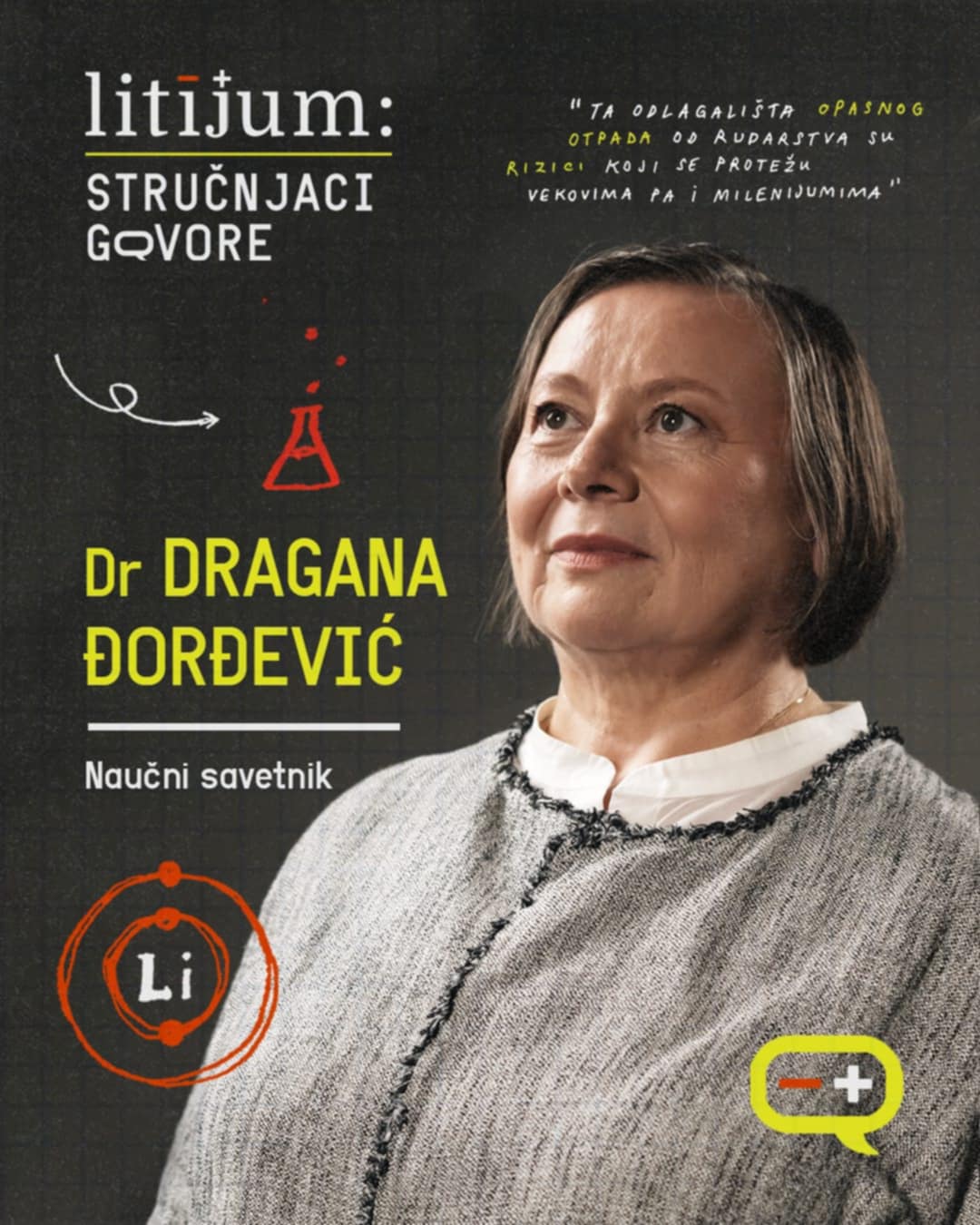
In the third episode of the series "Lithium: Experts Speak," we discussed the issue of opening a mine in the Jadar Valley with Dr. Dragana Đorđević, a scientific advisor and environmental science expert. Dr. Đorđević shared her expert views on why it is important to prevent the opening of a mine in this area, whether environmentally friendly mining is possible at all, and what the long-term ecological and social risks associated with such projects are.
Good afternoon.
No, nowhere on the planet is there a lithium mine that has been opened in a populated and fertile area, nor is there any plan to open such a mine and destroy healthy, fertile land.
No, not at all. And that has nothing to do with the company that would open the lithium mine. This is not a fight against Rio Tinto, but a fight against opening a lithium mine in Jadar because the local environment does not support ecological lithium mining.
Absolutely. We must leave a healthy environment for future generations, just as we inherited it. We must also preserve resources so that they can decide what to do with them.
Not as an industry—mining is useful, but it must serve the interests of the majority of the Serbian people, not the profit of a foreign company.
No, because the Jadar region is rich in surface and underground water. Lithium mining carries significant risks, as it involves processing lithium ore in Jadar and transporting large amounts of highly aggressive chemicals. All of this poses great risks, primarily to the local population but also to the broader environment.
Because the project is planned in one of Serbia's healthiest regions, an area that has the largest reserves of underground drinking water in Western Serbia and is one of the country's three major water reservoirs. Serbia has been struggling with water supply issues and droughts in recent years. If this water reservoir were destroyed—and mining would undoubtedly destroy it—Serbia as a whole would lose a major source of drinking water and face much more severe problems than it does now.
That is correct. In addition to the mine, a chemical processing plant would be required to refine the ore, specifically the jadarite concentrate. Jadarite is a unique mineral found only in Serbia, and there is currently no developed technology or facility anywhere in the world capable of separating lithium from boron within this type of ore. This means that the ore could not be exported; it would have to be processed on-site.
Furthermore, this chemical process is highly complex and based on outdated 19th-century technology, with nothing innovative about it. The process involves leaching with large amounts of concentrated sulfuric acid, using calcium carbonate for neutralization and sodium carbonate to extract lithium carbonate as the final product. It would also require vast amounts of water, likely sourced from the Drina River and its alluvial deposits. This, in turn, would generate enormous quantities of wastewater in an area surrounded by torrential rivers, leading to inevitable contamination of these watercourses and threatening the water supply of a large population—from Loznica all the way to Belgrade.
Jadarite is a mineral dispersed within the ore beneath the surface. It is not a pure mineral that can simply be extracted from underground. Instead, jadarite exists in small grains scattered throughout the ore, meaning that the entire material must be brought to the surface.
Once extracted, the material would first be crushed, generating massive amounts of dust that would enter the atmosphere and pollute the air. This is not ordinary surface dust that gets carried by the wind—this is mining dust, which contains harmful elements in addition to the useful ones being extracted.
We know for certain that jadarite ore contains, in addition to lithium and boron, toxic elements such as arsenic, lead, cadmium, and sulfides. Sulfides, in particular, would immediately vaporize, releasing hydrogen sulfide, which smells like rotten eggs. Beyond the unpleasant odor, hydrogen sulfide is highly toxic.
Approximately 20,000 people live in the vicinity of the proposed mining and processing zone, and they would be directly impacted by the lithium processing project.
So, this is the beginning of the problem, which would continue with the dispersion of mining dust from crushing, followed by grinding, then the transport of the ground material, which would be milled to a fraction of 200 micrometers in particle size. That material would then go into reactors, or digesters, where it would undergo digestion with concentrated sulfuric acid. The daily consumption of concentrated sulfuric acid would be 1,100 tons, which is a volume equivalent to an Olympic-sized swimming pool every few days.
Concentrated sulfuric acid is a very dangerous acid; it is classified as a hazardous chemical. Over the past few months, we have seen frequent incidents on our railways involving overturned shipments of hazardous materials, including tankers carrying sulfuric acid and ammonia, which pose significant transportation risks. We recently had an incident where a tanker, or rather an entire train carrying sulfuric acid, overturned. Then, a crane came to lift the tankers, and it too overturned.
This means that, as a country, we are not prepared for such large-scale undertakings. Why do I say large-scale? Because the Jadar project envisions the largest production capacities in the world. It is not just about lithium production; it also involves the production of boric acid and sodium sulfate as byproducts of the process. However, we still do not know what the company intends to do with the sodium sulfate. While it is true that it is used in detergent factories and has some market value, the global market is already saturated with this substance. This means it would have to be stored somewhere near the mine and processing plant. Sodium sulfate is a soluble compound, so with precipitation and frequent flash floods, which are common in the Jadar Valley, this substance would dissolve and lead to an increased concentration of sulfates in watercourses. These are the main risks associated with the Jadar project.
The key risks in processing – science tells us that lithium processing from brine solutions, which are most abundant in the salt flats of South America, specifically at the tri-border region of Argentina, Bolivia, and Chile in the Atacama Desert, accounts for 70% of the world's lithium reserves. The lithium there is found in brine solutions that are easily extracted from the Earth's surface. The brine is pumped out and stored in pools, where the water evaporates under sunlight, meaning no fossil fuels are used. Once the material dries, lithium is extracted from it.
Even though this method is far simpler and has much less impact on the environment—since it takes place in deserts—local communities still strongly oppose it because they lose access to water. A vast amount of water is required for lithium extraction, washing residues, dissolving compounds, and so on.
When it comes to lithium extraction from ore, the process is even more complex. It requires separating lithium from the ore, washing, and—what scientists have identified in the case of lithium extraction from rock—immense water consumption, massive chemical usage, and enormous energy consumption. In Jadar, gas is planned to be used for heating the system, which means fossil fuel consumption and, consequently, massive CO₂ emissions.
Isn’t it hypocritical to talk about lithium extraction as a means to reduce CO₂ emissions when, in Jadar, the production process itself would result in massive emissions? We have conducted some estimates—based on what the company plans to do, around 500,000 tons of CO₂ would be released into the atmosphere annually.
That is simply word manipulation. Spodumene ore is processed at 250 degrees Celsius, and many lithium ores undergo processing at 250 degrees Celsius. Jadarite would be processed at 90 degrees. But the fact that they plan to process it at 90 degrees and present that as a positive development—when it is still extremely harmful—is misleading. Heating concentrated sulfuric acid to 90 degrees Celsius is dangerous; just because 250 degrees would be worse does not mean 90 degrees is safe. Even at 20 degrees Celsius, sulfuric acid is highly hazardous, and it remains extremely dangerous even at 0 degrees.
How is that considered a small amount? How can 450,000 tons be "little"? It is nearly the same magnitude. The difference is just 130,000 tons—barely less than the total amount used in all of Serbia. Serbia does not even produce that much sulfuric acid. So, how does the company plan to transport it? Do they plan to build a sulfuric acid production plant as well? We still don’t know. Many aspects of the Jadar project remain uncertain, and building a new sulfuric acid factory would only further complicate the environmental issues already associated with the project.
It’s not just the water generated in the process that’s the problem. The issue is that the company has no solution for wastewater disposal. The company attempted to mislead the public by presenting a facility for purifying incoming water using so-called double reverse osmosis. This is a technology designed to purify water from the Drina alluvium, meaning it is used to clean river water for industrial purposes—specifically for obtaining high-purity lithium carbonate, known as "battery-grade" lithium. The company tried to portray this technology as a wastewater treatment solution, which is not true.
That technology requires an enormous amount of electricity and is extremely expensive.
It is costly even for purifying clean Drina water into highly purified water for the industrial process, let alone for treating wastewater using double reverse osmosis. That would be completely nonsensical, and I will explain why, as well as the quality of that water. If it were that simple, why hasn’t reverse osmosis been used to purify drinking water in Zrenjanin? Banat does not have clean water. Why hasn’t that technology been used to provide potable water for the city of Zrenjanin?
The city of Zrenjanin is facing a major problem due to the destruction of groundwater caused by extreme oil exploitation, particularly in the last 10–20 years. The use of banned technology, namely hydraulic fracturing, has shattered oil-bearing rocks, consequently disrupting the quality of underground water. Since then, Banat, specifically Zrenjanin, has had no access to drinking water.
Reverse osmosis could be used in Zrenjanin, but it is not being implemented. The reason is that the technology is extremely expensive and its capabilities are not as extensive. It can purify already relatively clean water, but it cannot purify wastewater. If applied to such polluted water, the system’s membranes would quickly become clogged and malfunction. Furthermore, even if purification were attempted through reverse osmosis, around 30% of the treated water would remain as waste. What would happen to that waste?
The problem is not only with technological water but also with groundwater. This area has three levels of underground water. The first level is the Drina alluvium, which is high-quality water. Thanks to this water, the Jadar region and the Mačva region are fertile, as the Drina alluvium extends beneath Jadar and Mačva, forming shallow underground water reserves. Even during extreme droughts in Serbia, such as in 2022, when almost all of Serbia and Vojvodina were drying up, crops in Jadar thrived due to the availability of groundwater for plants.
This first level is abundant and provides plentiful water. The next level consists of the remnants of the Miocene Sea, or the Pannonian Sea, which contains highly saline water. This water is separated from the upper groundwater layer by an impermeable clay layer. The third level of groundwater is located within the ore body zone. These waters are toxic, containing high levels of boron, arsenic, sulfides, and other harmful substances. However, as long as they remain trapped beneath the impermeable clay layer, they do not pose a direct threat.
The company, during its exploratory activities, drilled over 500 boreholes, damaging the impermeable clay layers in the process. As a result, the underground water layers began to mix, including the third, highly pressurized toxic layer, which started rising through the boreholes, contaminating the upper layers and eventually reaching the surface. Around the leaking boreholes, crop yields have drastically decreased, with plants either stunted or failing to grow altogether.
Absolutely. We have already observed elevated levels of contaminants in some village wells. Two years ago, we conducted field research and discovered increased lithium levels in household wells. In some springs, we also found elevated lithium concentrations. In the village of Korenita, for instance, lithium levels were significantly higher than in Donje Nedeljice, where we conducted well water tests on the same day and found lithium concentrations up to 50 times lower. The exploratory drilling has disrupted underground water flows, allowing these toxic waters to migrate and contaminate springs and wells.
That’s not surprising because Rio Sava has been conducting exploratory drilling since 2004. Between 2004 and 2015, the company drilled around 290 boreholes—nearly two-thirds of all its boreholes were created during that period, with 2015 seeing the highest number. That drilling activity released underground water, which, upon reaching the surface, mixed with rainfall and contaminated rivers. It is no surprise that by 2015, elevated lithium, arsenic, and boron levels were detected in the Jadar River downstream.
Our research focused on the environmental, geochemical, and sociological damage caused by exploratory drilling in the Jadar Valley. We assessed ecological harm, chemical contamination, and the sociological impact on the local community. We also examined the locations where the company plans to dispose of hazardous waste, such as landfills and tailings. The company still doesn’t know exactly where it will store its waste. Initially, the plan was to deposit toxic waste from the chemical processing complex in the Štavica stream valley. Later, they abandoned that plan and relocated the landfill near the industrial complex. However, that location is close to two torrential rivers—Jadar and Korenita—which flood the Jadar plain every year and, on rare occasions, raise the water level by several meters. In one instance, the floodwaters rose six meters above the Jadar field.
When we opposed that plan, the company reconsidered and moved the landfill back to the Štavica valley. However, that valley contains 167 hectares of healthy beech forests, which the company plans to cut down to build a dam and store toxic waste. Their justification is that the waste will be placed on a clay layer, sealed with a 2mm thick impermeable membrane, and will supposedly remain safely contained for the future.
Mining waste disposal sites pose risks that last for centuries, even millennia. For example, there is a tailings site near the village of Babe, between Babe and Kuberevac, dating back to Roman times. Even after 2,000 years, the land has not recovered, and nothing grows there because tailings contain all the unwanted elements from the ore extraction process. The valuable minerals are extracted, while the harmful elements are left behind, slowly leaching into surface and groundwater, contaminating the environment for generations.
Let me give you an example—Lukovska Banja. You’ve probably heard of it. I had the opportunity to analyze the quality of its geothermal waters as part of an international research project. Our goal was to assess geothermal water resources in several European countries. As chemists, we analyzed the chemical composition of these waters. What shocked us was the extremely high arsenic content in the Lukovska Banja river. This river is warm, and people bathe in it, unaware of its dangerously high arsenic levels. We were so surprised by the results that we repeated the tests multiple times, only to confirm the same findings. Further investigation revealed that the Lukovska River flows near medieval mining sites in the Kopaonik region.
Our leading geologists and geochemists recently published a scientific paper proving that medieval Serbian tailings still cause pollution today. Yet, many miners and geologists advocate for new mining projects and additional tailings sites, even though the old ones remain unresolved.
Whether it’s an underground or open-pit mine, the issue is the same—something is being extracted. The depth of the mine is not the problem; the problem is the entire mining process. To extract ore, explosives would be used underground to break apart rock formations. This blasting would cause land subsidence. Initially, Rio Tinto estimated subsidence at 80 cm, but their latest studies claim it would only be 20 cm. This suggests they are manipulating the data to make the project seem more favorable and are not presenting the real risks, which could be far worse.
The company is purchasing land from residents where it plans to establish the mine, waste disposal sites, and processing facilities. However, this is not enough—many people will still be forced to live in a high-risk environment, facing pollution, noise, and vibrations if the mine opens. Heavy machinery would operate daily, and light pollution would be constant since the mine would function 24/7. Those living nearby would be at significant health risks. The company is only buying what it needs, but it won’t buy land from 20,000 people.
Residents who are forced to stay will struggle to sell their properties, as no one will want to live near a mine. Their agricultural and beekeeping businesses will suffer. Those who manage to sell will do so at a loss and will be able to afford only small apartments in cities, transitioning from landowners to low-wage workers.
If the mine is approved, community life will be dramatically altered. Some residents are aware of the risks, but others are not. The company has a well-developed propaganda machine, portraying an optimistic future. Economic experts have noted that Serbia would have no control over the project—Rio Tinto would own everything, and the country would receive only a meager 5% mining royalty.
No. Serbia partially owns the Bor mine, yet it has no control over it. The state owns part of the mine in Bor, yet it has no control over it. Not only does it lack control, but the state doesn’t even know how much and what exactly the company Zijin is extracting from Bor. We know how much pollution they produce—how much they pollute the air. They have increased production two and a half times, opened a new underground mine, Čukaru Peki. The Serbian government does not know the quality of that ore. We know it is one of the richest, if not the richest, in copper and gold in the world. But copper and gold are accompanied by other extremely valuable elements, platinum-group elements—there is platinum, rare earth elements, whose market price is skyrocketing.
Zijin has stated that no institution in Serbia is capable of conducting chemical analyses, including the Institute in Bor, which has spent its entire existence analyzing exactly this type of ore and knows the details of each deposit. They transport this ore through the port of Bar directly—meaning they export the ore concentrate to China. What and how much? We don’t know. Meanwhile, they buy the lowest-quality concentrates on the market and process them in the Bor smelter, which is undersized for such volumes and lacks any air purification or ore processing systems. They have supposedly done something about removing sulfur dioxide, but it’s not enough.
In the Bor mine, there are high emissions of arsenic, cadmium, nickel, lead, and many other toxic substances. People in Bor breathe a cocktail of poisons, and the result is a dramatic increase in cancer rates and mortality. However, the state does not talk about this and simply cannot stop the Chinese company from causing harm.
Just before we get to that, I haven’t finished about the attack on our research. We published that scientific paper, gathering all relevant data and processing them using scientifically recognized methodologies. The paper was published in a reputable journal. However, Rio Tinto’s chief scientist and two professors from the University of Belgrade filed a request for the paper’s retraction, listing numerous criticisms. That request was sent to the journal on Rio Tinto’s memorandum. The professors from the University of Belgrade were signatories of a document with Rio Tinto’s memorandum.
That document was sent to the journal on August 19, and the editor forwarded it to us on August 22. So, from the 19th to the 22nd—three days. In those three days, all major domestic and international media were flooded with reports about how our paper was catastrophic and had to be retracted. We had no idea what was happening. We learned from the media that the paper was "bad" and that someone had objections, and only on the 22nd did we receive official notice from the editor. Of course, we did not engage in the media frenzy. Those days, I was overwhelmed with calls from various domestic and foreign media, but I chose not to give statements. I gave just one or two interviews where I said that it is legitimate to criticize a scientific paper because every scientific work, like any artistic work, is subject to criticism, and that is nothing unusual. But the level of media attention this received was highly unusual.
I have published over 100 scientific papers—almost 110 now—and I have never experienced anything like this. We realized that something much deeper was behind this. Ultimately, we understood that the issue was that while the company can manipulate communities in Serbia to some extent and present its intentions optimistically, this paper reached a global audience, an intellectual community that is much harder to manipulate.
Yes, exactly. We responded to every single objection from the company, and the editorial board reviewed the case, and the paper remained published.
Let’s be clear—that is not a study. They still do not have a study. They still do not even have a conceptual design for lithium extraction in Jadar, which they should have had long ago. Even the Special Purpose Spatial Plan for the Jadar project had to be based on a conceptual design that does not exist. That’s why the spatial plan was annulled in 2022—because it was adopted illegally. Why the Constitutional Court reinstated it this year is another question. The company has no conceptual design, and an Environmental Impact Study must be based on a conceptual design. The study must be reviewed by expert teams from our ministries, and that has not happened.
In the documents that the company has tried to present as an Environmental Impact Study, at the beginning of each document—three in total—they include a disclaimer stating that the company assumes no responsibility for the content of these studies. So why should I consider them official documents? I do not accept them as legitimate because they are not.
Practically no one is overseeing them. Our state is dismantled. Our inspection services are practically non-functional. These are people who are under pressure from big capital. If an inspector refuses to be corrupt, they risk their life. They work for low wages, and most people in these sectors are leaving.
We have very few inspectors. Environmental inspectors almost never go into the field. Until recently, there were only two mining inspectors in the entire country—maybe now they have hired one more, so there are three. That is completely insufficient for monitoring the 60 lithium exploration sites that our state has granted to foreign companies, as well as the more than 200 exploration permits for other minerals in Serbia. Our Mining Law has been adapted in such a way that when a foreign company finds a deposit, it practically becomes the owner of that mineral.
With such a small number of mining inspectors and a suppressed inspection sector—there is no one to oversee these activities.
That would be terrifying if it happened. According to Serbia’s new Spatial Plan for 2035, that is the projection. Over 500 objections were submitted to that document—I submitted an objection as well. So many objections were received that a public discussion couldn’t be held in a single day; it lasted five days.
I think even government officials started questioning what they were doing, especially after the recent meeting that the president organized with faculty deans and institute directors to form a state team to analyze the Jadar project and provide a final opinion—whether there should be a mine or not.
During that meeting, it was revealed that Serbia’s geological maps had gone missing and ended up in the hands of foreign companies. Now, these foreign companies know exactly where minerals are located in Serbia, and without any permits or markings, they are intruding, drilling, and conducting exploration on people’s properties—vineyards, farmland. This has alarmed the public, and I believe people are organizing to strongly oppose this practical colonization of the country.
If 40 new mines open—40 new Bor- and Majdanpek-like sites—Serbia will no longer be a livable place. Beyond that, over 200 exploration rights have been granted to various international companies in areas where mines should never exist. For example, in Vlasina, Čemernik, and Crna Trava, where Serbia’s last remaining high-quality water reserves are located. If a mine opens there, that water reservoir will be destroyed. If one opens in Jadar, the water reserves of Western Serbia will disappear, and we will be left without drinking water.
Well, you know, I had the opportunity to attend the first project presentation by the company more than four years ago, in Loznica. According to our laws, they were required to present the project to the local community. Some people from the local community, who were more aware, invited me to attend because they weren’t experts. I was found by them as a scientist and asked to come. I agreed and went. What I heard was about the opening of the mine, that it would be an underground mine, so that’s the story that is still being presented in the media—that it’s an underground mine, that it is completely safe, that high-tech machines with computer-controlled operations, remotely controlled, and so on, will be used. But other than that, nothing else was said.
I then asked the question, well, they don’t come from Australia just to make tunnels underground and drill some hole, they must be extracting something—what exactly is it, and what is its chemical composition, so I can assess whether it’s environmentally safe or not? I didn’t get an answer. I asked what they would do with it next, and then he said it would be treated with acids and washed with water. I asked how much acid, how much water they would use. I didn’t get an answer to several other questions either, and eventually, I got the response that it was their business secret. That was the communication with the company.
Soon after, I experienced horrific attacks, with circular letters arriving at my Institute, my university, the Ministry of Science, saying that I was ignorant, that I didn’t know what I was talking about, that they should take my diplomas away, that my degrees should be revoked, that I should be fired. This lasted for about one to two years, followed by a flood of anonymous bots attacking me on social media, on regime-controlled media. Observing their vocabulary and seeing that they all use the same rhetoric, focusing on the same issues, trying to discredit me as a scientist and an expert in the field, I realized that this came from a single training center. It’s obvious that these people are trained to do this and are doing it for money. I somehow don’t see how any dialogue or conversation could happen with such a company.
In their various documents, different data for the same category appear, and that’s one of the reasons why they tried to show that our work was very bad, because when we were writing that paper, we used data from documents that were available to us. Not all of them were available to us, and in some of those documents, the data was there, while in other documents, different data appeared, but we didn’t have access to those other documents. Meanwhile, they changed the data and then sent it to the journal, claiming that we were presenting false information. Of course, we documented everything, proved it to the journal, and the paper was not withdrawn.
This is not comparable for several reasons. The first reason is that the Kolubara open pits were opened to produce electricity for Serbia. 70% of the country’s electricity comes from the Kolubara and Kostolac pits, meaning from coal. As for the Jadar mine, the entire profit from the 5% mining royalty would go to the foreign company that would come to mine there.
The 200 hectares mentioned by the company refers to the mine and processing facility, but we still don’t know how much land they need for the waste dumps. In Štavice alone, there are 167 hectares, as I mentioned at the beginning, and according to the spatial plan for the Jadar project, which is now valid, 2031 hectares are designated for the mine, or for the Jadar project. The architects who worked on that spatial plan published a scientific paper last year, where they state that over 2400 hectares are planned. So, it’s not 200 hectares, as the company claims.
Well, you see, new mines are not being built in the European Union. Take Finland, for example, where lithium exploitation is planned in existing, old quarries. The material would be transported 70 km away to Kokola, where it would be processed. The capacity of this production is much smaller than what is planned for Jadar. I think it’s about 20,000 tons of lithium per year, while in Jadar, 58,000 tons of lithium carbonate and over 260,000 tons of boric acid are planned, along with similar amounts of sodium sulfate like Glauber’s salts. These capacities far exceed what is planned in Europe. In Germany, the Zinwald mine, a mine from World War II, will now be used for lithium exploitation. Similarly, in the Czech Republic, Cinovec, a mine from the 13th century, will continue to be used for lithium extraction. In Cornwall, UK, five existing quarries will now be used for lithium. In France, in the Alès region, lithium ore extraction is planned, but the processing will take place 700 kilometers away in Bovaro. In Austria, the plan is to open a mine with a capacity of about ten thousand tons of lithium per year, but the ore will be shipped to Saudi Arabia for processing.
So, nowhere in Europe is there a plan to open a new mine and process it at the same location, let alone destroy a healthy area that is inhabited, rich in water and agriculture. Likewise, in Australia, the Greenbushes mine is old, dating back to the 18th century. Lithium is extracted there, but processing is planned in an industrial zone south of Perth, 500 or 200 km away from the mine. So, nowhere is there a mine and processing located at the same site.
In Australia, Rio Tinto would be processing lithium ores for the first time. They have no prior experience with lithium ores. They would process it with the limitation that they return the tailings, which are non-toxic, unlike those in Jadar, back to the mine. That is, they would take it from the mine to the industrial zone, and after processing, return the tailings to the mine, with restrictions that they cannot emit more than 100,000 tons of CO2 per year, whereas in Jadar, the emission could exceed 500,000 tons.
No, no. There is no ore that contains both lithium and boron together. In all the ores I mentioned, there is exclusively lithium, and that’s why the production is much smaller, and the capacities are much smaller as well, only for lithium, with no boron processing. The residues are generally not hazardous, but companies have been instructed to return even such residues back to the mine.
60 exploration licenses have been granted, and lithium is being explored at 60 locations in Serbia, including eastern Serbia—Bor, Zaječar—starting from western Serbia, through central Serbia, all the way to Vranje. Research is still ongoing, and I don’t know how he knows there is no more lithium when the research has not been completed.
Well, to my colleagues, I would advise them to stick to the ethical code and moral standards, to consider the problems our country is facing according to their conscience, not based on how much the company is paying them.
Naši gosti, nezavisni stručnjaci iz raznih naučnih oblasti, pružiće stručno i objektivno mišljenje o ovoj temi, koja ima dalekosežne posledice za našu prirodu, buduće generacije i zdravlje.
Naši gosti, nezavisni stručnjaci iz raznih naučnih oblasti, pružiće stručno i objektivno mišljenje o ovoj temi, koja ima dalekosežne posledice za našu prirodu, buduće generacije i zdravlje.
© Copyright 2026. All right reserved