
Dejan Šoškić is a Full Professor at the Faculty of Economics in Belgrade. He teaches financial markets, risk analysis, and derivatives.
He served as the Governor of the National Bank of Serbia from 2010 to 2012.
He is a Fulbright scholar, a member of the Serbian Academy of Economic Sciences, and the author of numerous books and over 70 scientific papers.
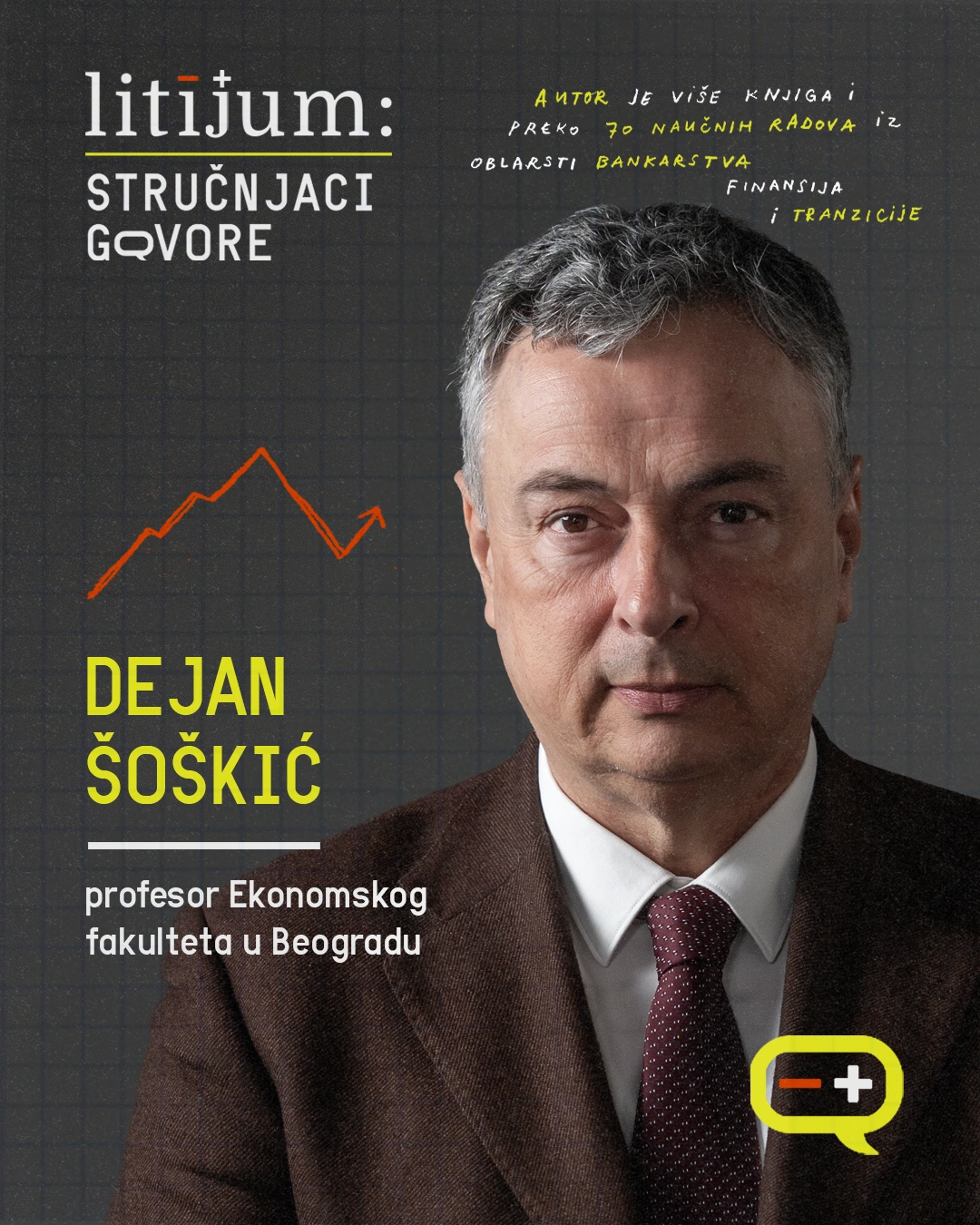
Professor Dejan Šoškić, an economist and former Governor of the National Bank of Serbia, appeared on the show “Lithium: Experts Speak” to shed light on the economic, environmental, and social aspects of the planned lithium extraction project in the Jadar Valley. He discusses the limited financial benefits for Serbia, the uncertainty of profitability, the impact on agriculture and tourism, and the need for a transparent and accountable state policy regarding such projects.
I haven’t heard of such a plan until now. From an economic point of view, that would always be a challenging situation to a certain extent, because every investment project must take into account so-called opportunity costs—namely, what else could be done in that space or whether there is an existing economic activity that would be lost by starting the project. As a rule, projects are ideally implemented where they don’t cause a loss of prior economic activity. On agricultural land, you certainly lose agricultural production, potentially tourism, or other sectors. Therefore, I believe that from both an ecological and economic perspective, these are not favorable circumstances for such investment projects.
That is not my field of expertise, but based on what I heard from the experts who gathered at the Serbian Academy of Sciences and Arts (SANU) in 2021 to analyze the matter, I think their conclusion was unambiguous. I rely on their findings as the most professional assessment available at that time.
Absolutely. Especially since the scarcity of natural resources changes over time. Something that was of interest one or two hundred years ago might not be today. Conversely, future technologies may allow for easier and more environmentally friendly extraction of resources that we currently cannot process safely. I like to look at the experiences of developed countries that manage their natural wealth so that the current generation doesn't consume all the benefits. They link this to state pension funds, accumulating wealth for future generations. This requires a mechanism that I don't think we as a country have even considered. We should learn from the Norwegian experience regarding oil and gas.
N0.
It is difficult for any company to state clearly in advance that there will be no negative effects. What I have learned is that jadarite has never been extracted anywhere in the world before. This would be a first. Furthermore, up until our short study was published in October, the company mentioned in connection with this extraction had never actually mined lithium before. We are talking about highly uncertain economic activities. We cannot rely on previous experience to speak with any degree of certainty. This would be a "pioneering" venture by a company with no prior experience in this specific field.
It is extremely uncertain. That is why Zoran Drakulić, Dana Popović, Boško Mijatović, and I came together to offer our economic reflections. Official statements from the state and the company have been quite affirmative, with promises regarding GDP and benefits for Serbia. However, there is a lot of uncertainty. What motivated me to react publicly was the narrative surrounding GDP—as if we can know for certain how much it will grow. Furthermore, GDP as a measure of economic activity can be flawed; you can have a situation where nominal GDP grows, but the broader community sees no benefit.
GDP depends heavily on whether a company is profitable and how much value it adds. Profitability can be hit by real economic circumstances, especially when the product’s price is tied to stock market fluctuations, which is the case here. The price of lithium is one thing today; it could be much lower tomorrow. New technologies could also make lithium less sought after. If there is uncertainty regarding the price, there is uncertainty regarding the business result and the project's contribution to future GDP.
The projected benefits presented by the company and their consulting study suggest that the largest potential effects for Serbia would come from corporate income tax and dividend tax. Both are tied to profitability, which we cannot predict with certainty. Moreover, multinational companies often have policies to move profits from a subsidiary in one country to another with more favorable tax conditions through "transfer pricing." We cannot even be sure that all profitability will be reported in Serbia.
We started from publicly available data: the company’s website, official statements, the consulting study done for the company, and our own tax regulations and spatial plans. We applied standard investment analysis techniques.
The company predicted cash flows over 40 years of extraction. In the first five years, they would invest about 2.45 billion euros. Much of that money would go toward imported machinery and foreign services, meaning the actual benefit to the domestic economy during that phase is small. The company projects 184.5 million dollars in "normal years" for Serbia, including mineral royalties (about 40 million annually), corporate tax, dividend tax, and payroll taxes.
However, because of the initial large investment, our laws provide tax exemptions. Practically, for the first ten years, there would be no corporate income or dividend tax. If they apply for additional capital investment incentives, those exemptions could last through the 20th year. When you project these cash flows until the end of the project and apply a discount factor (the weighted average cost of capital, which we set at 10% for Serbia), you arrive at a Net Present Value (NPV). Divided by 40 years and the current population, it results in 2.6 euros per person per year. No one has yet contested this calculation.
Lithium prices are currently significantly lower than in previous periods. The global attitude toward electric vehicles is shifting, and electrification ambitions are being revised even in the EU. At lower prices, profitability could disappear entirely in some years. This would make the "normal years" where Serbia sees tax revenue much fewer than projected.
The state should build infrastructure for society, but when specific expenditures are made solely to reduce a private investor's costs and make their project more profitable, we must ask if that is in the public interest. The company’s own website mentions that in other countries, they took on obligations that they haven't here. For instance, in Madagascar, they gave the state a 20% stake, and in Congo 15%, without the state having to invest.
In Serbia, the spatial plans suggest the state will fund clean water supply, railways, roads, and electrical infrastructure for the mine—projects that wouldn't otherwise be necessary in that area. Why should Serbian taxpayers fund this while the investor takes the lion's share of the profit? Especially since Serbia would have zero ownership stake in this model.
Models vary. Some African countries secured better terms from Rio Tinto than Serbia has in these initial versions. After our study, officials began mentioning the possibility of negotiating a 10% or 20% stake. Historically, mineral extraction rarely enriches the local population. Look at the "Lithium Triangle" in Latin America; those countries are not examples of great prosperity, nor has extraction significantly accelerated their growth when performed by foreign multinationals.
Officials also claim lithium extraction is a condition for battery or EV factories in Serbia. Reality contradicts this. In the Latin American lithium triangle, there is no battery production. In California, where Tesla is located, there is no mine. One does not necessarily follow the other. A mining company cannot be forced to produce batteries if that isn't their business, nor can they be forced to sell lithium only to Serbian companies.
The risk of "weak institutions." International observers have noted a constant decline in Serbia's institutional development and a rise in corruption since 2014. Without strong, independent institutions, we cannot control "negative externalities" like air and water pollution.
There is also the "Dutch Disease" risk—where focusing on a low-accumulation branch like mining leads to the neglect of other sectors like education, science, and high-tech development. No country has ever become rich solely by mining. Wealthy countries are built on human capital and knowledge.
That is a question of politics. Why do our politicians seem to care more about the interests of a foreign company than those of their own citizens? The EU has an organic interest in Serbian lithium because it wants to reduce dependence on China and keep its own costs low. It is "convenient" for them to have a project with environmental risks located close by but outside their borders. However, we must be free to exercise our sovereignty and say no if it is not in our national interest.
That is a legal question. If we haven't signed a binding contract, I don't see how we would suffer such consequences. If such obligations were made, we should ask who authorized them for such an uncertain project. It would have been normal to have a public tender.
Mining can be an economic branch, but it is not a path to long-term wealth. Prosperity comes from education, science, and high-tech innovation. We should not be a country that takes a 3% or 5% royalty while the rest goes to a foreign company that does not share our long-term fate. We need public debate, not decisions made by a very narrow group of people.

Naši gosti, nezavisni stručnjaci iz raznih naučnih oblasti, pružiće stručno i objektivno mišljenje o ovoj temi, koja ima dalekosežne posledice za našu prirodu, buduće generacije i zdravlje.
Naši gosti, nezavisni stručnjaci iz raznih naučnih oblasti, pružiće stručno i objektivno mišljenje o ovoj temi, koja ima dalekosežne posledice za našu prirodu, buduće generacije i zdravlje.
© Copyright 2026. All right reserved