
Retired full professor of the Faculty of Mining and Geology, graduated, earned his master's, and obtained his doctorate in the field of hydrogeology.
He served as the Head of the Department of Hydrogeology and was a member of the Council for Technical Sciences of the University of Belgrade from 2007 to 2012.
He is the founder of the Karst Hydrogeology Center at the Faculty of Mining and Geology and has mentored 12 PhD candidates.
He has published 395 scientific papers, including 46 in SCI-listed journals, and has lectured at universities worldwide.
He is also the author of several monographs and university textbooks, and a recipient of numerous awards and recognitions both domestically and internationally.
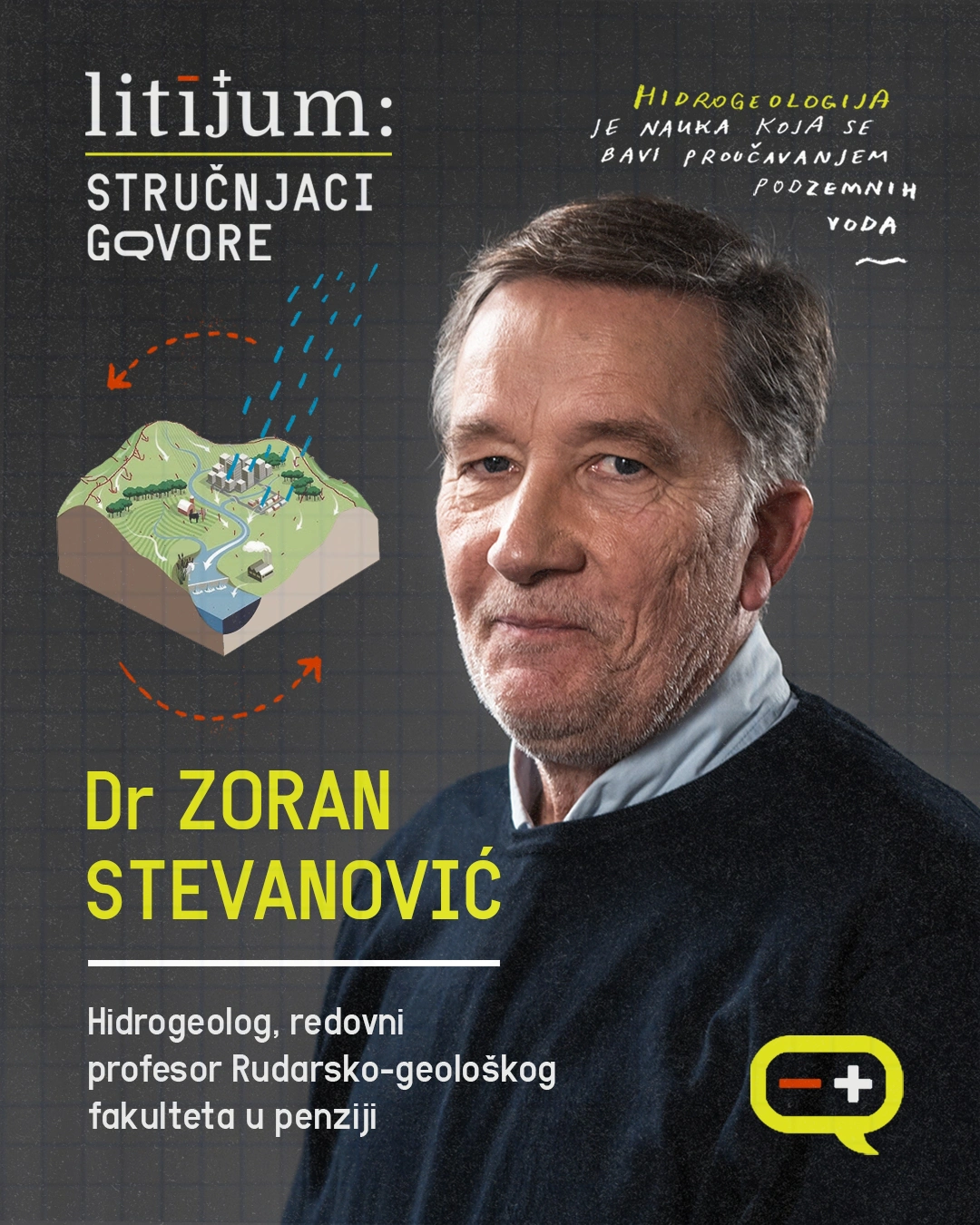
In the fourth episode of the series "Lithium: Experts Speak," we spoke with hydrogeologist Prof. Dr. Zoran Stevanović, who answered numerous questions and uncertainties – will the opening of the lithium mine in Jadar jeopardize drinking water sources in Serbia? Could this mine have a negative impact on water resources, even far from the actual location? Is ecological mining even possible?
We’ll try that. Thank you once again for the invitation.
Not in the way it's planned to be done in the Jadar Valley. In some areas, perhaps Portugal, I think there was talk of such a possibility, but certainly not on land this fertile. Most of the current methods of exploitation involve completely barren areas in arid regions and use other approaches—such as evaporation from brines or so-called salt flats.
Theoretically, according to what the authors from Rio Tinto wrote in the three drafts of the environmental protection studies, they claim it is possible. In my opinion, that's a rather fairy-tale-like narrative, and I’m afraid it cannot have a happy ending. The risks involved are so significant that I believe, sooner or later, one of those incidents will cause environmental contamination, which will be impossible to prevent.
That’s a given—it is the basic principle of sustainable development, which has been globally promoted. The concept of sustainable development has been around for over 20–30 years. It’s widely accepted and incorporated into our legal frameworks and planning documents. Unfortunately, we live in circumstances where everything that would be sustainable for future generations is not being implemented adequately.
Absolutely not. I’ve lived and worked for 40 years alongside mining colleagues and was a professor at the Faculty of Mining and Geology. I believe I understand the issues, even though mining isn’t my narrow field of expertise. Mining is not only possible—it’s necessary. But not in a way where we allow companies whose primary interest is profit—not a healthy environment—to take over. That’s exactly why they’re interested in operating in Serbia. So yes, to mining—but only in an ecologically acceptable manner, and only when all conditions ensuring a healthy environment are met.
If you're asking about jadarite specifically, that’s a unique case—there’s no other place where jadarite exists. So, if you're asking whether another company could do it...
Look, they can guarantee. If they guaranteed with all their assets—even to the point of having insurance policies that would shut the company down in case of any incident—then we’d see how many would be willing to sign such agreements with the state. So yes, they can guarantee things on paper—anything is possible—but in practice, I think that’s highly unrealistic.
If you’re asking about this specific topic—which is of course the right question—I became interested when it became a public issue, like any engineer in the field of mining or hydrogeology would. Unfortunately, access to data was very limited. The company treated it as classified—confidential documents. The results weren’t available either. Some of my colleagues were involved, but they couldn’t discuss it due to non-disclosure agreements.
Naturally, I didn’t want to press the issue, but here and there I could infer the direction the project was heading. However, real access to data became possible only in early July 2024, when the company, to reassure the public that there would be no major environmental issues with their mining operations, published three drafts of environmental impact studies. These included the basic technical elements of the project in three parts:
Only then did I gain access to the data and could conduct a more detailed review. It took a great deal of time and energy. Of course, the three draft studies amounted to around 2,000 pages. Some content was repeated across the studies, and some parts were outside my direct area of expertise—so I couldn’t technically follow everything. We are all specialists in specific fields, and though we can expand our understanding, we can’t cover every detail. That was the case here as well.
It cost me a lot of energy, time, sleepless nights, and delays in other projects I was working on, but the project deeply intrigued me. I needed to answer a question for myself: is it truly possible to carry out the project in an environmentally sound way, without endangering what I specialize in—water quality and major water sources for Serbia’s population. That was the main reason I got so deeply involved. Being retired helped too, giving me more time than some of my colleagues who may not have had the same opportunity.
Oh, please. The impression people get from the media depends on which media they follow. If you follow those aligned with the current regime in power in Serbia, that impression is likely. They invite only guests who support the project. Most of them are designers of the project. There are 14 of them from the Faculty of Mining and Geology, mostly from the mining department—I believe only two are geologists.
Our faculty is a specific institution with two departments—Mining and Geology. Along with the Faculty of Technology and Metallurgy, it’s the only one at the University of Belgrade with two faculties under one roof. From the first year, geology and mining are taught separately. Of the geology programs, only one is directly linked to mining—exploration of mineral deposits. My field, hydrogeology, supports mining by helping to dewater mines and ensure operations proceed safely. Hydrogeologists also contribute to environmental impact studies and hydrogeological modeling.
So yes, the mining department likely supports the Jadar mine. I can’t say for certain, but based on my experience and communication with former colleagues (now from retirement), I believe most geologists would not agree with this project or the approach taken for jadarite exploitation and lithium extraction.
I even suggested to my colleague, the current dean Professor Cvjetić—a respectable and professional man—that when speaking in the media about the Jadar project, he should not sign as the Dean of the Faculty, but rather as one of the project designers. To represent the faculty’s view, he should propose a secret vote of the teaching-scientific council. Everyone has enough knowledge to form an opinion on the lithium issue.
If a secret vote were held, my personal estimate is that most would oppose the project. That’s why I believe the faculty should publicly express a stance—but only after such a vote. Not publicly, to avoid offending or discrediting colleagues whose primary field is mining and who support the project.
We must be precise here. I’ve tried to clarify this in earlier statements and in a paper for a monograph that should soon be published. We are not endangering all water in Serbia. Claims like that drew justified criticism. The correct focus is on the alluvial groundwater of the Jadar River and surface water in the river itself, which could easily carry contamination downstream about 13 km directly, or about 17 km through the Mačva region.
There lies the most significant groundwater reservoir, in what's known as an intergranular aquifer—sands and gravels with intergranular porosity—around 100 meters thick. This is one of the main water sources, planned in Serbia’s national water strategy up to 2034, for supplying the Belgrade–Posavina and Mačva regions. It holds three times the amount of water currently used by Belgrade. This is an exceptional reserve for the future, especially considering climate change. It must not be contaminated under any circumstance.
The risk of contamination transfer due to mining and processing in Jadar is, in my view, the main reason the project should be abandoned.
Back to what I said—our faculty has six geology specializations. Hydrogeology is one. I have not heard a single hydrogeologist from the faculty support the project. So when mining colleagues sign off on something called a “hydrogeological map,” I have to say—they have no right to speak for the Faculty on groundwater issues.
The same goes for some colleagues from the Geological Survey of Serbia who claim there would be no impact on groundwater. But the "Jaroslav Černi Institute" conducted mathematical models and projections showing potential for major flood waves in Jadar Valley—ranging from 1.5 to 3.8 meters high under worst-case scenarios. From a hydrogeological perspective, such floods could contribute to contamination from mining operations.
The environmental studies do not address this risk. They mention embankments, but those solutions are poorly detailed and raise many concerns. I could go into more detail, but let me just conclude: among the hydrogeologists at the Faculty of Mining and Geology, I am confident that most oppose the Jadar project.
Well, it would deplete the water reserves at the very site, because mining wouldn't be possible without draining the groundwater. However, those reserves are not essential at the actual location of the mine. They're not significant for the Republic of Serbia in the way the downstream water reserves in the Mačva valley are, which can be contaminated. Therefore, drainage is inevitable. In the previous document, the draft environmental impact study, it mentions the amount of water that would be pumped out of the mine area — 38 liters per second. Now, there are issues with that as well. That figure is defined as a so-called "stationary" rate — meaning it's assumed to be continuous — but we don’t actually know how much water will be pumped at the beginning, how much later, etc.
But imagine pumping out 38 liters per second — that might not seem like an essential amount. The entire Jadar valley is estimated to have water reserves between 200 and 300 liters per second — or more precisely, 0.2 to 0.3 cubic meters per second. To put that into perspective: if we compare it to Mačva, which has 19.9 cubic meters of water per second, we can see there’s a drastic difference. The real issue is the downstream resource, which could be contaminated by the transfer of certain pollutants from the direction of the mine.
We would contaminate it. We’d contaminate it just like when you have a clean and beautiful meadow, and then someone comes along and dumps garbage on it — it’s contaminated. The next question is: can we decontaminate it? The answer could be yes — there’s a process called remediation. Cleaning it isn’t impossible, but it’s extremely expensive, and the question becomes: for how long would we be without that resource, and can we even truly complete the decontamination in the end?
Let me put it this way: boron, which is mentioned and would be one of the extracted elements — boric acid — is one of the most aggressive contaminants, and it strongly binds to the environment. Additionally, boron, as a migratory element, is also problematic in the process of reverse osmosis. Let me step away from the Jadar region for a moment and go to the Pannonian plain. In Kikinda and Zrenjanin, groundwater — not of good quality and extracted from depths of 200 to 250 meters — contains high levels of arsenic and boron.
Technologists and colleagues from Germany, with whom we conducted studies from the Technologiezentrum Wasser (TZW) in Karlsruhe, concluded through analysis that reverse osmosis could retain arsenic. However, boron is problematic when it comes to retention on reverse osmosis membranes—membranes established to allow water to pass through. This is likely why colleagues from Rio Tinto and their experts proposed a double reverse osmosis process—where water passes through the membrane once, and then again.
Boron is especially problematic because the sludge left behind by that process hasn't been analyzed in the studies. However, according to my estimate, up to 500 tons of such sludge could be produced over years of exploitation. This retained sludge, as it's called in English, poses a serious issue: where to dispose of it and how to manage it. Boron is migratory, and its movement downstream presents a challenge—especially in terms of whether decontamination would even be possible.
I haven’t dealt with that in depth, nor have I had much practical experience in that field, because unfortunately, this country lacks developed mechanisms for cleaning up its landfills. Currently, in the context of mining, we have around 250 registered mining waste disposal sites in Serbia. We’ve managed to count and integrate them into the cadasters thanks to technical assistance from Germany (GIZ) and funding from the European Union. We now know where these landfills are located, and we also know what they contain—something we already had a general idea of even before, but now it's officially published on the Ministry of Mining and Energy's website.
But how many remediations have been carried out? How many of these contaminated areas have been decontaminated? That’s the key question—and the very reason many of us are afraid that new mining operations in previously untouched areas could lead to further environmental degradation, particularly of water resources, which is my area of expertise.
Yes. One part would be located directly at the mine site, next to the two shafts planned for entry into the underground mine and ore extraction. A waste deposit would be formed there with two main components:
These two components would be stored on-site, forming a mound or “pyramid”, if you will, with a base size of about 20 hectares, which I like to explain as approximately 30 football fields. The height would be 6 levels of 10 meters each, or 60 meters tall—roughly equivalent to a 16-story building. So, we’re talking about a massive volume of material located right at the mine itself.
The second portion would be transported 14 kilometers away to a landfill located in the valley of a small stream called Štavica. This location was selected after dozens of alternatives were considered—at least, that’s what the draft study claims. That site would be used for disposing of material with no current or future economic value. In some future scenario, a portion of the slightly mineralized ore might potentially be reprocessed to extract useful raw materials.
So, there would be two large disposal sites. Both are vulnerable to flash floods. Both are exposed to potential flood waves.
Possible flood waves — and I must say, this is my main focus — raise the following question: What kinds of flood waves can we expect over the next 100 years? Or maybe 200? Perhaps even 250–300 years? People are supposed to continue living there. The company claims they could carry on their activities as normal. But let me put it like this: a recent flood wave in Valencia brought 500 mm of rainfall in just 8 hours. That used to be nearly a whole year’s worth of precipitation for that region — and it happened in just 8 hours!
We witnessed catastrophic consequences. Before 2014, when a devastating flood hit the Jadar region, as well as Kolubara, causing serious damage and even loss of life, the mathematical models for what’s called “100-year floods” were based on completely different historical data than what we saw during that event. So now, we must ask ourselves: what new kind of flood could hit us next? What would its intensity be? And how would it impact the area where mining takes place and where the waste is deposited? There’s a real risk of accidental contamination from those deposits, especially if they are damaged and the materials are spread. That’s one part.
The other part concerns four lagoons mentioned in the plans, which are supposed to hold mining wastewater before it enters the treatment process. If flooding occurs and the area is not sufficiently protected, those lagoons — containing what we might call toxic mining water — could overflow and that contaminated water could be carried by the Jadar River downstream, toward the Drina. That scenario was not analyzed in the study. The experts involved assumed that the contamination wouldn’t spread beyond 6 square kilometers. Based on that rather optimistic figure, which seems to have come out of some theoretical model, they claim the pollution won’t travel further downstream. But we know, from many accidents in our region, that contamination does travel.
Let me just mention that nothing remained alive in the Pek River after one such accident involving a flotation pond near Majdanpek in the 1970s. Then there was the contamination of the Šaška stream after a dam burst on another flotation pond, which caused Donji Milanovac to permanently lose its water source due to the spread of that contaminated flotation water. There was also an accident in the upper part of the Jadar watershed — in Stolice in 2014 — when mining water spilled from a smaller basin or flotation pond and partially contaminated the downstream area around Korenita, and even reached the Jadar River itself.
So, we already know about these types of accidents, and they represent one of the greatest threats to the area of the future Mačva water source — or even the current water source — which we hope to further develop in the coming decades as one of the most secure water resources.
Personally, I am satisfied and thankful to Rio Tinto for providing this data so we can have a conversation about it. As we said at the beginning, the data was initially somewhat shrouded in secrecy — understandably, since the company wasn’t eager to share details before it had formed a clear concept of how mining would look and what would be done. That’s reasonable — it’s a professional approach.
Today, this information is available. However, an interesting thing is that in July, the company published three draft environmental protection studies for the three components we have discussed: the mine, the processing technology, and the waste disposal. Two months later, a request was submitted to the Ministry of Environmental Protection of Serbia to determine the scope and content of the Environmental Impact Assessment (EIA) study, along with a portion of the technical documentation. I expected that what we had already read in July would simply be repeated. But in just two months, three essential components were changed. They mention a half-reduced amount of mining water that will be pumped out. I believe I calculated about 56% less land subsidence in the area above the mine. Land subsidence is inevitable, as it is a consequence of blasting and excavation. The model tests mentioned in the studies were revised, nearly halving the results. And the biggest surprise for me was the fact that the waste disposal site I had mentioned — which would occupy the area of 30 football fields, 16 stories high — was moved from one location to another, still nearby, but at a higher altitude to prevent the issues we had already discussed.
So, I asked myself: How is it possible that a company, which continuously claims that the results of its work over the past six and a half years — during which it has been active for the last 20 years — involved 100 independent experts, including 40 university professors, can then change three essential components in just two months that were previously presented to the public? This is difficult for me to understand. A company that presents itself as one of the most serious, second in the world by the value of its project, operating with its financial results and wanting to be seen as one of the most powerful, claiming it will safely conduct mining in Serbia — I have to ask: is it really possible that things can change like this and still seem serious enough?
Well, the changes were likely made under the influence of the criticisms they heard from the public, including from us. This is the same mechanism that was applied to the comments made in 2021, after the conference held at the Serbian Academy of Sciences and Arts in May 2021, and the subsequent publication of the monograph, which publicly raised numerous critiques about specific aspects of the proposed solutions, particularly regarding the potential impact on biodiversity. After that, you can see certain changes in the approach. Even before the Academy of Sciences conference, they had abandoned the surface mining plan, which would have been much more problematic than the current underground mine. Some other modifications were also made, and now, between these two studies, or two technical documents, we are presented with the idea that they likely realized that some things weren’t going down well with the public, so they made changes. But I still wonder: how did they make these changes in just two months, when 100 independent experts had been working continuously on this project for six and a half years? That’s what I personally find troubling in this situation.
It means nothing, I think that from this entire conversation so far, this is some phrase that has been promoted. I believe it’s a ministry in the Ministry of Mining and Energy, I’m sorry, when I saw that some other colleagues, it seems from the Faculty of Civil Engineering, mentioned similar things, and they’ve never actually dealt with underground waters and what it means to be hydro isolated. You know, hydro isolation is in its natural state. We have impermeable layers that prevent complete active communication.
It can still exist along some faults, fractures, you know. Water goes up sedimentarily under pressure sometimes, and sometimes it goes down along those fractures, so from the near-surface layer along the Drina, it can descend into deeper parts. These are possibilities. And hydro isolation disappears the moment you enter those layers with two shafts and 54 km of access roads underground. You have practically broken them. Every borehole, if not well isolated, allows water to circulate along it, either gravitationally downward or ascendent. So, there’s no complete hydro isolation in the sense it’s being discussed. It exists in its natural state, but as soon as we disturb the natural state, cause land subsidence, or trigger changes in natural conditions, there’s no more hydro isolation.
There are no own sources for Rio Tinto. Rio Tinto bought, I believe, a number of facilities, became the owner of some plots, but it doesn’t have its own sources. In this country, thank God, water is still owned by the state and is state property. Concessions are not easily granted, and they are not granted anywhere in practice. Some changes were made in the legal regulations due to the Zrenjanin water supply, but we are the owners of water resources. We can grant a concession for bottling water, but it’s a minimal amount at certain locations, and the concessions are time-limited. Rio Tinto doesn’t have its own sources. They might consider that all mining waters, the ones they will pump out, are their waters, but that's not ownership. I think it’s important to say that all of this that we’re talking about, Rio Tinto is trying to present as something sustainable and possible. I again emphasize that there are numerous risks that arise in that environment. I think that’s an important point.
You didn’t ask me, but I’m asking myself this. You know, bringing 943 tons of sulfuric acid to the mining site every day, or if you don’t bring it every day, you’ll bring 2700 tons in three days. And how? By railroad composition. What kind of composition is that? How many wagons does it have? The calculation is that it must have at least 17 wagons to fit 943 tons. They will also transfer it. They will be used in a closed process afterward, as my colleagues say, the pollution will be amortized, but there is a constant risk.
Fifteen thousand days should be the duration of the mining operation. Fifteen thousand days should be spent bringing, unloading, transferring, depositing, and removing it, without any contamination occurring. You know, then we think, well, there is indeed an idealized situation, an idealized case in which, let’s say, nothing would go wrong. Everything would be perfect. The idealized case is... We recently had a conference dedicated to Milutin Milanković, and we reminded ourselves of what Milanković did once, in his free time, as a hobby: he calculated how high the tallest building in the world could be, which, in an ideal case, could be made with the materials available at that time. Do you know how high it is? 20 km. So, mathematically idealized, he showed - if we dig its foundation so deep, if we make it circular, if we lift it, if that material... Theoretically and mathematically, it is possible to prove that the object could be 20 km high. Now, of course, he did that jokingly, playing with himself when he made that calculation.
So, this too can look the same. You can calculate everything, and depending on the input, you can insert idealized data for this or that. Some things you have to invent. And I don’t even blame the colleagues who worked on the model from the Jaroslav Černi Institute; they had to, as they didn’t have records of every element. They had to think something through and say that the water infiltration from precipitation will be 7% or 12%. And with that data, they enter their calculations. Then, if the result works for them, fine, if not, they tweak the input until they arrive at the idealized variant.
I say, it’s all wonderful. Idealized, we can wrap it up nicely and put a ribbon on it and say, yes, it could be like that. But you know, it could be like that in relation to what the benefit is and what the profit from it is. And when we compared that, economists will calculate that better than I can, I’m just using the data that Rio Tinto itself provided. In the idealized case, 180 million euros per year. Everyone proves that it’s drastically less. I mean, not everyone, those who don’t support the project. But for 180 million euros at current prices established in the Republic of Serbia, you could build between 9 and 10 km of highways. Okay. And what can we do after forty years of mining, to connect two places in Serbia? And what do we get from that? The mineral wealth is gone, and we’ve left significant ecological damage, which future generations will inherit. We’ve eliminated the people who live there from continuing with their agricultural activities, though everyone says they will still be able to engage in agriculture. You know, who will buy their products, others can probably explain that better than me, but it’s clear to me that, for example, we have mining in Bor and Majdanpek, that part of Serbia has somehow been sacrificed. They’ve been mining there for 100 years, and now turning all of Serbia into a mining pit, I don’t think even mining colleagues would agree. It might sound appealing, hey, we can do many projects, alright, but I’m sure that no one in this country, not even its political leadership, would like to open it all up. The regulations have been made very poorly, so almost anyone who explores and certifies reserves gains the right to start exploitation once they meet some basic environmental protection conditions.
We don’t. I recently asked a colleague, specifically from this area, I don’t have a complete overview of what’s going on in the Ministry of Environment and the Ministry of Mining and Energy, but I heard there are four of them. Of which one will likely get a permanent position in Eastern Serbia, around Bor and Majdanpek. Do you think one person can oversee that? What’s happening almost daily, and maybe they can, I don’t know. They can, as mining inspectors, monitor what’s being done, but the amount of contamination or anything like that, we would need teams assigned to monitor the area.
I’m starting with water monitoring. Do you know how many water bodies we were obligated to identify according to the EU Water Framework Directive? Out of 153 groundwater bodies, only about 20% are currently monitored for quantity and quality, with the Environmental Protection Agency having a shrinking budget and monitoring only 70 points, under the Serbian Hydrometeorological Institute, which is negligible.
The Ministry of Environment is trying to improve that lack, implementing operational monitoring projects, trying to show the situation a little more favorably in terms of monitoring, but monitoring in this country is terrible compared to the requirements. It can be expensive, but the damage that follows is much greater. We have a rule in our regulations, taken from the principles of sustainable development and what the European Union has already done, "The Polluter Pays." You know where the polluter has already paid? I can’t find an example, but I found an article where a legal colleague wrote that in 2020, 20 proceedings were initiated against polluters, of which 13 were known. What are 13 pollutions in this Serbia that are ongoing? We would likely have to shut down, if not the majority, at least half of industrial plants because industrial water treatment is inadequate. We’d have to close the Belgrade Water Supply and Sewerage company because it releases untreated water into the Sava River in part and mostly into the Danube.
What about that? How can we talk about something being ecologically implemented here when we don’t have the capacity or invest in environmental protection? Why don’t we remediate 250 landfills or at least part of them? Why don’t we have projects that are validated and implemented in practice? Why aren’t our colleagues, the mining engineers who have a specialization in environmental protection and occupational safety, engaged in such projects, stimulated by the state to do this as a primary task? Instead of monitoring it, like experts, consultants hired under the umbrella of Rio Tinto to design how we can mine in the Jadar region?
Nothing would change. Why would it change? Then the state itself enters into it, and profit becomes just as primary for it as it does for the company, compared to the ecological damage. The state would probably monitor it with a little more focus, but if pollution occurs, then the company would say, "20% of the remediation is on your shoulders." So, let’s ensure that the company, with Lloyds or whoever, deposits capital, say, equivalent to 75% of their operating capital, let them deposit billions of dollars in a bank account so we can access it if there’s an accident and see if they’d accept that. Then we can discuss it, okay, we can’t give 20%, but we have your funds, and we’ll ensure ourselves from them and resolve everything else that arises from your operations.
It depends on which colleagues.
Hydrogeologists, well, lift your heads, speak freely, don’t be afraid. I mean, I’m not pulling anyone by the arm to go public. I’ve talked to many colleagues, and I understand the situation completely. On one hand, there’s some opportunism, a bit of fear. We live in an environment where fear has become almost part of our daily lives. Fear of this or that. We see that we live in an increasingly less safe environment, both in terms of construction and the projects that are being realized or have been realized. Unfortunately, with very tragic consequences. So, fear, and also, opportunism. There’s a certain lethargy, a disbelief that something can change significantly. And that’s what is being worked on systematically.
There’s a mechanism in which people are trying to be told that they have nothing to hope for, only to listen and nod. If every word you speak gives the company the right to appear in all the media with defamatory campaigns against those who have openly and freely expressed their opinions, then there’s a general sense of insecurity, and I understand why people won’t speak out unless forced.
And the third thing, to speak freely, you also have to be somehow established. Established, confident in what you’re saying, having verified everything.
It wasn’t easy for me to go over all these facts and establish them, not because I want to criticize at all costs. I’d be the happiest if I saw no flaws, if the mining could proceed. But when you see flaws, what’s left for you is either to remain silent or to express your opinion publicly. Therefore, that role, I assigned it to myself. And not out of malice toward colleagues who were engaged and have a stake in the project and who were paid. I’ve earned enough, and I’m confident in what I’m saying, so I think it won’t be easy for others to express their opinions. But if not publicly, let’s do it secretly. Let’s test who’s for it and who’s against it. I say again, every geologist and miner have an opinion on this project.
You're welcome, thank you for the opportunity to discuss this.

Start building your first prototypeno time Ogency intuitive, drag drop interface gives building blocks that you needs
Learn More
Start building your first prototypeno time Ogency intuitive, drag drop interface gives building blocks that you needs
Learn More
Start building your first prototypeno time Ogency intuitive, drag drop interface gives building blocks that you needs
Learn More
Start building your first prototypeno time Ogency intuitive, drag drop interface gives building blocks that you needs
Learn More
Start building your first prototypeno time Ogency intuitive, drag drop interface gives building blocks that you needs
Learn More
Start building your first prototypeno time Ogency intuitive, drag drop interface gives building blocks that you needs
Learn More
Naši gosti, nezavisni stručnjaci iz raznih naučnih oblasti, pružiće stručno i objektivno mišljenje o ovoj temi, koja ima dalekosežne posledice za našu prirodu, buduće generacije i zdravlje.
Naši gosti, nezavisni stručnjaci iz raznih naučnih oblasti, pružiće stručno i objektivno mišljenje o ovoj temi, koja ima dalekosežne posledice za našu prirodu, buduće generacije i zdravlje.
© Copyright 2026. All right reserved