

Dr. Božo Drašković, professor of economics and ecology.
Graduated, earned a master’s, and defended his doctorate at the Faculty of Political Sciences. Became a research associate at the Institute of Economic Sciences in 1991, and served as director from 2004 to 2006.
Published numerous scientific papers, co-authored two monographs, and participated in research on enterprise restructuring, markets, and foreign investment.
Currently teaches Microeconomics at the Faculty of Banking, Insurance, and Finance, Union University, and Economics of Ecology at the Faculty of Applied Ecology, Futura University, Singidunum.
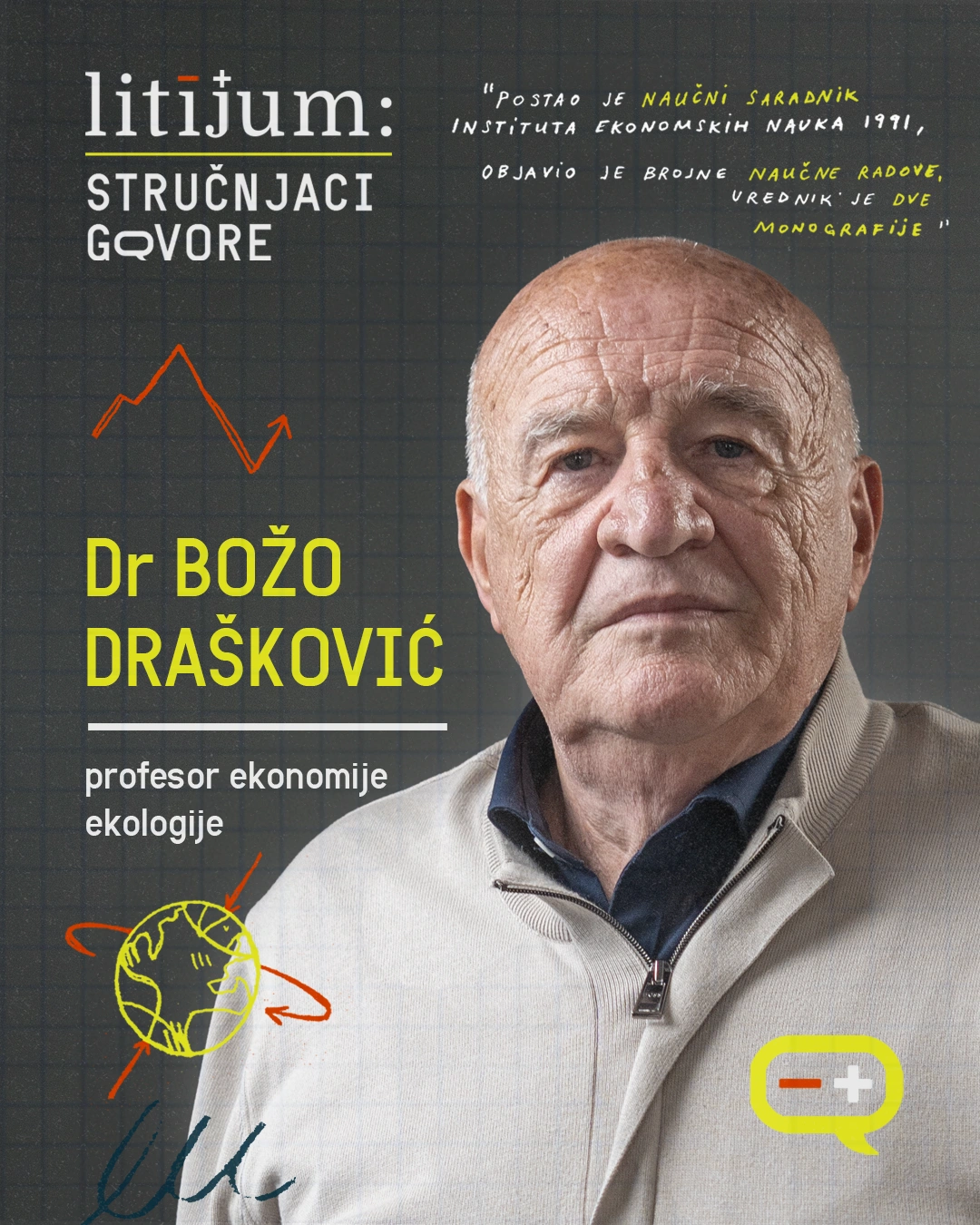
In a conversation with Professor Božo Drašković for the show “Lithium: Experts Speak”, key economic, ecological, and social risks of lithium exploitation in the Jadar Valley were highlighted. Drašković shares his views on the sustainability of the project, responsible use of natural resources, and the need for independent and transparent analyses that would protect the interests of Serbia and future generations.
Let’s just look at some basic information, seriously, without manipulation. I am not aware that lithium exploitation is being carried out in areas that are inhabited and where there is agricultural land, or resources suitable for other activities. Planning is one thing, implementation is another. In serious and responsible countries, planning may exist, but investment and execution only happen once all prerequisites are met to ensure that exploitation—in this case, lithium—does not endanger the environment, surroundings, or biodiversity. In other words, in such countries, operations do not take place where these conditions are not met.
According to existing technologies and plans for extracting ore from the ground, processing it on the surface, and storing mining waste, it is de facto impossible to carry out in an environmentally acceptable manner.
The basic postulate, developed in the second half of the 20th century and promoted by the Club of Rome in the 1970s, is that the exhaustion of resources and environmental pollution must be considered. It is important to achieve a balance so that current resources are not depleted, and future generations do not inherit a polluted nature. What is the essence of the whole process? In mining, it is always the processing of nature into money. Mining and exploitation of natural resources represent a form of capital—natural capital, a natural good, or value that we convert into money or profit. For this, technology, a market, and demand for products are needed so that nature is processed into a product and sold. The actors involved in this process make a profit, but usually leave negative consequences for the environment. De facto, there is no mining that does not leave negative consequences for the surroundings or the environment, and the more preserved and diverse the environment, the greater the potential damage.
No, certainly not. People need to act and use natural resources; otherwise, we would return to prehistory. Certain segments of nature need to be appropriated and converted into something useful for humans, but with strict responsibility to ensure that this benefit does not cause harm elsewhere—to nature or to humans living in it. Sustainable mining is possible. Where mining is necessary, one must be aware in advance of all the damages and consequences of the process, to timely plan measures for damage prevention and remediation of the affected area—meaning to minimize changes and pollution of air, water, and soil. This is a necessary and serious process, multidimensional, which must be considered before any mining, without bias or influence from interest groups operating in the multinational company–state relationship. They often present things as ideal, while the actual consequences are significantly worse.
When it comes to mining, or attempts at mining in the Jadar Valley, the first problem is that there is no known technology for processing, extracting, or separating lithium and boron from the existing mineral structure, called jadarite, which has its own chemical-physical structure. That technology does not exist. Therefore, we cannot trust anyone on their word, and even if someone conducts laboratory experiments, they very often will not disclose all aspects to maximize their position to exploit a certain resource. That is the first issue—we do not have it. The second issue is that there is no way to avoid the destruction of the environment, especially land, forest, and water resources in the area, and the destruction of these resources means the impossibility of normal human life in the area or in the wider environment affected by pollution. Simply put, it is unacceptable, it is not economically viable for Serbia when comparing costs and benefits of such a project. Unfortunately, we do not have a single serious, objective, calm study that confronts benefits and costs to see where we are going and in which direction. Unfortunately, propaganda operates at the level of multinational companies and certain individuals at the top of our government. In the end, the President of the country, Aleksandar Vučić, as the omniscient man, advocates the whole matter. And we have a problem in that we do not want to hear another perspective. One must sit down and objectively analyze, weighing benefits on one side and harms on the other. Benefits and harms involve all actors. In this case, it is the multinational company that will maximize benefits in the form of profit, in the form of what I mentioned earlier—the extraction, or converting nature into money/profit. The state, local communities, and Serbia will receive some minor portion of the economic effect, while the damage will remain for hundreds of generations in the future in the area and across Serbia.
It is important to understand the structure of resources to then draw valid, analytical conclusions. There are resources that are exhaustible. From the moment you begin exploitation, there is a lifespan in which these resources will be depleted and will no longer exist in a given territory. The process functions roughly as follows: you start exploitation, exploitation proceeds, after a certain period—as planned here—lithium will be depleted after 30 years. The question always arises: what is the parameter, the measure by which you will evaluate the speed and profitability of exploiting a specific exhaustible natural resource? You extract it, process it from the earth, convert it into money, leave pollution, and that’s the end.
For renewable resources, the situation is somewhat different. It is necessary to consider the dynamics of their exploitation, allowing both human activity and nature itself to regenerate its resources. Greek philosophers, equating nature with God, called it Physis. This means it is important to allow nature to regenerate and avoid complete destruction of resources. Therefore, with renewable energy and other resources, it is possible to prevent human greed and profit from destroying the resource by leaving it space to renew. Mines or coal deposits, once extracted, cannot be renewed, but you can ensure that renewable resources, such as forest ecosystems, are not destroyed and are given the opportunity to regenerate, with active support from humans and economic activities of human society. This is the second aspect—two different types of resources, but a common outcome: one must ensure that resources have space to regenerate and are not exploited in a way that destroys the environment.
There is also a third theoretical group of resources: continuous resources over which humans have no influence. No human activity directly affects them—for example, wind, ocean waves, gravity, sunlight. These are continuous resources independent of us, no matter how egocentric we are as humans. It is especially important to consider the dynamics of exploitation of a particular resource. For continuous resources, thanks to scientific innovations, you can harness wind energy, solar energy, and other sources. These are very important aspects to understand. Given this, one must consider the economic policy in the resource utilization sector.
We have actually neglected careful management. We have good regulations, but our practice is completely different. We destroy water quality, reduce or destroy forest ecosystems in some areas, conduct intensive exploitation of various mineral resources—not only coal but also copper, gold, other minerals, and quarries. We do not pay much attention because the basic thing is to enable actors to earn as much money as possible by converting nature into wealth, while society usually suffers, and in the long term, the entire community suffers. We do not pay enough attention, we lack strategy, and we do not have a clear plan. Why? Because strategies are often written very generally. True research is rarely conducted, and future projections are rarely made. Such strategies must be developed for 20, 30, 50 years, not 2 or 3 years, and that is the problem.
It is necessary, especially when evaluating resource value, to consider two things. One is the structure of their influence on the final product and market price—how much each factor affects it, which can be modeled—and on the other hand, the costs necessary to reserve to prevent and mitigate negative consequences from exploiting a specific resource, in this case, mining.
These are two things you must consider to have a proper economic-development policy. Let me give an example: you exploit coal to run a thermal power plant. Negative effects of the plant include emissions of sulfur dioxide and carbon dioxide, as well as ash and other byproducts. Technologically, solutions like electrostatic filters can be applied to reduce emissions, but the fundamental benefit is producing electricity that reaches consumers, electric motors, devices, etc. In that final energy, coal itself is not visible. If we focus on coal itself, we must consider the cost of electricity, allocate resources to mitigate impacts, and remediate—that is, compensate for damage caused by economic activity in nature. For open-pit coal, some mitigation through natural processes is partially possible.
Two things are especially important to understand: first, in theoretical debates in social sciences, we must consider the theoretical positions of authors, how they justify them, and demonstrate the applicability or shortcomings of those approaches in practice. Only by synthesizing different approaches can solutions be found that allow proper management of resources. Unfortunately, authorities or policymakers often do not appreciate such approaches, as seen in many countries, including ours.
It’s simple. A previously explored resource, such as gas, oil, and thermal sources in Vojvodina and parts of Serbia, was handed to another, foreign company. It did not matter if they were Russians, English, Chinese, or others—in this case, Russians. This was done by uneducated people making such decisions. The same logic continues: uneducated people unwilling to open serious discussions now make decisions on other natural resources, including copper, gold, and lithium.
De facto, it already has. Historically, after the Balkan Wars and the continuation of Serbia as an independent state, then the Kingdom of Yugoslavia, looking at ownership data of mineral wealth, most of it was in the hands of foreign companies - “Rudnik Bor Francuza” etc. This applied to other mines in Serbia. Foreign companies owned resources. If there was justification at that time due to lack of education or engineers, it might have been necessary, but today, there is no justification. Current reality: hydrocarbon exploitation is handed to Russians, copper and gold to Chinese. These are key resources. Minor ownership in Bor is another matter.
We have handed over exploitation, and they exploit intensively. Chinese companies, for example, achieve in one year what used to take our managers ten years. Political factors dictated management instead of experts. This applies also to the oil industry. Except for coal and some zinc exploitation, key mining and processing is in foreign hands. Once majority ownership is granted, Serbia has de facto entered a neocolonial position. Regulatory frameworks were designed to maximize benefits for owners.
We have scientific resources, young researchers, institutes, faculties that could work on such a multidisciplinary project. Focusing only on formal legal aspects or mandatory environmental impact assessments is insufficient. The state should engage people independently of political influence. Two separate groups could conduct parallel studies. Six months to a year is sufficient for thorough studies, covering mining, technological, physico-chemical, hydrological, economic, legal, sociological, and biological aspects. The goal is a comprehensive analysis presented to state authorities, then results can be disclosed publicly.
Currently, we have a study by the Serbian Academy of Sciences and Arts from several years ago, largely ignored. Pre-agreed arrangements exist politically, with European structures outsourcing “dirty” projects while keeping their own areas clean. Agreements, strategic plans, and raw material lists serve their interests—reducing dependence on China for batteries, cars, lithium, and boron. My interest is different: Serbia’s strategic interest must be prioritized.
The alliance pushing this involves key EU officials and influential domestic actors, including Zorana Mihajlović, Aleksandar Vučić, and Ana Brnabić. Their actions serve the interests of foreign companies rather than Serbia.
No, it is never too late. Mechanisms exist. Social movements can prevent exploitation. Citizens must be informed to make decisions. We can act, as in the cases of Bor, oil, and gas. Companies and states have economic interests, and Serbia must protect its own.
To citizens: think critically, use your own judgment, and do not trust propaganda. The issue concerns a wider region. For colleagues: scientific integrity and responsibility are key. Rigorous research, accountable communication, and openness to critique enable better solutions. Political authorities must respect expertise.
Naši gosti, nezavisni stručnjaci iz raznih naučnih oblasti, pružiće stručno i objektivno mišljenje o ovoj temi, koja ima dalekosežne posledice za našu prirodu, buduće generacije i zdravlje.
Naši gosti, nezavisni stručnjaci iz raznih naučnih oblasti, pružiće stručno i objektivno mišljenje o ovoj temi, koja ima dalekosežne posledice za našu prirodu, buduće generacije i zdravlje.
© Copyright 2026. All right reserved