

“We simply cannot just hand over any kind of resources to foreign companies, no matter where they are located. That’s a sign that we are not taking care of our own population. It’s either going to be the corporations or it’s going to be us.”
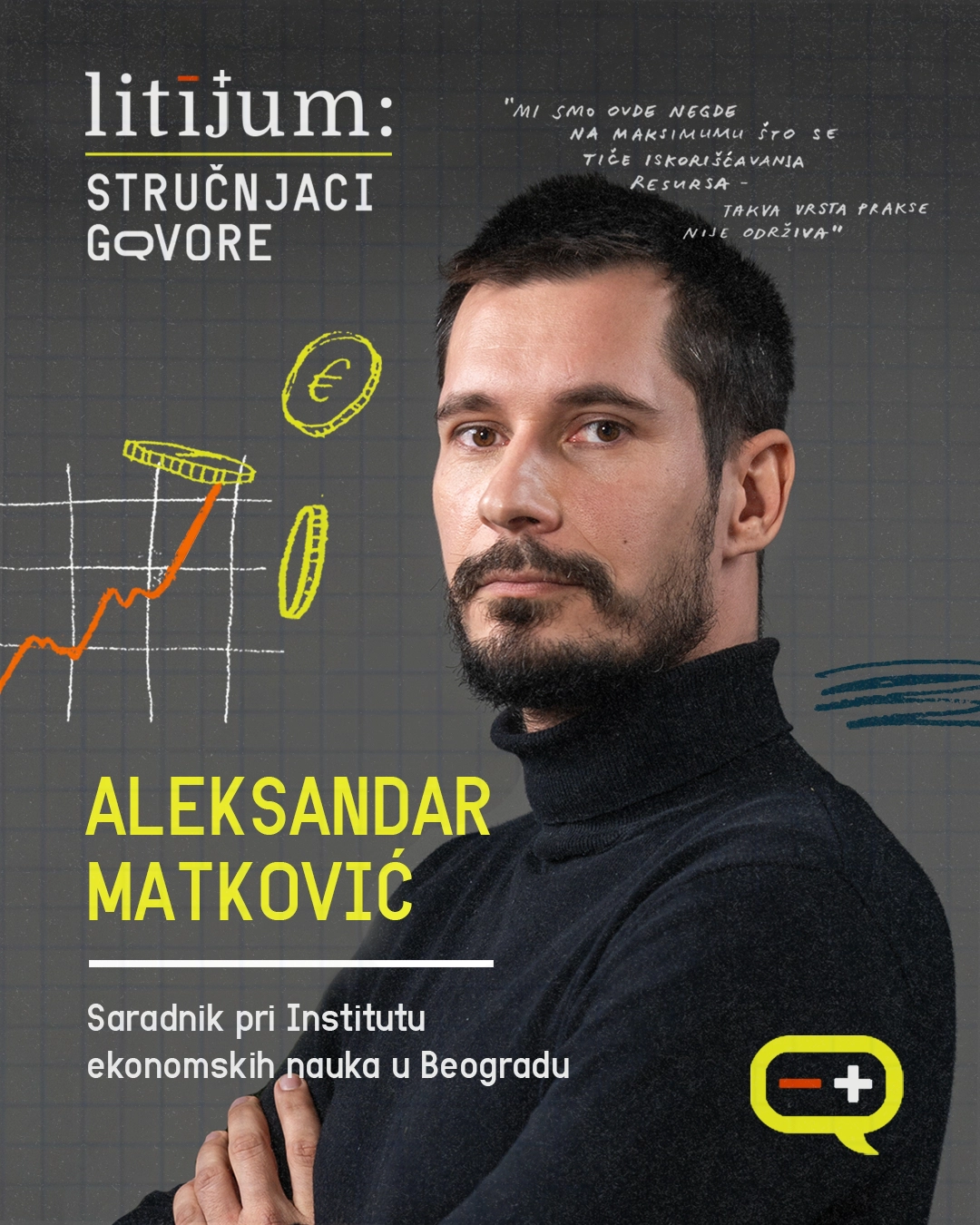
In the fifth episode of the series “Lithium – Experts Speak”, Aleksandar Matković, research associate at the Institute of Economics, openly questions: Does Serbia have a clear strategic development plan, or is it surrendering to the interests of foreign corporations?
No.
No.
No.
Absolutely, and much depends on our strategic development plan for Serbia—which we currently do not have. Without it, any kind of mining is completely counterproductive.
Absolutely not. No company in the world can guarantee that in any project.
Not as an industry. We will always need mining. No civilization has existed without mining—it simply doesn’t happen. But is there senseless mining purely for profit? Absolutely. We’re at a historical peak of resource exploitation, and it’s no surprise that resources like oil are disappearing. That kind of practice is unsustainable.
That’s why I’m not against mining per se; I’m against uncontrolled, problematic mining that harms national interests and is organized solely for profit.
First of all, I believe that the phrase "white gold" hides more than it reveals. Why? First, the term "black gold" – oil – was used in the 19th century when it was discovered, but oil is a fuel, whereas lithium is used for storage. These are two different types of commodities. That’s one thing. Second, the whole idea of "gold" originates in America during the gold rush, when mining expanded rapidly, and there was, it seems to me, an excess of capital that could be invested in resources. You had Rockefeller, one of the people who coined the term "black gold," and also Henry Ford, who developed cars that created the demand for that black gold.
But the situation today is drastically different. We no longer live in the 19th century; we live in the 21st century, where it's very questionable what kind of demand for lithium really exists. I’ve contacted Rio Tinto, I’ve contacted the Ergo Group, which did those calculations, and even some departments in the European Parliament that worked on those estimates – and they’re not certain. They often commissioned third parties to extrapolate historical demand trends for lithium. To call it "white gold" seems unjustified to me. Back then, there was an actual demand for oil, while with lithium we are speculating about a possible future demand.
At the same time, this is corporate ideology – let me just emphasize that. When I say corporate ideology, I mean that these are the kinds of "facts" corporations want you to believe – such as the supposed future demand for lithium. However, the German auto industry is in crisis, Volkswagen is closing factories, Northvolt (a battery producer) is near bankruptcy. All of that affects demand and our projections of demand. So, when I hear "white gold," to me, it’s just a marketing term. Listeners shouldn’t take it at face value. Lithium is for storage, not for fuel. And for storage, there are sodium-ion batteries, hydrogen engines – a whole range of alternatives that can, but don’t have to, be used for building electric vehicles. This wasn’t the case with oil, which was historically irreplaceable – and soon to be depleted.
Exactly. Absolutely.
Australia is the number one producer. The latest data I have is from 2022, when I believe Australia mined around 61 million tons of lithium carbonate equivalent. After that comes Chile with 40 million tons, and then China with 19 million tons. So: China, Chile, and Australia. Of course, there's also the "lithium triangle" – Bolivia, Argentina, and Chile – which spatially has the largest concentrations of lithium. But globally, one of the areas with the highest concentration of lithium within a single country is the small region of Gornje Nedeljice in Serbia.
So, depending on the criteria we use, there are different ways of extracting lithium. In Australia, it's mined from spodumene; in Chile’s Atacama Desert, it’s extracted through evaporation from water – and that led to a situation where 65% of all potable water in the region is used for lithium extraction, which is a major issue.
What I find problematic here is what you mentioned earlier – has any mining project ever been initiated in a densely populated area, in 22 villages? Not really. I think this is not just about lithium but reflects the lack of a strategic development plan in the Republic of Serbia. We simply can’t hand over resources to foreign companies just like that, regardless of location. That’s a sign we are not thinking about the local population. Any kind of economic or spatial planning always implies – I’ve done research on ecological planning in Yugoslavia – those development plans lasted for 30 years or more, were thoroughly debated, and only then would mining begin, or not. Here, it’s as if you build a house first and only then ask whether you actually need it. That’s insane. We waited 20 years for this company to just sit there silently, do nothing publicly, inform no one, and now all of a sudden we’re having a debate about whether to proceed. Completely crazy.
The price of this so-called "white gold" is interesting. Right now, it’s about $10,500 per ton of lithium carbonate equivalent, which is less than 50% of Rio Tinto’s original projections. So, all that profitability – you can cut it in half right now. The price has slightly increased recently – maybe from $10,000 – but here's the point: even if the price rises, it’s not necessarily a good sign. For example, the price is rising now – but why? Because a new trade war is brewing between China and the U.S. Trump has become president, and what’s happening? Chinese manufacturers are buying up lithium and investing heavily in batteries to sell cars quickly before tariffs hit. On the other hand, Australia is reducing production, anticipating lower demand from China. Different mines respond differently. So, when you have less production in Australia and a spike in demand from China, the price rises – but for the wrong reasons. It signals preparation for conflict and tension. And when that tension hits, the price will drop again. I don't even think the price will go as high as Rio Tinto and others claimed – that we’d all get rich off this "white gold."
I don’t think that will happen, for the reasons I just mentioned. Those projections were mostly made in 2021, before the German auto industry crisis. Anyone who followed that industry knows it’s been in a profitability crisis for at least a decade. They mostly produce high-end vehicles that can't compete with China. Meanwhile, China is preparing to flood the European market with vehicles. Even Serbia plays a role here – for example, Ling Long makes tires. You have to look at the global picture. The point is, there may be a slight upward correction in the price, but I would also consider government policies. The price surge and profitability narrative came when the EU, U.S., and China all announced their green transition goals and massive lithium demand by 2050 or 2060. That’s when the "boom" happened – but prices fell afterward.
We live in a completely insane time – war in Ukraine, global tensions, Russia threatening with nuclear weapons – who can predict any of this? The market is very unstable. Lithium, in general, is what’s called a hyper-cyclical commodity. Mining is highly volatile, and all of this can affect us if, as a country – the Republic of Serbia – we latch onto it. We could get dragged into global conflicts and fluctuations. This idea that someone can come and tell me "this will be the price of lithium" – based on what? How do they know? The price fluctuates constantly. And if we tie our GDP to lithium, we’ll experience massive economic swings. What if, as often overlooked, the military industry also uses lithium? Germany is developing aircraft and drones powered by lithium batteries. There's a security component here. Do we really want to be part of all that? I sincerely think this is too complex for the simplistic narrative that we’ll all suddenly live like lords – no, forget it.
Well, one example or perhaps a parallel is Mongolia. They also negotiated with Rio Tinto and opened that mine, and Mongolia didn’t have a state stake in the mine. Even if they had, or Serbia had one, I don’t think it would change the dynamic. I’ve always said we don’t know what was negotiated – not because I’m uninterested, but because in a thousand other projects I’ve tried to access those negotiations and documents, and it’s all kept secret. So what was negotiated with Rio Tinto – I believe we’ll find out eventually. But the way this is being handled – every now and then, the media reveals that Rio Tinto is preparing machinery while still conducting environmental assessments, that economic feasibility studies were done while the project was officially suspended, that agreements were signed with Maroš Šefčovič in New York while the project was halted – all of this suggests that maybe even those negotiations are a bit… ad hoc character. I believe they were negotiating sometime around 2020 or maybe even in 2018, but the fact is that all of this is changing so rapidly – for example, when they tried to amend the expropriation law in 2021 – I mean, it's all so chaotic that I honestly believe that whatever they agreed upon could be changed at any time. And I’m quite sure that there are constant negotiations between the corporation and the party. So whatever they may have agreed on in 2021 or earlier, that could very well be changing now. And that, I think, is perhaps the most important point of this whole story – that we actually don’t know what they’re doing, and that they could renegotiate something completely different tomorrow. The key point – lack of transparency, no democratic oversight by the public, and as long as that’s the case, we can only speculate.
You know how every company that finds itself in the situation Rio Tinto is in—having an entire nation against it—will try to inflate its costs and claim major losses? That’s where the so-called ISDS courts come in, Investor-State Dispute Settlement. These are international arbitration courts that corporations use to sue states. Now, what’s the key point of these courts? In order to have a successful case, you must prove that your corporation followed the law. And here we hit a bit of a snag. How can you prove a company followed the law if it was signing agreements during a period when the project was banned? How do you explain that connection?
Look, I mean, I received death threats. Those messages contained Rio Tinto’s name. I wrote to them publicly, pleaded with them to condemn those messages. They basically said I was spreading misinformation against them and didn’t really distance themselves from it. I’m not saying someone from the company wrote those messages. But the point is, all of that will end up in court, as part of the documentation. So how will you prove that the company was operating legally if it’s involved in so many questionable things? I'm not a lawyer, so I won’t comment on that too much—I’ll leave that to the legal experts. But the bottom line is, it’s not that easy to win. For example, in Romania, the Roșia Montană mine—there, the state won against the corporation. So we can’t just assume we’ll lose. How do you know we will? You don’t. There are so many factors, so why act like the judge? Leave that to the judge.
Yes, well first of all, they have that "Questions and Answers" section on their website, where the supposed benefits are summed up in about two paragraphs. I did contact them with some questions about how they did certain calculations, and they responded, yes, but I think the issue here is not just Rio Tinto—it’s our general culture of secrecy when it comes to foreign investments.
You know yourself how long it took us to even access those contracts after the canopy collapse. Some of the documents that were public were removed from websites. I’d say that’s part of our local dynamic, for which, ultimately, the government bears responsibility. We also have laws on foreign investment that allow us to label a project as being of national importance, grant subsidies, and so on. Usually, those contracts are kept secret, and I assume, in the case of potential subsidies for InoBat, we won’t know those agreements either. So you can’t really assess what the state gave and what it got in return—and that’s public money in the end. So I think that’s a serious issue. As for Rio Tinto, I would say that even the public documents, like the economic impact and feasibility studies, seem like a kind of promotional material—a show program—with huge figures: millions in revenue, millions in benefits. And if I were reading that without any background on the topic, I’d think, “What’s wrong with this project?” Look at those bold headlines: millions in gains, impacts, local development funds. But then you realize, especially if you’re an econometrician, that they didn’t do scenario analysis—for example, low, medium, and high profitability cases. What if the war in Ukraine escalates—how would that affect things? What if the auto industry crashes? That’s the kind of analysis they should have done. I find it hard to believe that someone from a mining multinational corporation wouldn’t be concerned with the crisis in the German auto industry.
Even if we stick to public data and Rio Tinto’s own studies on economic impact—if they really want to convince us this is ultra-profitable—why haven’t other mining countries like Congo or Rwanda developed? And if Vučić says this project will increase GDP by 16%—which no country in the world has ever achieved through one project—then we’re not dealing with a scientific debate. This is pure marketing, and we’re tossing around figures that are sometimes not even accurate. So what all of this shows is that not only are the confidential data problematic, but so is the public data—and what we’re really being fed is just pure marketing.
Well, it’s being explained to us as having a complete production chain in Serbia. But there are a few things. You mentioned that InoBat is a Rio Tinto subsidiary, and what I also find interesting is that in Slovakia—InoBat is based there—they are under investigation by a Dutch group called “Follow the Money,” on suspicion of ties with Maroš Šefčovič from the European Commission. Allegedly, they may have received funds from the Commission outside of official calls. That same Maroš Šefčovič came here to sign agreements with Vučić, and is part of the promotional effort. I want to be clear: I’m not making accusations, but based on public information and what I’ve heard from journalists, there’s a lot to investigate there.
So, I would say that these large-scale projects definitely create what’s known in the literature—and what I’ve sometimes referred to—as technological momentum. People often view this just through the lens of corruption, but the point is that these massive projects generate social interests. People come to invest in them, to align with these corporations. And the bigger they grow, like this Jadar project of ours, the more interests will gather around them—until eventually, the whole society becomes polarized. That has often been the historical case with such mega-investments. And I fear we are at a moment when the green transition requires these megalomaniac projects, which demand the development of certain technologies and large-scale mining.
All of this demands huge amounts of money, investment, and funds—which have to come from somewhere. And there, the door is wide open. If the European Commission stands behind such a project and provides financial support, I think that’s how semi-corrupt networks are created—between European capital, our authoritarian governments, and multinational corporations. In a way, what was once called state capitalism begins to function again, and that’s how authoritarian regimes are actually being strengthened.
First of all, I wrote this open letter in support of my colleague Milica Kočović, who also wrote an open letter before me. However, instead of a response from the Rio Tinto company, or within their response, they threatened a lawsuit. I must point out that at that time, there were not many economists in that debate, and the whole point of this story was to make public data accessible to the public, where it should be. I publicly presented verifiable data, and my central thesis was that in the last 5 years, we have seen a sixfold increase in foreign investments in the mining sector. So, from about 100 million euros to over 700 million euros. And what has this brought us? Nothing, it hasn't translated into an increase in the standard of living. I mean, we have all those investments generating jobs, we have Bor, we have Rio Tinto, and when you look at the distribution of those investments, it turned out that Rio Tinto is responsible for over half of that increase, without it affecting us in any way. So, all these stories about how we, I don’t know, will live — I just looked at the data and concluded — well, we already have mining investments in Bor, we already have Rio Tinto capital coming into the country. Has this suddenly transformed us into a major economy? No, and I assume it will be the same in the future.
Additionally, I presented some data about the increasing extraction of natural resources, which leads to a rise in mining waste by over 150%, 90% of which is biologically active and hazardous. The point is that if we look at some indicators of the green transition, such as something called resource productivity — how much material we use per GDP, sometimes measured in kilograms per euro, that is decreasing in our case. We are digging more and more in Serbia, but it’s bringing us less and less benefit. Wait, this story completely contradicts everything we know.
And if you look at it, the green transition was supposed to lead to a win-win situation between the European Union and Serbia, improving the economy on both sides. That didn’t happen. You have the simple fact that while European countries are advancing in their transition, we are going backward, and that’s why I simply concluded what was once referred to in literature as — a colony. Of course, I can talk about that later, but the point is that it caused a stir in the public because we have the feeling that, in some way, the emperor has no clothes, that’s what it is.
We can talk about this or that piece of data, about this or that number, but if we look at the social process happening to us, we are actually aligning with the European periphery, and positioning ourselves as one of the new mining colonies in this new world of the green transition, where capitalist countries absolutely profit from this, where corporations reap the benefits, and I fear we are undergoing a similar process to what happened in the 19th century in Congo, Rwanda, and these African countries, where they were basically forced to service the service sectors of European countries, and that was unfortunately done in similar ways — by saying it would bring benefits, it would civilize them, and so on, and that they would be happy, but then you look at what that did.
People think it's an insult. However, it was once part of the learned discourse, it was once studied. And if you look, I think we need to rethink historical colonies a little. They were not, so to speak, feudal countries that colonized them, they were modern economies. You have the development of the automotive sector in Belgium, for example, where King Leopold suddenly, after the Berlin Conference, gets about a million square kilometers in Congo. He gives something called concessions to factories like Abira, or investors like Abira and Belgian mining companies, who then, in response to the demand for rubber in Europe, start investing in those countries.
So what happens? You actually have countries controlling the economies of other countries. When I talk about colonialism, I’m talking about economic colonialism, and the fact is that this type of colonialism historically continued even after the colonies gained independence. So, even after Congo became an independent state, you had, for example, Union Minière, a company mining uranium in the Katanga region of Congo. People may know Patrice Lumumba, who was arrested and died in connection with that. He was actually killed by the Belgian police that were still there. The same police, Force Publique, came there in 1885. So, Belgian police and military were still there even after independence, and the company was still there, and the same economic processes continued both before and after. Whether you call yourself a colony or not is not the point. The point is what is happening. And what was happening is that you have the automotive sector in European companies, which absolutely needed rubber at that time. There was an increasing demand for rubber, and that’s why you had to somehow force those people to dig for rubber. And that unfortunately played out in such a way that corporations had their private armies, I mean, people had their hands cut off for low productivity.
But you know what the problem is here? If you look, these are data that are not known in Serbia. There was a book called "Women Speak" about textile workers in Serbia, where it turned out that due to low productivity, women in the textile sector were given a red band around their wrist when they got their period, because that was when productivity was low, and they were reassigned to other sectors. And if they didn’t wear the band for three months, they were fired on the assumption that they were pregnant. This is happening in Serbia today. Then you have workers wearing diapers, and you have our workers being threatened if they protest. For example, in Fiat, workers had to give up the right to strike. My point is, how do we increase productivity? Are we increasing it in the same way that historical colonies did?
This isn’t a black-and-white situation. You have nuances of forced labor. I, for example, studied the history of forced labor at Humboldt, because my topic was the political economy of Nazism. And you absolutely have researchers who define this in different ways, whether the worker can say they have a problem, whether they have freedom of movement, and so on. And if we look at some of these criteria, we can say that the type of forced labor, in one way or another, is on the rise in Serbia, including forced labor under the threat of voting for SNS. And if we want to see how that fits in, it fits into the theories of colonialism. Absolutely. We have the wrong image of historical colonies. These weren’t systems that belonged to the past. It’s not even 100 years since those colonies gained independence. And absolutely, you have econometric studies that prove that in countries like Congo, in those areas where mining took place, the population’s education level is lower because everyone worked in the mines, why would they need education, health is worse because they have inherited diseases, and the area is polluted. You have greater wealth inequality because mining magnates got rich while the general population stagnated. You have very poor regions because if you don’t work for the mine, you’re nothing. Like in Bor — if you work for the mine, everything’s fine, if you don’t work for the mine, nothing.
These are all economic processes that absolutely have their continuity. And I’m afraid that — if we look at these big corporations that today are getting more and more money from the European Union, from the European Commission, from subsidies from countries like Serbia — we are actually giving them power, and they are then having an increasing influence on our economies. They can, for example, as Rio Tinto did in Spain at the beginning of the 20th century, become so strong in Spain that they could dictate wages to people. If Rio Tinto lowers wages for miners, then other corporations will do the same. And I think we are very lightly and perhaps even carelessly accepting and approaching the topic of colonialism. As if it’s just an insult. Sorry, but colonialism historically developed in capitalism, in modern market economies. And you even have — in Britain, there was this imperialist party, there were studies on imperialism. John Hobson was one of the first to go to Congo, went to Africa, and reported on it. I mean, you have Henryk Grossman and Lenin even wrote about it, even our people in the Kingdom of Yugoslavia, and I want to mention that at the end. French authorities were in charge of the Bor mines, and they were in the same cartel with Rio Tinto. And the point is, we had, for example, Sergije Dimitrijević, and some other Serbian authors who studied the Kingdom of Yugoslavia, which wasn’t formally a colony, but they studied it as a colony due to economic processes. If they did that back then, what’s stopping us from being serious and looking at the social aspects of these investments? Foreign investment isn’t just when someone gives you money, and you say, “I’m super rich,” no. You’re giving a company power over land, over the state, over a nation, and that company will do something. What will it do? You need to study that.
Well, of course, sodium-ion batteries and hydrogen-powered engines are being researched, for example, BMW is investing in that, as I mentioned earlier. But what perhaps isn’t discussed here, though it's being debated a bit in the European Commission and touches on the issue of colonialism, is that projections indicate that European companies themselves will need lithium to a certain point, after which they will supposedly start recycling it. They are already calculating that, if lithium is recycled, it will remain in the core countries, while we will just continue mining it.
Is that sustainable? Absolutely not. Mining is not sustainable in itself. It's an industry where accidents happen and problems arise, and you must manage that. Lithium itself isn’t something I would call sustainable. Why? Because the market is changing so rapidly, and extracting it requires new mines, that the expansion of mining, in and of itself, will cause more harm than good. Here’s what I mean: When calculations were made for how much lithium we need, when I spoke with some people, some even against it, they said they had never considered whether a European citizen really needs five mobile phones in the next two or three years, whether someone wealthy can have ten electric cars. They didn’t consider that.
So, what’s the point? If you want to calculate how much lithium we need for sustainable development, without addressing these questions, you are simply serving the expansion—economic expansion, material expansion—everything that the green transition is supposed to be against, which then ignores the issues it was supposed to resolve. The green transition benefits the current European economies by giving them more material, whereas the point is to reduce it. If we want to reduce it, we must recalculate based on what we truly need as human beings—what our needs are, whether consumerism is okay—we must solve that, it's a social issue.
If you really want to pursue a full green transition, you must reduce consumerism in core countries, in the EU. Without that, this story doesn’t even begin. If you don’t do it, you will simply continue to serve mining corporations and auto corporations, whose goal is to sell more vehicles, more lithium batteries, and make profits. If that’s the goal, we’re doing nothing but consuming more materials, and whether that will benefit anyone—probably not. For me, the solution to the green transition is investment in the public sector, investment in public transport. Germany has a railway transport collapse, France too; these need to be solved if they want to go into the green transition and invest in it. It's much less lithium for their public buses, for example, which service many more citizens. The benefit is greater. If you want to solve it, you don’t need new mines—you can solve it with existing resources and lithium reserves. But the point of that story is—mining companies and auto companies don’t profit from that, private sector does not profit. So, to me, the solution is the public sector and what is, for us, a taboo topic—economic planning. That requires planning, I apologize, some may be allergic to it, but the green transition itself is planned—either it's planned for companies or for citizens. If it's not planned for citizens, then it’s planned for companies. Without addressing that, we will again become those mining colonies that will serve others' profit needs.
Well, first of all, about 70 experts were present—lithium, energy, green transition, mining experts from various sectors, from civil society to engineers. As far as I saw, the director of European Affairs from Rio Tinto was there addressing us, but he didn’t present any counter-arguments. That’s it. He just told me that he had a different view of the economy, but what that means—I mean, my colleague and I don’t share the same view on the economy either. He didn’t provide any scientific counter-arguments. Likewise, Sara Matthews from the European Greens, who chaired the meeting, literally agreed at the end that this is neocolonialism and said that the European Parliament is under corporate pressure from Rio Tinto. She clearly thought that there were some pressures we probably don’t know about being exerted on the European Parliament. I would certainly ask her about that, but the point is, there are voices in the European Parliament against this. After that, several series of research were initiated regarding the economic effects of Rio Tinto. I participated in one. It's a document that will be sent to the European Commission for consideration when it decides whether to grant additional funds to Rio Tinto. I think if that happens, there will be chaos here, but if it doesn’t, it will somehow give us a boost.
In any case, the situation is polarizing, and this was one of the events that further polarized the situation and broke that silence that existed in the European Parliament before. This will give them, let’s say, additional arguments and ammunition when someone asks if you’re against this just because some Serbs are protesting, or is there another reason? Now they can say—first, this will harm the domestic economy, it will pull us into a politically sensitive project, now linked to violence, death threats, arrests, imprisoning people, activists having their homes raided. When European politicians are asked, why did you support this project in Serbia, what will they say? I didn’t know they were arresting people. Why are we voting for you, and why are we giving our European taxpayers’ money to a corporation that is destroying Serbia? That will then reflect poorly on those European politicians, and that's the card we’re playing because this is increasingly becoming an international issue—it’s no longer just a Serbian problem, but an international one—how Serbia will react to Rio Tinto, how Rio Tinto will react to Serbia, because if problems arise, there will be chaos here, in the European Parliament, and in the European Commission, because now we’re tied in a way we didn’t want to be. I believe that if this project happens, it could even threaten the green transition because it will expose all the authoritarian layers that support it, and that’s the specificity of Rio Tinto and the Jadar project—because in a strange way, it’s turned out to be some kind of lens or microscope, I don’t know how to say it, but it has shone a light on all those hidden processes that have historically supported the mining sectors in former colonies.
They don’t care about Congo, and Rwanda is far, maybe someone will read about it in the news. But if something happens in Serbia, in a European country, where people are suddenly arrested, pregnant women’s homes are raided, and citizens are being coerced into accepting a mine, that already looks bad in Germany, in German media, in the European Parliament—it raises many questions: will we treat every other EU member state this way?
Lastly, what’s interesting is that in the European Parliament, lectures on neocolonialism were held precisely because of this, where they themselves asked—wait, when it came to historical colonies, we acted like this and that, do we want to act like that now?
First of all, you can never know when you will win. Even in the darkest moment when you’ve given up on everything, thrown your hands up, everything seems awful, Vučić sends the BIA to kidnap people on the streets, the police harass people, they’re closing down our friends. I see my friends in prison now, I see friends who’ve been hit with smoke bombs. My morning looks horrible, but I know that each of us, even if we’re losing, needs to fight because this project stands on glass legs, and we don’t know that.
Maybe, if the opposition can use this, we have a chance to win, and not even know it. And that’s the strength because you’ve never had this level of resistance to a mine anywhere, not even in Portugal or Chile, where there were mass protests, where 8 metros burned in one night when Atacama was approved—here you have Serbia, where literally the whole country has risen against this. It will either be corporations or us.
Naši gosti, nezavisni stručnjaci iz raznih naučnih oblasti, pružiće stručno i objektivno mišljenje o ovoj temi, koja ima dalekosežne posledice za našu prirodu, buduće generacije i zdravlje.
Naši gosti, nezavisni stručnjaci iz raznih naučnih oblasti, pružiće stručno i objektivno mišljenje o ovoj temi, koja ima dalekosežne posledice za našu prirodu, buduće generacije i zdravlje.
© Copyright 2026. All right reserved