
Radmilo Pešić, Professor at the University of Belgrade, Faculty of Agriculture.
Graduated, earned his master’s and PhD at the Faculty of Economics, University of Belgrade. Completed doctoral studies as a Fulbright scholar at Texas A&M University, USA, 1990–91.
Employed at the Faculty of Agriculture, University of Belgrade since 1981; full professor since 2001 in macroeconomics and economics of natural resources and the environment.
Visiting professor at Central European University, Budapest, 2000–2004. Chair of the Department of General Economic Theory, 2000–2004.
One of the leaders in drafting Serbia’s national sustainable development strategy, 2006–2011. Member of the European Association of Environmental and Resource Economists and the Interdisciplinary Committee for Environment at the Academy of Engineering Sciences of Serbia.
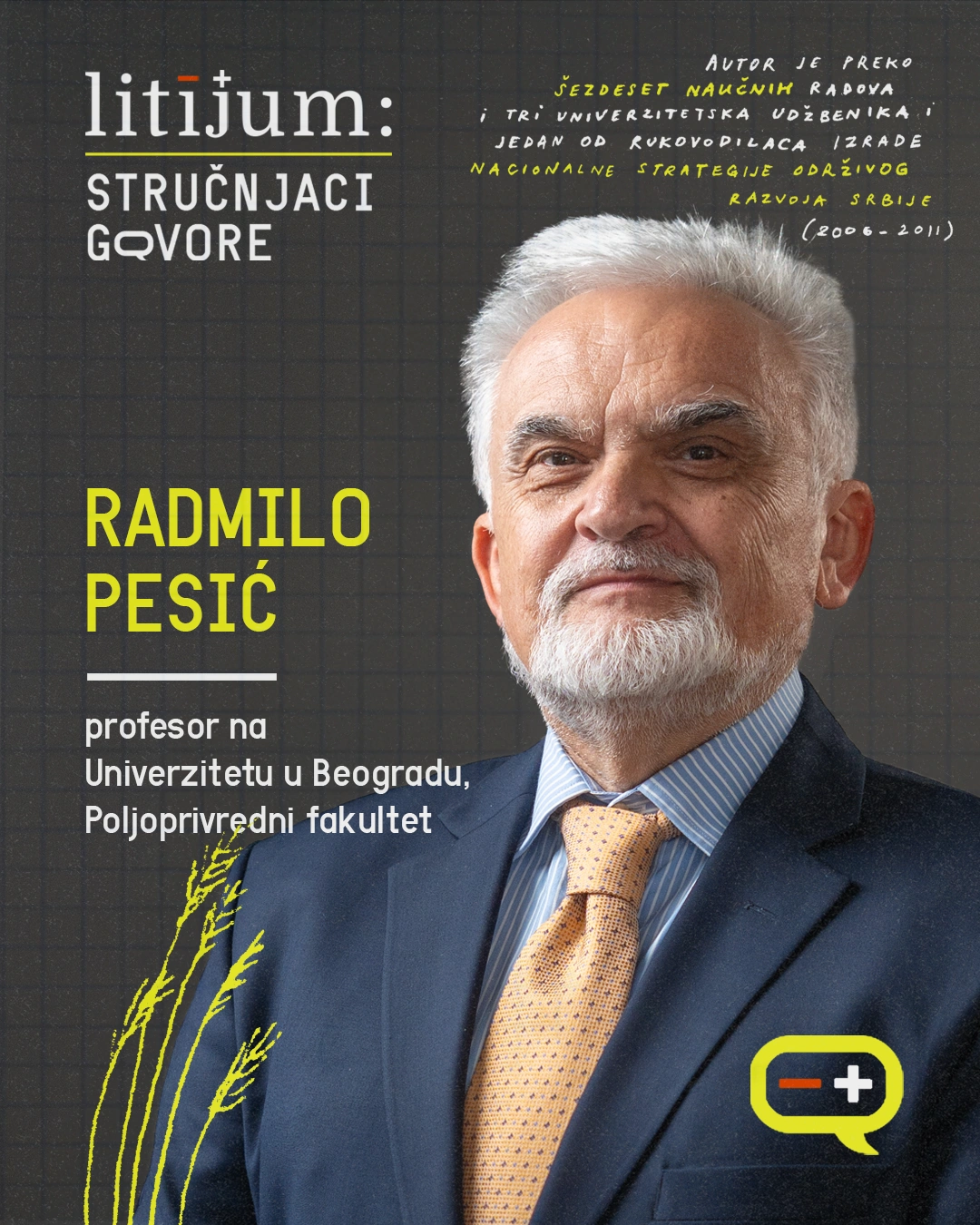
Dr. Radmilo Pešić, Professor at the Faculty of Agriculture, University of Belgrade, and an expert in natural resource economics and environmental issues, discusses the risks of the planned lithium mining in the Jadar Valley. Pešić emphasizes that given the population density, fertile land, and rich biodiversity of the region, lithium mining cannot be conducted in an environmentally acceptable way. He also criticizes the decision-making process in Serbia, noting that public interest is often subordinated to corporate interests, while transparency and public participation are lacking.
Good day to you as well.
I know there were attempts in Portugal to open a mine, but I am not sure how far the process went. That attempt caused a political crisis and led to the government’s collapse. However, the agricultural land in the Jadar Valley is significantly more fertile than that in Portugal.
I don’t think so. I will elaborate on why and how.
Yes, absolutely.
No, I’m not, but I always ask: What, how, and where? I will also elaborate on why. I always approach it with caution.
I don’t think so. I’m just an economist, not a technologist, metallurgist, or mining engineer, but to my knowledge, no one can guarantee that, and the risk is always present.
In short, poorly and non-transparently. Public interest is not respected, and corporate interests dominate. This is evident in legislation and, even more, in practice, through the marginalization of public participation, for example in the new draft laws on environmental impact assessment. Legal expert Sreten Đorđević has written and spoken extensively about this, and I often refer to his arguments regarding the marginalization of public input in these assessments. There is no real dialogue, no proper answers; the public is sidelined, corporate interests are favored, and public interest is not heard or defined. And of course, problems arise. This is not only an agricultural issue. Here we face significant pressure on ecosystems and biodiversity, which also have economic value. Unfortunately, public authorities do not recognize the need to account for this.
I don’t think so. Here’s why: all the measures proposed in certain draft documents, whatever they are called, are meant to protect the environment and the ecosystem. However, at the current lithium price, I don’t think any company, whether Rio Tinto or another, will act against its own interests. The costs of implementing such environmental protections are extremely high. For example, water purification using double reverse osmosis requires energy—it’s expensive. Ion exchangers are costly. Air scrubbers cost money. Drying tailings to deposit them in underground layers from which ore is extracted is very costly. These operational expenses for environmental protection would be immense, and at the current price, it is simply not profitable. Therefore, the environmental measures Rio Tinto claims it will implement are unlikely to be achieved.
Moreover, as my esteemed colleague Boris Begović from the Faculty of Law once paraphrased, mining is feasible in areas with low population density. It’s not just about mineral deposits; population density matters. Siberia, Alaska, large parts of Canada, Australia, Latin America, and the Atacama Desert—yes, there it can be done, because population density is low. In Jadar, population density is much higher, as it is in most of Serbia. That’s the problem: agriculture and local communities are at risk. People are connected to farming—it’s not just a source of material and financial security; it’s the epicenter of social relations in the local community. Losing the people ultimately means losing the territory. History has taught this lesson many times. Yet, in Serbia, lithium mining has been discussed for years without properly considering these issues.
I first learned about the planned mining around 2006–2007, through sensationalist media claiming Serbia had a “magical” mineral, unique and capable of leading us into the future—a sort of Serbian kryptonite tied to the Superman myth. Initially, I didn’t take it seriously. Separating boron and lithium in the mineral requires complex technological processes, as boron is toxic and lithium flammable, both requiring special handling.
The turning point was when the Serbian Academy of Sciences held a scientific conference where experts presented problems we had not been aware of. That sparked my interest from an economic perspective. Later, in 2021, I reviewed a preliminary feasibility study conducted by a consulting agency at the Chamber of Commerce. Their analyses were overly optimistic, and I couldn’t access key data, such as the lithium price assumptions or energy costs. Only after the publication of the draft Environmental Impact Assessment (EIA) did I gain access to substantial technical and technological information.
My conclusion is that the proposed environmental protection measures are likely impossible given the current lithium price and cost structure. Not all elements related to environmental pollution are accounted for—for instance, the sludge generated during reverse osmosis. Professor Zoran Stevanović from the Mining and Geology Faculty explained this well. Additionally, cumulative costs from tailings disposal, transport, and CO₂ emissions during mining and processing are substantial. The project could impose enormous costs on Serbia, especially if Europe introduces cross-border carbon taxes.
The draft EIA is divided into three parts—mining, processing, and waste disposal—but this is one integrated project. Dividing it gives the impression that cumulative impacts are smaller than they are. The processing stage, especially waste disposal, is critical from an environmental perspective.
No. There is a lack of comprehensive consideration of the so-called Gross Ecosystem Product (GEP), which accounts for the value of all goods and services provided by ecosystems. Most of these have no market price, but their value is substantial. Economic theory increasingly recognizes the need to include ecosystem accounts, a practice adopted even by China in recent years. GDP alone does not capture natural capital or societal well-being. Many economic activities increase GDP but decrease welfare, such as large administrative complexes or monuments that are costly to maintain.
Ignoring ecosystem contributions leads to irreversible losses. Ecosystem services like pollination, water purification, and soil fertility are critical. For example, in Vojvodina, a study valued the contribution of pollinators to agriculture. If such services are ignored, agricultural productivity suffers. The same applies to the Jadar Valley. A project should only proceed if the increase in GDP outweighs the decrease in GEP. Otherwise, it should be rejected.
Unfortunately, no. Unfortunately, that element is missing. I said that the public interest is being neglected, that the interests of corporations are being favored, and that is not good. About nine years ago, an interesting book appeared by my colleague Dušan Pavlović from the Faculty of Political Sciences. The book is called “The Money-Wasting Machine: Five Months in the Ministry of Economy.” He served for a time as State Secretary in the Ministry of Economy and had the opportunity to observe firsthand and describe all possible flaws of the current economic development model, which is based on attracting foreign investments and supporting those foreign investors with large subsidies. He described it well and explained the problems that such an economic development model can create. Unfortunately, the book was quickly forgotten; there were no significant discussions. When I first read it, I thought it would generate a huge, major debate. However, the book was very quickly forgotten. At the time, I used to give it to my students to read because I believe it is important, as it points to something that was yet to happen—the crisis of the existing economic development model based on foreign investments, which are attracted with large subsidies, but in return, you only get a small link in the value chain. What foreign corporations bring is just a small link in the value chain. You do not establish a market actor; you only place a part of a large production system, which at a certain point can easily abandon you and your role, especially when the subsidies are depleted or stopped. That is when corporations leave, and that is something that certainly needs to be considered. I fear that this concern is missing here, and the applied model of economic development is, in fact, flawed.
Supporting this point is the fact that, from the highest levels in this country, we very often hear that opening a lithium mine would actually be a major development opportunity for Serbia. Does that claim really have a fundamental and expert economic basis?
I don’t believe so. I simply do not believe it. I think it is an overly optimistic claim, an excessive optimism, or an attempt to at least create some sense of optimism among the public, for which I don’t think there is much justification. Because to truly value what is produced in a mine and through processing of jadarite, high degrees of finalization are required. We simply do not have the conditions for that, to be honest.
I do not believe we will become a major power in the automotive industry or produce electric cars, because some of our closest neighbors are already doing that. So, I fear there is currently no space for that. Especially considering that the global market for electric vehicles is declining. Interest in electric cars is falling in the wealthiest countries. In poorer countries, there is interest in electric vehicles, but, unfortunately, there isn’t enough purchasing power. And that is the problem. So I do not believe we will become a major player. Regarding batteries, they are not only used for cars. I would mention one important function: drones—all types of drones depend on batteries. Currently, these are lithium batteries, which are not particularly ideal, and, as far as I know, experiments are already underway with sodium-ion batteries.
Professor Branislav Grgur from the Faculty of Technology and Metallurgy in Belgrade is an expert on this and has spoken about it on several occasions. Lithium batteries are still used for certain reasons, but it is evident that they are slowly losing their dominant position in the system of power for mobile devices such as drones and cars. So I am not sure that this is the right path for economic prosperity. Producing a battery requires producing electrodes as well. I am not a battery expert, not a technical specialist, but as an economist, I follow the flow of money, and it has told me a lot. The emergence of new materials, especially 2D materials, those materials with atomic thickness, very thin materials like graphene, represents a revolution in material science. Two-dimensional materials will certainly influence electronics production, battery production, and so on.
I recently learned that a few years ago Samsung invested more in researching 2D materials than the entire European Union did in its research. Large companies are reluctant to talk about their R&D spending because it reveals the strategies they will implement in the near future. But Samsung clearly showed the direction. Not just graphene, but the entire family of 2D materials exists, including so-called nanonetworks made from nanomaterials, which are currently a focus of intensive research and large investments. Flexible electrodes and elastic electrodes will likely be revolutionized by these 2D materials, so regarding batteries, I don’t think we can go far or play a leading role like the big countries with highly developed research centers and enormous corporations that can conduct their research.
I believe it is a myth, a populist policy. We used to be car producers; there is tradition and goodwill, but I don’t believe this will happen automatically. First, because the global electric vehicle market is stagnant. Second, as I said, corporations around us are already producing cars. The question is whether there is space for us. So nothing will happen automatically.
Nothing will happen automatically, so I think that the economic development model being offered to us as a path to a better future is deeply flawed. It is justified supposedly by some liberal, neoliberal concept, but it is far from any form of liberalism. If you reward one participant in competitive markets with subsidies and starve others, that has nothing to do with liberalism. It is merely favoring corporate interests over others.
Professor, in our series, we have also heard serious warnings from hydrologists. You just mentioned the potential threat to water sources and reserves in the Jadar valley. What is your view on this? Can lithium mining and water preservation go together, and what is important for our country in the long term?
If you ask me, I am not a hydrologist, civil water engineer, or hydrogeologist, but I do follow water as a natural resource, as an important component of production, including agriculture. I can tell you that globally, there is a near-rule that when the standard of living rises in a country, water demand increases almost twice as fast. The wealthier we are, the more water we need. Interestingly, we need it not only for food and household use but also for public services and all other activities. Agricultural production heavily depends on water, so water is a critical resource. In my opinion, water is the resource of the future. Especially by the end of this century, it will become clear that water is a key resource and must certainly be preserved.
What we have heard so far from Professor Stevanović and especially Professor Vukosavić is that such mining could endanger water reserves that are very important for us. For 2.5 million people in Serbia, these water reserves are crucial. Therefore, extreme caution is necessary regarding water resources. Water is a key resource worldwide. Today, even water markets are being formed. Where there is no water, futures markets are even emerging to address water scarcity. We are talking about fresh, potable water, which is extremely important. Agronomic and agro-technical analyses exist showing the water footprint—the amount of water required to increase production of certain agricultural products. For one kilogram of product, it can be thousands of liters. There are studies showing that the most optimal agricultural production depends on abundant water supply. Meat production is particularly critical. To produce one kilogram of meat, more tons of water are needed, especially for high-yield cattle raised in intensive systems, not on pastures. High-value feed requires much water. So water footprint is vital for agriculture, cities, and our country, which faces water supply issues. Unfortunately, we tend to have short-term memory, usually talking about water scarcity in summer, about air pollution in winter, and neglecting soil contamination, which is also a major problem. Water is a critical resource and must be preserved. In my opinion, water is our key to the future, not lithium in its current form. Perhaps one day, in another form, for other production, lithium may become relevant again, but we should not deplete resources now with high ecological costs, major ecosystem losses, and water risks.
According to Rio Tinto’s studies, water will be purified to almost distilled quality, which is not necessarily good for the environment either. Moreover, with the current lithium price, this is impossible—it is an empty promise. Such technology requires high capital and even higher operating costs. Only if someone provides free energy could it work, but that is a big question. What really threatens water resources are potential accidents—during ore processing, at storage sites, or due to natural events such as floods or erosion. Transportation incidents, especially involving sulfuric acid or explosives, could contaminate and endanger our water resources far more than we realize. Extreme caution is necessary.
We are in a poor situation. According to official data from the Environmental Protection Agency, between 2011 and 2021, Serbia generated an average of 0.5% to 1.3% hazardous waste within the total annual waste, which amounts to around 70 million tons. Hazardous waste is a small portion of this total, so one might think: “It’s not that bad.” However, with hazardous waste, the issue is not quantity but its potential danger and impact on the environment and human health. Hazardous waste can include petrochemical, electrical, electronic, medical, or mining waste. In Serbia, besides official waste streams, there are thousands of illegal dumpsites with all sorts of materials, including hazardous ones. That is what is dangerous. We talk about water scarcity in summer, air pollution in winter, but rarely about soil contamination, which is evident. Illegal dumps still exist and must be addressed. Official data alone do not give us confidence that environmental protection policies are sufficient.
An interesting historical detail: just as the recent study and collection of papers from the Serbian Academy of Sciences sparked interest in lithium mining in the Jadar valley, in 1973 the Serbian Academy of Sciences held a major symposium called “Man and the Environment of Serbia”. The proceedings were published that year. Leading experts contributed, and I recently reviewed this collection. I was struck that many diagnoses of the situation and recommended measures are still relevant today, over 50 years later. It is a sobering realization.
I fear that in many areas, we are stagnating. We talk a lot about green transitions, green jobs, and green transformation, but the terms have inflated, lost meaning and value. For instance, “green transition” and “green economy”—when you examine the entire production cycle, including direct, indirect, and ancillary effects, many green products are not environmentally friendly at all; they can even cause more harm than benefit. One must consider the full production cycle, not just a segment in one country. For example, global biodiesel production may increase costs, cause ecological problems, and raise food prices in producer regions. Even supposedly eco-friendly fuels may release carcinogens like acrolein. The concept of “green” dominates today, but excessive, improper use devalues it.
Another devalued concept is the “independent expert.” Let me explain: if someone signs a contract to work for a corporate project, they are no longer independent—they are part of the project team. They should be identified as such, not as independent experts. I have always acted openly as part of a project team, even as a university professor. Worse, when one is simultaneously on a governmental commission evaluating environmental impact studies, this is a serious conflict of interest. The term “independent expert” has been seriously devalued.
To make it clear, imagine playing a game: you are the captain of a team in the first half, then the referee in the second half—it’s impossible. This is what happens when Rio Tinto claims some “independent experts” are evaluating their projects—they are part of the project team. This breeds mistrust and skepticism, especially when real independent names are removed from documentation. One must be extremely cautious about such claims.
I fear not. I would like the state to succeed, but I doubt it. For example, drying tailings, slurry, and liquid waste requires a lot of gas. I do not know where Rio Tinto will get it or at what cost. Depositing dry waste in underground tunnels is expensive and technically demanding. Groundwater presents additional challenges. I fear we do not have a proper solution. Serbia’s large rivers are illegal dumpsites with all kinds of waste. Forests near cities are full of garbage. Illegal dumps remain unresolved. The number of environmental inspectors is insufficient, a problem NGOs have highlighted for decades. Mining inspectors are even scarcer. Without inspection, no improvement is possible.
Problematic legislation, weak enforcement, and an inefficient judiciary exacerbate the situation. Courts must be more effective and systematic in enforcing rules. Continuous, systematic penalties are more important than the size of the fine—any violator must be sanctioned. Without this, waste management remains a major problem, which is not surprising.
To both: Three things—changes, changes, changes. Specifically, changes to legislation: the Mining Law, the Environmental Impact Assessment Law, and the law on compensation for the use of public goods, which is extremely poor. These laws regulate everything from exploration fees to mineral exploitation, energy usage, road and port fees, hunting fees, agricultural and forest land conversion, and even radio spectrum regulation—all in one law. Usually, regulating everything in one law results in regulating nothing. I advocate reforming these laws and restructuring public administration. We need more inspectors—environmental, mining, water—and a stronger inspection system. Water, as a critical resource, requires more oversight. Agriculture must be protected, and the environment preserved for the future.
Naši gosti, nezavisni stručnjaci iz raznih naučnih oblasti, pružiće stručno i objektivno mišljenje o ovoj temi, koja ima dalekosežne posledice za našu prirodu, buduće generacije i zdravlje.
Naši gosti, nezavisni stručnjaci iz raznih naučnih oblasti, pružiće stručno i objektivno mišljenje o ovoj temi, koja ima dalekosežne posledice za našu prirodu, buduće generacije i zdravlje.
© Copyright 2026. All right reserved