
Professor Dr. Ratko Ristić is a full professor at the Faculty of Forestry, a corresponding member of the Academy of Engineering Sciences, and a licensed engineer specializing in ecological engineering for the protection of soil and water resources.
He has led over 140 projects, including ski resort planning in Serbia, water reservoirs, flood protection, and erosion control. He has published over 100 scientific papers.
From 2020 to 2022, he served as Vice President of the UN’s Scientific and Technological Bureau.
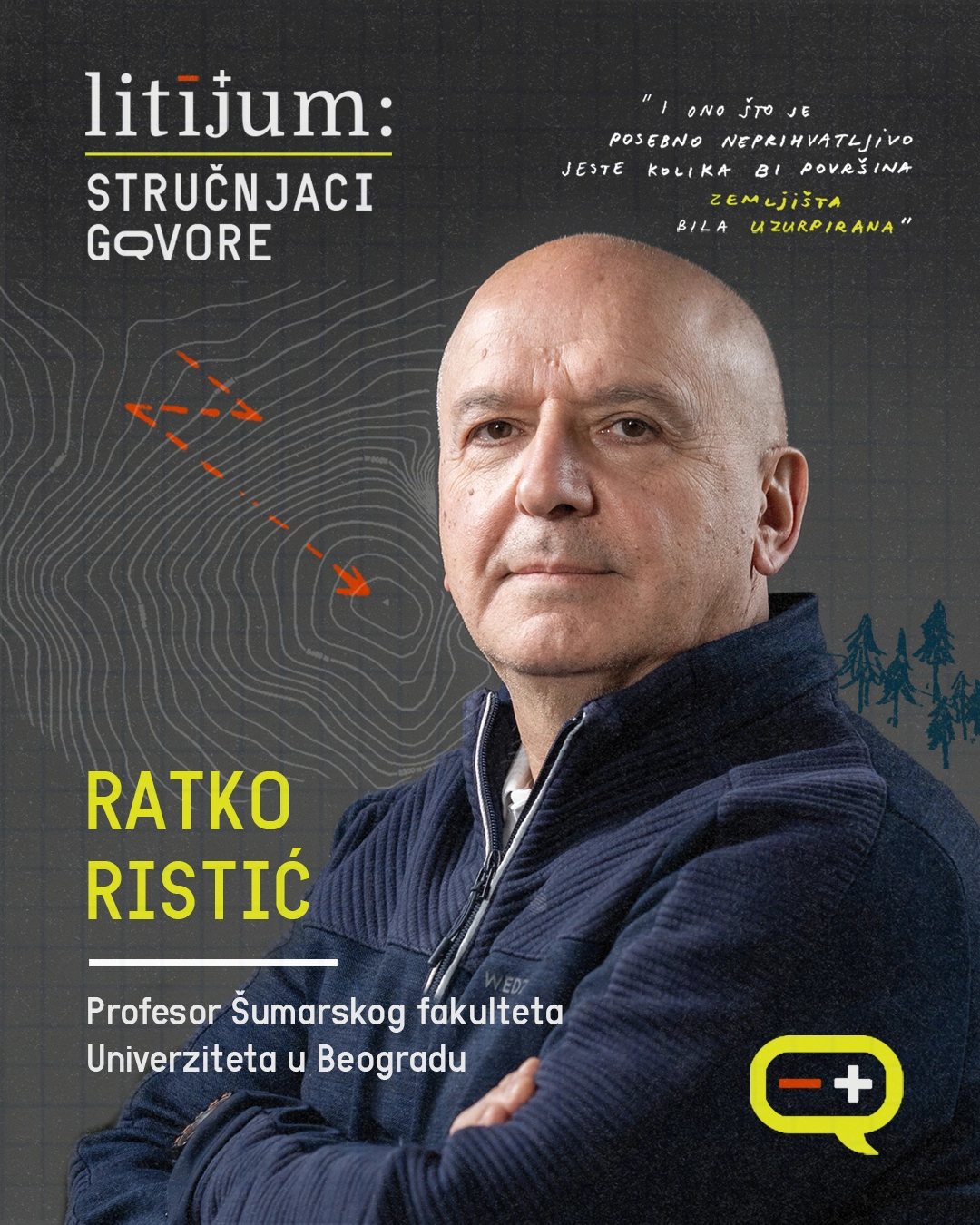
As part of the series Lithium: Experts Speak, Professor at the Faculty of Forestry, University of Belgrade, Dr. Ratko Ristić, issued a number of serious warnings regarding the environmental, health, and societal consequences of potential lithium exploitation in Serbia, especially in the Jadar Valley.
“The only place on the planet where, in the middle of a stable agricultural area inhabited by thousands of people, lithium mining and processing would be carried out, along with the construction of waste disposal sites, would be this case of ours. I hope it never comes to that,” said Ristić.
Good day, thank you for having me.
That case is unknown to me. What I do know is that lithium from land-based reserves is only extracted in deserts or uninhabited regions. I truly am not aware of any instance of this happening in a populated agricultural area.
Judging by all the technical documents published by Rio Tinto so far, independent studies, and the results obtained, I believe it is not possible to conduct mining in the Jadar Valley in an environmentally acceptable way.
Of course, we should preserve natural resources. Regardless of whether we’re talking about present or future generations, any exploitation of natural resources must take public health into account. Resources needed both now and, in the future, and that do not endanger public health, should be extracted with extreme care and solely in the context of national interest.
I don’t think that’s possible. The most vulnerable layers are underground, where large quantities of high-quality groundwater are stored—suitable for drinking water supply. Given that Serbia is already facing a water deficit and is the poorest in the Balkans in that regard, I believe no company should be given the opportunity because none can guarantee the safety of these water reserves.
Of course not. Mining must be sustainable and in the clear public interest; it must not be driven by the profit motives of private foreign mining companies. As a responsible and mature society, we must reach a consensus on which mineral resources we truly need, which we possess, and under what conditions and in what manner we can extract them—without endangering ecosystem stability or public health.
Because I clearly understood what was coming. I’m a professor at the Faculty of Forestry at the University of Belgrade, specializing in ecological engineering for the protection of soil and water resources. Based on my work as a professor, licensed engineer, and researcher, it was immediately evident to me that such a massive project in a stable agricultural region, home to thousands, would lead to serious soil degradation and threaten both surface and groundwater quality. My colleagues from the Faculty of Biology also demonstrated the catastrophic impact on local biodiversity. The social aspect was particularly unacceptable to me: that a private foreign mining company would be granted the right to conduct a relocation plan for the local population. Those were the key reasons why I found this project completely unacceptable from the beginning.
I have read all the technical documents released by Rio Sava, a subsidiary of Rio Tinto. These include their feasibility study, the draft special-purpose spatial plan, the Loznica city spatial plan, and what I call a failed attempt at an Environmental Impact Assessment, which had three parts. When you read these documents carefully and compare them with your own research, it becomes clear that extracting and processing jadarite at the proposed site—using 1,100 tonnes (or 1.1 million liters) of concentrated sulfuric acid daily, destroying the physical soil structure, and producing about 1.2 million tonnes of waste annually—would lead to massive toxic and carcinogenic waste dumps.
These waste dumps would contain large amounts of borates (used to produce boric acid), arsenic, and other substances. As Berkeley chemist Jovan Tadić put it, these would essentially be massive piles of insecticides and rat poison, as boric acid is a base for insecticides and arsenic for rodenticides. Even more alarming is the land area they would occupy.
The company often talks about relatively small areas for waste storage. For example, they mention a waste site in the Štavica stream basin where they’d supposedly place compacted and dehydrated waste “cakes” behind a dam. But different documents give different figures. One says 553 hectares in the Jadar Valley and the Rađevina area near Krupanj would be used. Depending on the document, they plan to mine for 40 to 60 years. That’s between 48 and over 70 million tonnes of toxic waste. Yet, geological analysis shows the Štavica basin could only hold around 130,000 cubic meters—perhaps up to 300,000, which is far less than the required capacity. This means they would have to place waste on flat agricultural land near rivers like the Korenita or Jadar, which is illegal under Serbia’s Water Law and would severely endanger groundwater quality.
Moreover, they’ve already drilled over 500 boreholes, between 300 and 700 meters deep. In some of these, toxic water from different geological layers has surfaced. In those locations, nothing grows, and the company pays farmers compensation for damages. That’s just during the exploration phase. Imagine what would happen during full-scale exploitation.
My colleague Dr. Dragana Đorđević, whom you’ve also interviewed, and I co-authored a paper published in Scientific Reports, the fifth most cited journal in the world. We documented the ecological damage already evident even before mining began. The article has been viewed and downloaded 98,000 times—a remarkable number for a scientific paper. A group of project supporters, unfortunately mostly from the University of Belgrade along with Rio Tinto’s “lead scientist,” attempted to discredit the paper and have it retracted. However, after our well-substantiated response, the editorial board dismissed their complaints, and the article remains published.
We’ve also seen damage outside the Jadar Valley. Near Valjevo, another company conducted a single test drill in the village of Lukavac. It caused groundwater contamination with significantly increased boron levels. Local wells were rendered unusable, livestock died, and crops like blueberries and hazelnuts were lost. Some people reportedly became ill. And that was from one single borehole.
Yes, lithium. After that, thanks to the excellent legal work of attorney Sreten Đorđević, further applied geological research was legally banned in the city of Valjevo.
It’s also worth asking what’s really behind the push to mine lithium in Serbia. When you consult global sources—like the U.S. Geological Survey’s Mineral Commodity report—Serbia ranks 11th globally with 1.2 million tonnes of verified lithium reserves. Bolivia or Chile lead with 25–26 million tonnes. Yet, a current Serbian minister publicly claimed Serbia has 158 million tonnes, which is simply false.
Initially, former Minister Zorana Mihajlović, along with President Vučić, Prime Minister Brnabić, and the rest of the government, promoted the Jadar Project as a major development opportunity. The argument was that Serbia could play a key role in electric vehicle battery production. But today, companies like Northvolt—worth billions of euros—are going bankrupt due to declining demand for lithium-ion batteries and electric cars. Parking lots across Europe are filled with unsold EVs.
Meanwhile, Chinese company CATL has developed sodium-ion batteries with the same energy density as lithium-ion but at a much lower cost and risk. Lithium-ion batteries are prone to spontaneous combustion; Tesla cars in Europe have caught fire. These fires release hydrogen fluoride gas—one battery can contaminate 800,000 cubic meters of air. Inhaling that for ten minutes is likely fatal.
We now also have graphene-based and hydrogen fuel cell technologies. So, it's very hard to understand why our politicians are still framing lithium-ion batteries as a major decarbonization opportunity—when the global market is moving in a completely different direction.
An analysis was conducted on the agricultural potential of the land in the Jadar Valley, assessing its capacity for agricultural production. This was carried out by a group of top experts in the fields of animal husbandry, vegetable and fruit farming, and other agricultural products. With fair support from the state—through quality subsidies, assistance in acquiring agricultural machinery via decent (non-usurious) credit lines—the agricultural production in Jadar could exceed €80 million annually. In contrast, the mining royalties that Rio Tinto, or more precisely Rio Sava, would pay would vary between €7 and €15 million per year, and only if the project is profitable.
So, we are not using our own resources—this land, and the water found in the Jadar Valley and Rađevina. We are not helping people who have been engaged in traditional farming for generations to continue doing so in an improved, more efficient way, which would generate significantly higher income. The area within the proposed mining zone covers approximately 4,800 hectares. If we raised the productivity to European standards, say €15,000 per hectare (some countries like Denmark achieve €25,000–26,000 per hectare), the total income would be substantially higher—especially if we invested in the processing industry. That way, we wouldn't be exporting raw agricultural products, but rather processed ones. From corn alone, over 80 products can be made. We don't have to export raspberries as raw fruit; we can produce jams, concentrates, and juices, or ingredients for the confectionery industry.
If all of this were processed locally, far more people would be employed than in mining, significantly higher income would be generated, and there would be no threats to the ecosystem or public health.
Our colleague Dragana Đorđević presented soil sampling results in the study I mentioned. The concentrations of boron and arsenic were found to exceed the maximum allowed limits and surpass remediation thresholds. What does that mean? There are locations so contaminated that remediation is not possible—they are permanently lost. Once the extraction and processing of lithium begin, what is currently limited to a few sites would spread over much larger areas.
I visited the site of Covas do Barroso in Portugal, in the Monte Alegre region about 100 kilometers from Porto. That area has been designated a globally significant traditional agricultural region. I spoke with the local farmers—they drove out the company, Savannah Resources. The proposed production process was similar to what is planned for Jadar. Interestingly, the Portuguese government fell as a result of this project—it was exposed as extremely corrupt. Portugal involved both its public and secret police; Prime Minister António Costa was detained, several ministers were questioned, and arrests were made. It was clearly established that the project was riddled with corruption, and it has since been halted.
There is talk of a project on the Czech-German border, near the villages of Cínovec and Zinnwald, where lithium would be extracted from existing mine tunnels using magnets. But this has not yet begun.
The active project is in Landau, Upper Rhine. There, lithium is extracted from hot underground waters using ion filters. The concentration is between 200–400 mg per liter—completely harmless to the environment. The extracted heat is used through heat exchangers for greenhouse farming and residential heating. The cooled water is returned underground.
A similar startup-level project is underway in Cornwall, UK, where lithium, rubidium, and cesium are extracted from underground waters using ion filters—again, without chemical processes or land degradation.
Austrian project promoters mention the Wolfsberg project, where lithium would be extracted from spodumene (a hard rock mineral). However, the entire mined volume would be transported by rail to a port and shipped for processing in Saudi Arabia—not in Europe.
Exactly. Both mining and processing are planned, and worst of all, the tailings would remain here. In Australia, on the Greenbushes site (exploited by a Chinese company), the ore is extracted, loaded onto industrial railways, shipped to port, and then sent to China. The processing and waste disposal are done in China—not in Australia.
The largest lithium extraction capacities are in the Atacama Desert, spanning Chile, Bolivia, and Argentina. There, underground brines are pumped to the surface and stored in artificially created, sealed ponds. The sun evaporates the water, and the remaining lithium salts are collected. That’s a desert. But here, they plan to exploit, process, and dump toxic waste in a fertile agricultural region, home to thousands of people. I sincerely hope that never happens.
In addition to contaminating land, surface, and groundwater—and likely the air—vast areas of fertile land would be physically destroyed. One must understand that the natural regeneration rate of soil is 0.1 mm per year. That means it takes 10 years to regenerate 1 mm, 100 years to regenerate 1 cm of soil. Now imagine how many thousands of years it would take to regenerate 30–40 cm of soil, which is a living medium. Soil is the foundation of life.
That is why it is hard to comprehend the calculations of various analysts and economists who talk only about lithium-ion batteries, electric vehicles, and production chains. All of that exists in some abstract "cloud of desires." It is completely unrealistic. Meanwhile, we risk and destroy precious natural resources we already have—and instead of preserving and using them wisely, for our own benefit, some want to hand them over to foreign companies motivated solely by profit.
I would quote Ljilja Bralović, a farmer and poet from the village of Pranjani, who summed it up perfectly: “The time has come to defend the homeland from the state.” Our state has behaved in an extremely hypocritical way. Then-Prime Minister Ana Brnabić claimed the state was not backing the project. And then we saw a government decision to establish a working group for the implementation of the Jadar project.
The head of that working group was then-Minister Zorana Mihajlović, and its members included representatives from nearly every relevant ministry, directors of public enterprises, district officials, and—interestingly—the Second Secretary of the Australian Embassy and the head of the World Bank office in Serbia.
On the European Commission website, there is a registry of lobbying organizations—about ten thousand of them—licensed to advocate on behalf of their interests within the EU. Rio Tinto is listed and is particularly active in lobbying on issues related to critical minerals, batteries, and the green transition. We discovered that Rio Tinto even has the right to lobby during Serbia’s EU accession process.
So, it is the only company that has this very specific lobbying aspect—no one else does. And then you ask yourself: who gave them the right to do that? What did our state commit to that enabled them to act this way? How much is that costing us today? And where is our sovereignty if we are handing over a very important national issue to some foreign mining company? The state has not been transparent—this was even admitted by Vučić himself—who said that the Serbian public, especially people in the Jadar Valley and the Rađevina region, were treated as intellectually inferior. They were treated as an amorphous mass that simply needs to accept and implement what someone on a much higher and more elevated level has decided. So, this is outright hypocrisy.
However, I must, with bitterness, note that we have not experienced anything better from the European Union. You may remember that German Chancellor Scholz visited Serbia and expressed support for this project. This project is also supported by ambassadors from the United States, the United Kingdom, France—they all support it. But what's interesting is that during Scholz’s visit and the signing of the Memorandum of Understanding regarding the implementation of the Critical Raw Materials Act, German media wrote that Serbia was effectively becoming a new mining colony of the West. That was even the front-page headline of Die Presse, the Austrian daily.
You also have statements from German officials saying they support the project—but that such a project would never be possible in Germany, because German laws are extremely strict when it comes to environmental protection and public health. And they say, mind you, that they hope Serbia will, in line with its own legislation, enable the project’s realization while protecting the environment. Scholz himself promised to urge the company to do so. This is a truly disappointing form of hypocrisy. In translation: ‘We support doing in your country what we would never allow in ours.’
I believe this decision was made in violation of the Constitution of the Republic of Serbia. Why do I say that? For a project of this kind to even be discussed, Serbia must first have a national strategy on mineral resources. We do not have that strategy—it was only initiated this year, and it is supposed to be developed by the Faculty of Mining and Geology at the University of Belgrade. Only once that strategy is completed, goes through public consultation, is adopted by the National Assembly, and then proposed for adoption by the government—only then can the National Assembly authorize a ministry to proceed with projects like Jadar.
So, Aleksandar Vučić violated the Constitution. Ana Brnabić violated the Constitution. So did Đedović-Handanović, Zorana Mihajlović—all of them violated the Constitution. They had no right, without this national strategy and without the Assembly’s authorization, to enter into any agreements or arrangements. I believe this is yet another in a series of illegal decisions by our authorities—including this decision by the Ministry of Environmental Protection regarding the scope and content of the EIA study. It is simply another unlawful act.
My message to the citizens of Serbia would be to persist in what they have already understood perfectly well. We must not allow Serbia to become, as Die Presse put it, a mining colony of the West. Unfortunately, our Ministry of Mining and Energy has issued over 200 exploratory permits to private foreign mining companies. These are expensive investigations—costing millions or even hundreds of millions of euros. No one is exploring to simply inform Serbia whether it has certain mineral resources. They’re all doing it to secure exploitation rights and to make a profit. That much is clear.
Now, the question arises: who in their right mind designs a concept where our ministry grants over 200 exploration permits—for gold alone over 80, for copper over 70, for strontium over 50, lithium and boron, and so on. If even every third or fourth project were realized, it would mean opening dozens of new mines across Serbia.
And unfortunately, this is what’s envisioned in the draft spatial plan of the Republic of Serbia, which, for reasons unknown, has still not been adopted. People have recognized the enormous risk this presents—one that cannot be justified by any supposed economic benefits—because it fundamentally threatens ecosystem stability, the health of our population, and overall reduces the chances of our survival as a healthy community in this region. People were rightly alarmed and expressed their dissatisfaction through protests held, I believe, in almost every city in Serbia. My message is: keep protesting and don’t allow these projects to be implemented.
As for the academic community, I would like to express my deepest respect for the people who have dedicated their knowledge, their integrity, and their personal courage to inform the public of Serbia—primarily because of their own moral imperative. I truly thank them and give them my full support. I’d like to mention my dear colleague Dragana Đorđević, Ljiljana Tomović, the late academician and biologist Vladimir Stevanović, Bogdan Šolaja, the outstanding hydraulic engineer Veljko Dimitrijević, hydrogeologist Zoran Stevanović, academician and chemist Nenad Kostić—and I apologize to all those I can’t recall at the moment due to lack of time—they all have my full support to continue their work.
At the same time, I would ask all those conformists, small self-serving individuals who work at universities, faculties, and institutes, to step out of their comfort zone, to stop playing it safe and looking out only for their own interests. They work in academia not to feel comfortable, but to help improve the wellbeing of their people and their country.
It is their moral duty to speak up. I know many people who are highly knowledgeable but refuse to go public. Yet, in private, at cafes or informal gatherings, they fully support those of us who have spoken out. Well, let them speak up too. If we can create a critical mass of people willing to say what they know, then things will begin to normalize in public discourse. A culture of respect for the public interest—for all of us—will be established.
It will then become crystal clear that no partial interest of a private foreign mining company or any internal lobby group can outweigh the needs and interests of the majority. If we reach that level of public awareness, I believe we’ll be able to resolve all of today’s challenges—those that now pose a real threat to the survival of our society.
Let me mention one more amazing person: Dušan Stanojević, a doctor and gynecologist, former director of the Gynecology and Obstetrics Clinic “Narodni front.” At one gathering, he spoke spontaneously and said something profoundly true: “The meaning of development in any society is to create harmonious and stable conditions for the renewal of life—that is, for the birth of as many children as possible.” I think that’s the essence.
Thank you as well.
Naši gosti, nezavisni stručnjaci iz raznih naučnih oblasti, pružiće stručno i objektivno mišljenje o ovoj temi, koja ima dalekosežne posledice za našu prirodu, buduće generacije i zdravlje.
Naši gosti, nezavisni stručnjaci iz raznih naučnih oblasti, pružiće stručno i objektivno mišljenje o ovoj temi, koja ima dalekosežne posledice za našu prirodu, buduće generacije i zdravlje.
© Copyright 2026. All right reserved