
Prof. Dr. Imre Krizmanić, Associate Professor, Faculty of Biology, University of Belgrade.
He finished elementary school, Master's and doctoral studies in biology at the universities of Novi Sad and Belgrade.
He began his professional career as a teacher in elementary schools, and then worked as an expert associate and a pustos at the Institute for Nature Conservation of Serbia.
Since 2001, he has been teaching at the Faculty of Biology, University of Belgrade, at the Department of Morphology, Systematics and Phylogeny of Animals.
He is also active in the academic community as a member of the board of the Serbian Academy of Sciences and Arts, and an associate of Matica Srpska.
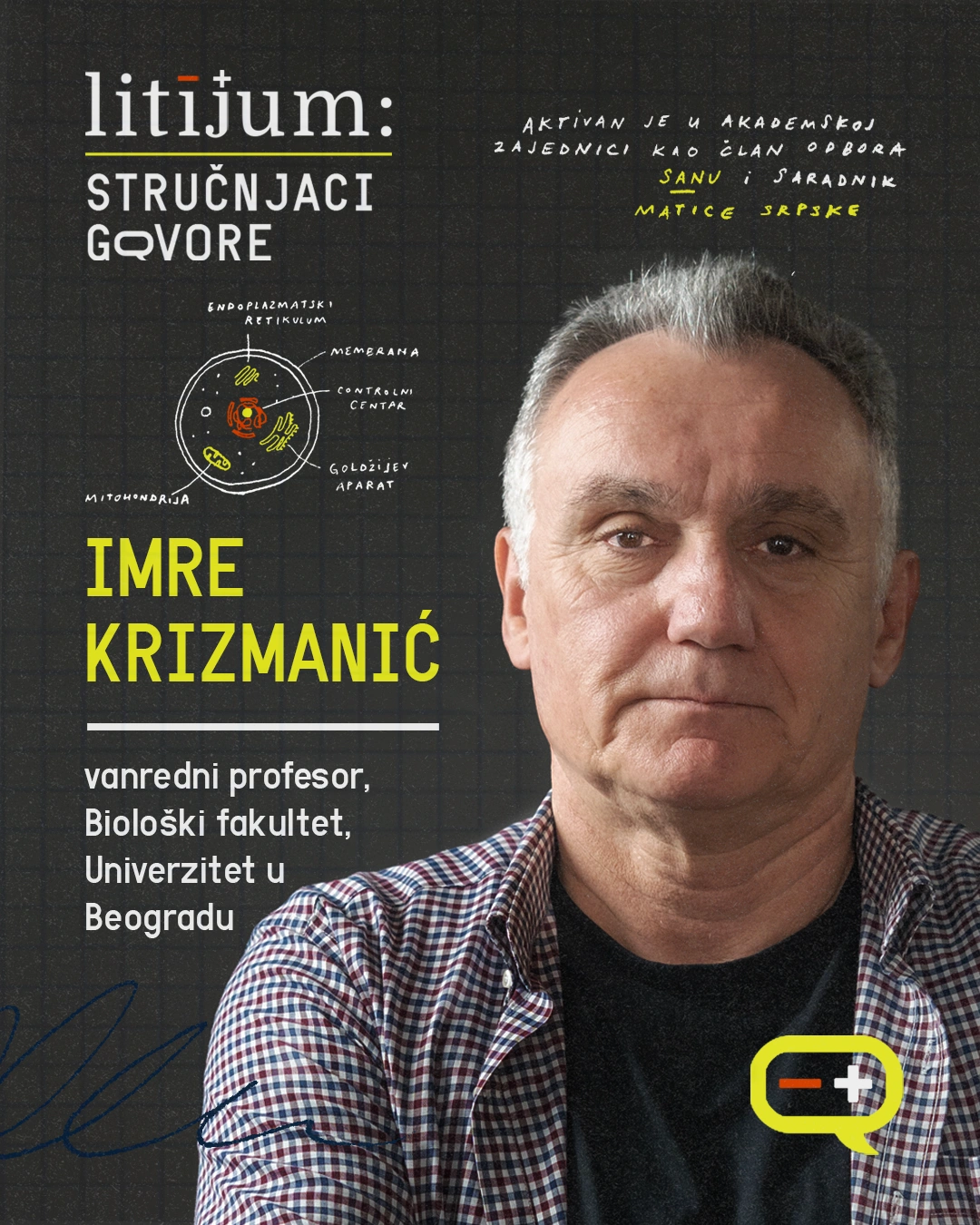
In the show “Lithium: Experts Speak” we talk to Professor Imre Krizmanić about the ecological and social aspects of the planned lithium exploitation in the Jadar Valley. Professor Krizmanić emphasizes how fertile land is a precious resource that is difficult to renew and warns of the potential risks of mining to nature and biodiversity. In the interview, he discusses concepts such as “ecologically acceptable” and “sustainable” mining, as well as the moral obligation to leave healthy land and water for future generations.
According to my knowledge and analysis of lithium exploration and mining in the world, there has never been a case where lithium mining is planned, let alone carried out, in such a fertile valley. This is not entirely surprising, because all responsible and smart countries that think about their future have realized that fertile land is the most important resource they currently have, because according to world research, it has been observed that there has been a huge loss of fertile land on the entire planet, to the point that it is believed that if the use of artificial fertilizers were to be stopped now, food could be produced in the next period for only 40% of the population on planet Earth. All responsible countries then think about it and try to save their fertile land. We know that fertile land is very difficult and slow to regenerate. Is it possible to carry out lithium exploitation in the core in an environmentally friendly way? I have a big problem with that name, with that term. Ecology is a biological discipline that studies the mutual influences of living beings and living beings with the environment in which they live. It cannot be related to mining in any way. I would like the gentleman who coined the term to explain what he meant by that. And even the term sustainable mining is also very problematic, sustainable in relation to what? In relation to human society, mining can have both positive and negative effects. Most often it has both. When it comes to nature, mining has exclusively and only negative impacts. There is not a single mining that has contributed to the improvement of natural conditions. And if I have to give a concrete answer to this question, then I will use a thought from one of our greatest thinkers of all time, Mahatma Gandhi, who said that the earth provides enough to satisfy everyone's need, but not everyone's greed. I think that has been said quite enough.
Well, I will take this as a rhetorical question. I cannot imagine a conscious homo sapiens who would answer me no to that question. We are obliged to leave to our future generations all that we received from the previous ones. Our species has been here for 300,000 years and we are not the longest of our species in our lineage. We have ancestors who have been here for a million and a half years and more, so they did not leave such a problematic nature as we are leaving for ourselves and for future generations. So the answer to your question is, of course, that we must not destroy nature for our future generations.
No, no. No one rational and realistic can be. Archaeological findings indicate that for 40,000 years, mining has actually been the driver of civilizational progress on the one hand, and that is an undeniable fact. Another undeniable fact is that mining is also one of the main causes of global nature degradation on a planetary scale. So, our main task is to create a balance between these two things, and that is essentially what we come to when we think about the JADAR project.
Well, I have not yet met a single company that has not guaranteed this, but in words. They are always full of praise for their projects, and they guarantee that from now on everything will remain clean. However, I would just recommend that, while they are saying that, go to some of the world's insurance companies and have them insure their project. It would be very interesting to see how much the insurance company would charge for such dangerous projects, such as the future mine, or rather the planned mine.
In order to answer this question correctly, we would have to shed light on two aspects. But first, I will start with why Jadar is extremely important compared to perhaps some other areas in Serbia. We are witnesses to the fact that human civilization is rapidly destroying the nature around it, not realizing that it is essentially cutting down the branch on which it is sitting. The goal of biologists and all those who deal with the problems of nature destruction and its impact on human society is to establish a balance between nature and human civilization, or between the natural world and the Anthropocene, the modern era in which we live. In what sense? We live in areas that we have taken over from former nature. In some places, I will now mention, for example, New Belgrade. 150 years ago, New Belgrade was a swamp, where biodiversity was 100%. So, everything was in accordance with natural laws. Today, when we look at the same area, biodiversity is 5%. So, we have lost 95% of biodiversity. There were certain reasons for this to happen; people have to live somewhere. If we do this in places where there is no need for it, then we are making a big mistake. To continue the story, in Jadar, or rather in that part of Podrinje, what is happening is that humans live in harmony with nature. When you look at that area, you actually see a mosaic or mosaic arrangement of different ecosystems. These are mostly anthropogenic, or human, modified ecosystems. However, there are also groves, streams, valleys, and so on. And it may happen to you that on a cloudy, fresh spring morning you open the door to your house in Rađevina and find a striped salamander 100 meters away or on your doorstep. Or you go 100 meters to the stream and find a skunk. Neither the striped salamander nor the skunk is particularly sociable creatures. They do not like many habitats close to humans, but they have learned through centuries and centuries of living alongside humans that they do not have to be afraid of humans, because humans have learned that these animals, this nature, actually benefits them. That slime will be eaten by rodents that destroy his harvest, that destroy his products, and of course we will aim to use as few chemicals as possible if he can get the same from nature. I have just given a trivial example, but in that example, we can actually see what human coexistence with nature means. And that is what we are trying to maintain. The Jadar project, no matter how fabulously it is conceived and presented, will not do that.
Our study of the final report on the state of biodiversity in the Jadar area was conducted in 2020 in the summer months of June and July, for only six days, that is how much we were given to research. The Faculty of Biology, in cooperation with four other renowned research organizations in Serbia, such as the Institute for Biological Research Siniša Stanković, the Institute for Multidisciplinary Research, the Natural History Museum and the Faculty of Science in Niš. So, over 20 researchers worked for six days, reaching certain conclusions about the state of nature. We compiled a completed report, within which we also had to analyze the threatening factors. The processes that will occur during the operation of the mine will lead to the destruction of nature and we were obliged to propose measures for remediation and environmental protection. What should be emphasized here is that we did this on an area prescribed by the spatial plan of the special purpose area JADAR, on almost 30 thousand hectares. I emphasize this because it is stated in the Official Gazette in issue 26, 2020. Because both Rio Tinto and many other experts are dealing with completely wrong, deliberately distorted values of the areas to which the impact of the mine will apply, because when you reduce the area, then you will also reduce its impact. We may have time to come back to that a little later when we analyze what today, unfortunately, state institutions and how they distort the facts. As for our report, the report actually showed that in the entire area, during all phases of the mine's operation, and this is very important to emphasize, because today we have a state-supported distortion of facts, in a way, falsification of data, which allows Rio Tinto to divide its problematic project into three parts, thereby reducing its impact and ultimately leading to the fact that you will have three projects that are not unique, but in fact together have their own cumulative and synergistic effect. What they are doing is not a fish pate factory. Well, you have, you catch fish and go to the sea or the river, you catch fish and you have negative impacts on nature. Then, when you have transferred the fish to the factory, the impacts of fishing stop, the impacts of processing the fish into pate begin. Then, when we eat pate at home, then we throw the can in a plastic bag and throw it in the landfill, that is the third type of impact. These three impacts are not interconnected, but mining, or rather extracting ore from a mine, you will not extract it if you do not process it. If you process ore, you must first extract it, and then you have waste to dispose of. So, these are closely related processes that Rio Tinto is now trying, with very good intentions and permits from the state, from the Ministry of Primary Industries and the Institute for Nature Protection, to present as three independent projects that will not have anywhere near as disastrous impacts as they do when they are the only, so to speak, projects. However, Jadar is not the only one with such a problem. We have a large number of mining activities on the territory of Serbia, and I will mention only the most disastrous one, which, of course, we have had before us for more than 100 years, which is the Bor-Majdanpek basin. It is now expanding. After all, you cannot even get close to it. That area is inaccessible to you. And what about the area of research or obtaining any information about what is happening there? So, we have terribly big problems in that our entire country, or rather nature, is slowly turning into one interconnected mining area, or rather the opening of mines, and on the other hand the leaving of tailings, or mining waste. Mining, by the way, generally looks at nature only from two aspects. On the one hand, where are the raw materials that it can extract and process and make a profit. And on the other hand, it looks at nature as a place where it can hide its waste. If possible, in the cheapest way possible and to pick it up and go away and then leave the people who live there with a problem forever.
The analysis of the threatening factors, which are extremely, extremely enormous and can have multiple sides, are related to all the aspects that this mine will have from its very beginning. At the very beginning of the mine opening, there is a multi-year aspect of site preparation. This process alone, this phase, will lead, when it comes to nature, especially the above-ground part of nature, to irreversible damage. That is why we can talk about two types of impacts. One type is those impacts that can be repaired with some procedures, to some extent and in some time. The problem with these reversible impacts is that they cost a lot of money. And mining companies usually try to avoid this. That is why we have the kind of layouts that we have visible to the naked eye. The second type of impact that is much more problematic are the so-called irreversible impacts, or irreversible impacts. These are impacts after which no matter what you do, no matter how much money you spend, you can no longer restore the nature that was there, and when you analyze the percentage of the area that will be occupied by irreversible impacts, it very often does not show you the real impact of these consequences. I will give you an example. When you build a road, a railway, lay a water pipe, a long water pipe, all that is currently being done in that area, so these are preparatory works, not a single shovel has been buried in the ground yet, you have already damaged and destroyed the natural values and habitats in the entire area where these impacts occur, so where the road passes, where the railway passes, long water pipes and so on. Why? Because you first cut off the migratory routes of all the animals that live there. All the animals that remained on the left side of the road and on the right side of the road, they can no longer communicate. It can happen that you have cut off the communication routes to the place where they branch off. If you do that, you don't have to kill those animals now, right now. Those animals will not be able to leave offspring and in 7-10 years you will have literally destroyed nature, because those animals that do not branch off do not leave fertile offspring and simply, when their life cycle comes to an end, they die and those species are no longer there. That's one way. The other way is, these are long-term processes, we all know, for example, here in the Sava and Danube there are fish living. Fish can withstand water temperatures from, say, 3-4 degrees to some 30 or maybe more degrees of water that warms up during the season. However, during the spawning period, they can spawn in only one narrow temperature range between, say, if it's pike, between 15 and 16 degrees or 18 degrees, and when it's carp fish, between 22 degrees. If during that period, and these are the spring months now, you change the water temperature, you won't kill those fish, those females and males, but they won't be able to have offspring, there won't be any offspring and again in a few years you will simply lose the fish stock in those rivers. That's what is mostly far from the public eye and we only react to those disasters when someone spills, I don't know, a truckload of toxic material into the stream and all the fish turn over and then we see it. These long-term consequences that you just asked about are incomparable, incomparably serious and they are in fact the basis on which we claim that such projects will at least be underground, and Rio Tinto is very fond of saying that precisely because they will be underground, they will not have any consequences. They will. You have to keep in mind that when those two shafts that they are planning are opened, 4 tons of explosives will be introduced into the depths of the earth every day, 365 days a year, for 60 years, and that is much more dangerous than the explosives that the military uses, because that explosive is basically the highest range of ammonium nitrate, over 90 and a bit percent, but there is also diesel in it, about 6 percent. When you detonate such a mixture of explosives, 4 tons of it every day, underground, you will get ore, but you will also get a terrible number of gases and dust. In those gases there will be carbon dioxide, carbon monoxide, there will be nitrogen compounds and a terrible amount of dust. Of course, people are working down there. You have to evacuate it from those spaces through those ventilation pipes, it will reach some evaporation, or rather, places where that air will be cleaned, but a large amount of dust will still come out. It will mix with the dust that you will get from other parts of the mine that are in the area. Trucks will come there, trains will go there, so there will be dust from crushing the ore and so on from that whole process. When that dust rises and is spread by the winds, scattered, it will fall to the ground somewhere. For years, tens of years, that dust mixed with atmospheric deposits, with rain and snow will create chemical compounds. Those chemical compounds will penetrate the ground. Plants will extract those toxic substances from the ground with their root system to their bodies, to their leaves. Herbivorous animals will use that, or vegetable crops, wheat, corn, which these people will try to sell, will be grown there. When someone asks them where they got their potatoes, they will say from Radjevina. People will not buy those products and in ten years you will have a quiet exodus from that area, or they simply will not be able to economically withstand that pressure. And therefore, the ecological consequences are not only ecological consequences that are reflected only on nature, but they also inevitably have their impact on humans. We can talk about ecology and changes in living systems for hundreds of hours. It is a very complex system and if there is time, I would also address the problem that we all use, so to speak, the term biodiversity in everyday speech, but we hardly know what it actually means. And if we were to look at what biodiversity itself is and its concept on the planet in the simplest way, biodiversity actually represents the diversity of all the different genes in all individuals, in all species on the planet that live in their ecosystems from the beginning of life on the planet 3 billion years ago to the present day. So, it is not just a simple number of species of animals, plants, microorganisms and fungi, but their inextricable tangle of mutual influences, but also the habitats in which they live, because they do not live by chance. A cactus cannot live in the Danube, and a carp cannot live in the Sahara. Precisely because it is adapted to these specific environmental conditions, we like to say habitats, and if I like the expression the most, the framework of life. Every living being has its own framework of life from which it cannot escape. If you change these frameworks, a little earlier we talked about the temperature of the water, you will simply destroy it sooner or later. So, the biodiversity that we established by analyzing nature in the wild, showed me that this very coexistence of man and nature is at such a level that even we, the experts, were surprised. In six days, a team of over 20 researchers determined that over 250 strictly protected and protected species of plants, animals and habitats live in that area. Over 250. Of that, only plants and habitats, over 60% are protected by either national or international laws and conventions. The problem is even greater with animals, because they depend on many other factors. Of all analyzed vertebrate groups and invertebrates, we found that over 90% of all species are strictly protected and protected by national and international conventions. To make it even more disastrous, more disastrous for Rio Tinto, our dear colleague, academician Marjan Niketić, a botanist, also discovered a new type of flora for Serbia in that area. In the 21st century, finding a new species is really a great feat, but the most terrifying thing is that he found it exactly at the place where Rio Tinto plans to build a landfill for its waste of horseradish, and that landfill is planned to be built in such a way, such a terrible way. Although fellow miners brag that this will be a unique case in Serbia, I am very scared because for the first time, millions of tons of the most toxic waste will be deposited in that place, they say, in dry cakes, on plastic foil the thickness of Lidl bags. So, take a bag from Lidl, put it down, of course it's a special foil. They say that it will be one foil there forever. However, since their estimate is that the mine will last 60 years, when we called the manufacturer of those foils, he said that they are not completely sure, but they can guarantee that the life of their foils is up to 40 years. So, they will put poisons on that film for 40 years, and they will continue until 60 years, regardless of the fact that 20 years ago that film stopped working. Of course, when they close the gates of their mine and leave, they will take only money, that is, profit, and we and our descendants will forever be left with millions of tons of the worst waste we can imagine. That fact alone says enough that a project like this must not be implemented. When we analyzed everything, we are talking about in that final report, we had to propose measures. We proposed a large number of measures. Of course, there are measures that are easy to implement, or easier to implement. These are the measures that can influence these reversible processes. However, when we saw the problem with reversible changes, where the measures are of very limited capacity, of very limited duration, we have understood that the only basic measure that we can propose is to abandon this project. Because of all the possible consequences that could happen, that could happen, none of us say that it will happen, but by analyzing what has been presented, and what we have determined, everything that could happen, in the Drina, first in the headwaters, then in the Drina, then in the Sava and in the tributaries, this project must be abandoned. The price that we can pay is too high, how would I say, in relation to what the very, let me say, debatable gain will be. I would probably not discuss that. What worries me most, as a biologist, is that I have not seen anywhere a true assessment of the economic benefits that Rio Tinto would have done, because I cannot believe that such a company, and a company, a global company, for 150 years has been destroying miners under duress, that they do not have a precise analysis of their economic benefits, but they have not published it anywhere yet. Just as they have not published a truly real technology on which they will work. They do not even have projects for the rehabilitation of the mine, which they have to do before anything, and so on and so on, so as not to import it into the issue of legal analysis now, that is a separate story. There is something else that I found interesting from the work you are talking about, and that is that in the work you mentioned 6 general and 15 specific negative impacts that would arise from the implementation of the JADAR project.
Well, we have already partly talked about that, so each such project has several phases that are connected. First, we have the phase of the beginning of the works, when the terrain is being prepared. In that, let's say, we talked about it, in that preparatory period, in fact, the majority of the initial phases of the destruction of nature will be done, and that is the destruction, that is, the destruction of habitats. Some habitats will be completely destroyed. If you look at the special purpose spatial plan that is supposed to describe all possible aspects of such a mine, of course, it did not do that, and that spatial plan was not well done either. Regardless of the fact that it was first abolished, then reinstated, reinstated exactly as it was, that is, insufficient, undeveloped and without adequate data on what the mine will mean. First and foremost, there will be massive destruction of habitats. Rio Tinto defends itself by saying that it will be an underground mine. Yes, it will be an underground mine, but you cannot do an underground mine or build an underground mine without causing great damage to a large area. Not only by concreted over one hectare of land. That is only part of it. The second part is that you will destroy the natural streams, again to go back to the railways, roads, etc. That's while you're preparing. Then the next part is when the exploitation of the ore and the mines begins. We talked about that too. You drop four tons of explosives down, you detonate it, then you extract that ore from it, you grind the ore, you pour it, they really like to say not 250, but 90 degrees, heated sulfuric acid, as if it's really fine there. Try it with sulfuric acid at 0 degrees, drop it on your skin and you'll see what the result is. So, it's a complete reversal of the thesis. Of course, 250 is worse than 90, but that doesn't mean it's 90. There you will get another type of threatening factors, which will be in completely unknown quantities for now, because you don't have a methodology with which they will work. They say that it's a completely new methodology. I'll have to stop here for a moment and make a digression. Rio Tinto, as a company that has been mining and exploring for 150 years, has never processed lithium anywhere. Last year, they bought a company that does it, but Rio Tinto itself has never done it. And one thing is, in addition to the fact that we lied to our people that we have the largest lithium reserves in the world. Even by European standards, we are only third, but regardless of that, the way in which this ore is processed has never been done before. No one in the world has ever processed jadarite, not Rio Tinto, nor any other mining company, which leads to a devastating realization that, of course, the people and inhabitants of Rađevina, but also all of us in that area, and I'm also looking at the inhabitants across the Drina, are really an experiment in vivo. We are a live experiment. No one has done it before, they don't know exactly what the consequences will be, and they will do it here. I will now paraphrase, and I will have to refer to it, that last year, when the Rio Tinto company visited Ljubova, or Rađevina, their executive director stated that when they make a mistake, meaning when Rio Tinto makes a mistake, they will learn from it and will not repeat that mistake. And I will repeat, he did not say if we make a mistake, he said when. The man knows very well what he is talking about. When do we make a mistake? And I'll paraphrase a dear colleague of mine, who gave a phenomenal explanation of what it looks like. So, if I go for brain surgery with a surgeon who says, 'Look friend, I'm going to operate on you now', I've never operated on a brain, but I'm going to operate on you now, and if I make a mistake, don't worry, I'll learn from that mistake and I won't repeat it again. Yes, but I was operated on incorrectly. So, to say such a sentence, in my opinion, is unacceptable. And that alone shows me what kind of mindset the people who run such a company have. It's nothing new. That company has a decades-long, terribly problematic history. Let's not dwell on that, and therefore, their hiding of data that is now in effect, that was also the case when we were involved. We were not allowed to go everywhere we wanted and where we needed to investigate, that was a special story. Of course, that was not done by Rio Tinto, that is, Rio Sava, their daughter company, but they have an intermediary towards us, who washes his hands and says, I don't know anything, I just have to drive you, and then I don't know where they drive us and so on. So, In that sense, all the threatening factors, to return now to your question, are to that extent visible on the one hand and we can assess them. But you have a huge foggy cloud in which all these threatening factors are that we do not yet know which ones they will be, because we do not know exactly by what methodology, by what principles, by what technique and at what speed of time they will do it. All of that has its own extremely, extremely strong impacts on the destruction of nature. We cannot even assume that now. We said, when all of that was discussed, but you should have done monitoring a long time ago, and we have a project for that. Before you start, you have to go to the field and accurately measure all the parameters of that nature. Because they say, nothing will happen, everything will be wonderful and wonderful. After us, they say it pleasantly, there will be a botanical garden here and the water that we will release after our projects. It will be cleaner than distilled water. It will be so clean that, before we release the recipients, we will have to make it a little dirty. Add a little salt to it, because probably, if they release that clean water into the Jad and Drina, these leeches will probably migrate, because they will be surprised at how clean the water they received will be. Of course, those are simply nice words. When I was talking to the managers of Rio Tinto, I said: 'I assume that what you are saying is supported by your analyses and studies that our certain state-owned companies have done.' Because you probably won't say if that is not the case. And where are those studies and where are those reports? Have you seen any of those studies? Where are they?
Well, at Rio Tinto. Rio Tinto is hiding them. He says it's a secret. Now I wonder, if you tell me that there will be a botanical garden and distilled water there, you confirm that with the studies that you have. Show those studies so everyone can see, so they can believe what you're saying. No, he's hiding it. So, I'm perfectly allowed to deeply doubt the accuracy of those studies. So, we are, the Faculty of Biology is the only state institution that has publicly published its report. So, everyone can get it, everyone can read it. After all, they've been reading our report for five years. The best-paid experts from Rio Tinto in London and Australia have failed to find a single flaw in our report. For five years, no one has questioned a single line in that report, which simply shows that we did what we did and presented our evidence in a scientifically, professionally, and responsibly manner. You have nothing to say against that. So why are you hiding studies that, in your opinion, confirm the exceptional importance and value of your project, which will lead to you leaving nature in a completely pure state? What is key in your work, professor? What would you single out? So, we've covered a few parts of your work so far, but what would you summarize? What would be the most important thing you need to say to our viewers? What would it be? I mentioned a moment ago, maybe it didn't stand out that well. Our final conclusion, or rather, it is a summary of all the conclusions we came to during the analysis. Numerous structures and groups of living beings were analyzed there. So, from habitats to flora, or invertebrate plants, various, aquatic, terrestrial. Then fish, amphibians, reptiles, mammals. And I said, so, a huge percentage of all those species are strictly protected and protected. And when you look at all those tables, all those graphs, they are hundreds of pages. All the analyses indicated that the biggest problem will be the destruction of habitats, the pollution of those habitats, without accidents. So, I repeat, we did not say for a moment that Rio Tinto would break its dam, that any accident would happen, although it is a completely fairy tale scenario to imagine something like that. Because there is not a single mining facility so far where there have been no accidents. Well, Rio Tinto can't do that for nothing, telling all sorts of fairy tales about the latest technologies that they will work on. Not to mention that they are planning their lakes, which will be full of wastewater, in the very places where you have seen and now there are major floods and so on. So, literally the way in which they... I simply cannot even imagine that they themselves really believe that such a situation can happen that they have been working for 60 years and that no accident has happened. Not to mention that there are also some engineering postulates according to which they can assess themselves if they need to release some untreated water. So, you can ask the engineers, I have only heard from my colleagues about such a, in my opinion, terrible situation that they can, if they assess that there is a problem, that some malfunction will occur, they can open the water pipe themselves, to release untreated water, for example, into the drains. The basic measure, looking at the number of irreversible consequences in the entire area, meaning not only in the area where buildings are planned, where shafts are planned, where waste is planned to be left, but in the entire area, and we are talking about the area from the Drina River almost all the way to the area towards Valjevo. Not to mention, from Loznica and to the north, meaning those almost 30,000 ha. It will be endangered by so many threatening factors, that, according to the precautionary principle, if you assume such significant changes, negative changes in nature, that any measure you can think of cannot prevent long-term and very widespread pollution, because let's not forget, rivers flow downstream. If we pollute the Jadar, we have all of that in Belgrade in a few days. And they started to protest a lot, like, how do we say it will be? Well, as far as I know, every river flows downstream. And that is simply a fact. We have evidence so many times how rivers were destroyed, and not only very long ago, in recent history. So, the basic measure to prevent possible consequences is to abandon the Jadar project. And that is a global conclusion. For anyone who is interested individually, there are hundreds and dozens of factors involved, as well as our analyses, what they will do to frogs, fish, plants in particular. So, all of that was calculated and, in the end,, we adopted hundreds of measures. When we looked at those measures, each measure can only slightly and only briefly improve something, but it can never prevent it. And when we understood all of that, we realized that we simply could not give a positive report and conclusion, and we proposed, for the good of all of us, that the project be abandoned. I still say, the Biology Faculties of our organization cannot force anyone to implement that measure. Ours is only to propose. State authorities are the ones who should implement those measures. And now I will return to one, unfortunately, very bad example of how state institutions, by playing by the laws, play into Rio Tinto's hands. In August last year, Rio Tinto submitted a request to the Nature Protection Institute for issuing nature protection conditions. Until February this year, we had no insight at all into what measures the Institute had adopted. Rio Tinto. And then the documents were simplified in which it became clear that the experts working at the Institute, I must say, I worked at the Institute for many years and I know that there are many young and not so young colleagues who work there extremely professionally and expertly, but they are exceptional experts in their fields. And we were often surprised how such reports from the Institute appeared in the public. And then we learned that the heads of the Basic Departments at the Institute, biodiversity, geodiversity and so on, gave a negative position on the issue of Rio Tinto. And since according to the structure, each head submits his reports to the director, the then director of the Institute. She simply ignored those reports and compiled her own, her own report and decision on the conditions of nature. I must mention that Mrs. General is not an expert in the field, nor does she have the right to do such a thing and in fact she issued a forgery. That forgery enabled Rio Tinto to obtain a decision on the scope and content of the environmental impact study. And the environmental impact study is the final act. When they receive that, then it's over. Then, in essence, they have the right to mine. What's worse, Rio Tinto brought out three magical drafts in July last year. So, three documents that mean nothing, which themselves said that what they wrote there does not oblige anyone. That does not have to be true, nor can any organization take anything from it as a binding. So, they completely distanced themselves as if it was nothing important. And it is not, in fact, important, but when we asked ourselves why they actually did it, we realized that they issued three drafts. They distributed three drafts, I'm going back to that story again, they distributed their project. And that's how they started the story. Because it's a completely different thing when you ask for nature protection conditions to be issued for 30,000 hectares, or when you ask for 200 hectares. And in that decision that the director wrote, I think, so that everyone would understand what it was about, I said a moment ago that we had determined the existence of over 250 protected and strictly protected species and habitats. In that decision, the director stated that in that area, excuse me, only in the area where the mine is planned, so it has been divided, and that is some, I don't know, tens of hectares. Even if it is in that area, the figures are ridiculous. Out of 250 of all that, 12 habitat types and 8 animal species live, of which six species of birds and two species of mammals, beaver and otter. That's ridiculous. And when an official state institution issues it, in order to enable Rio Tinto, because if they now get a permit to issue, permits to dig through such a falsified impact study, then in essence the fight against this kind of corruption is extremely, extremely difficult for us.
Well, how can I tell you, we biologists have only one way, and that is to fight through institutions and fight with the profession. In addition to the pressure being exerted to react, as I would say, institutionally, legally and to ask the ministry to cancel these decisions, the ministry has not done that yet. Pressure has also been exerted on international organizations that are extremely, how should I say, aggressive in their policy, especially Germany, to do this in our country. We must know that Germany has the largest reserves of lithium and in the most ecological sense, because it has them in the thermal mineral waters in the Rhine Valley, which are used by the thermal waters to heat the population. But there is lithium in that water, and when our experts asked their colleagues in Germany, why now they... they have already extracted the water from the ground. They just let it go through a small exchanger, which would extract the lithium, let the hot water go further, heated as it was heated. They usually return that water back into the ground. Why don't they do it? First, it is ecologically clean, there is no waste after that. Second, it is twice as cheap as some classic, let's say, dirty mining. Then the German colleagues said that all of that is true, however, they believe that in 40 years a different, how would I say, energy agenda will be promoted, where lithium will be of essential importance. And they will wait with their exploitation of lithium, then lithium will be a hundred times more expensive. By the way, lithium has now fallen in the past few years, you have probably had the opportunity to talk about this several dozen times, and this also raises the question of why there is so much insistence now. But of course, some, how would I say, major world economies, such as Germany, believe that it is permissible to mine and leave waste in a country like Serbia, in order for their economy to be sustainable and clean. Professor, once, speaking about the JADR project, you said something very plastic and interesting: You can make stew from aquarium fish, but stew can never be fish. What did you actually want to convey to that thought? In fact, I used a very great thought, also one of our significant thinkers from the beginning of the 21st century, who tragically and tragically ended his life, dr. Zoran Djindjic,who said that you can make fish soup out of an aquarium, fish soup will never be an aquarium again because the fish are cooked. And I can't find a more plastic expression or a better explanation of the situation we are in now. If we allow a lithium mine to open in Serbia, we will have cooked ourselves. We will never again be a clean and healthy Serbia.
Well, now I will have to make a little distinction. I would like to thank my colleagues, biologists, in general. Of course, we never all think the same. But I think I have never noticed, and I am very, very glad about that, such unequivocal opposition from all biological disciplines against this project. Of course, biologists may be the most aware and see it, the best. We have not touched on the microbiological, molecular, or physiological aspects of it at all. We are only talking about protection now, because that is my profession, but my colleagues who deal with that will tell me for days and days, the most terrible stories. What else can this, this kind of story, which is otherwise invisible, bring? But for other colleagues, from other directions. And again I have to return to the sad fact for me that only the Faculty of Biology and its partners have come out publicly with their research, and that is very, very strange to me, because for the past five years we have been the only institution that has made an analysis and presented its data. And I am inviting my colleagues from others, after all, from the Faculty of Mining and Geology. What hurts me the most is, don't we have miners who can mine lithium? We have to leave it to an extremely corrupt and problematic company that is known to operate that way. There are billions of evidences that they do it that way. We have here, I won't say thousands, but maybe thousands of years of mining. We have such experts who are recognized around the world. Why did they allow this to happen to them like this? Of course, not wanting to hurt or offend anyone with that. I would also like, in addition to individuals, I think that you have had the opportunity to host here, to have a large number of young experts in various fields. We have only mentioned a little bit. No one talks about agriculture. In fact, we just use the paraphrase that it is rich agricultural land. That can be calculated very nicely. All of that exists in its economic sense. I think that little more needs to be said about water. The most important experts in those fields have long said everything they had to say. Simply, if not this above ground, what will happen underground should really make us aware that we must not do that. So, my general position and call to all colleagues who have and think they have something to say to say it freely, because I am afraid that very soon it will be too late.
Thank you once again for the invitation.
Naši gosti, nezavisni stručnjaci iz raznih naučnih oblasti, pružiće stručno i objektivno mišljenje o ovoj temi, koja ima dalekosežne posledice za našu prirodu, buduće generacije i zdravlje.
Naši gosti, nezavisni stručnjaci iz raznih naučnih oblasti, pružiće stručno i objektivno mišljenje o ovoj temi, koja ima dalekosežne posledice za našu prirodu, buduće generacije i zdravlje.
© Copyright 2026. All right reserved